


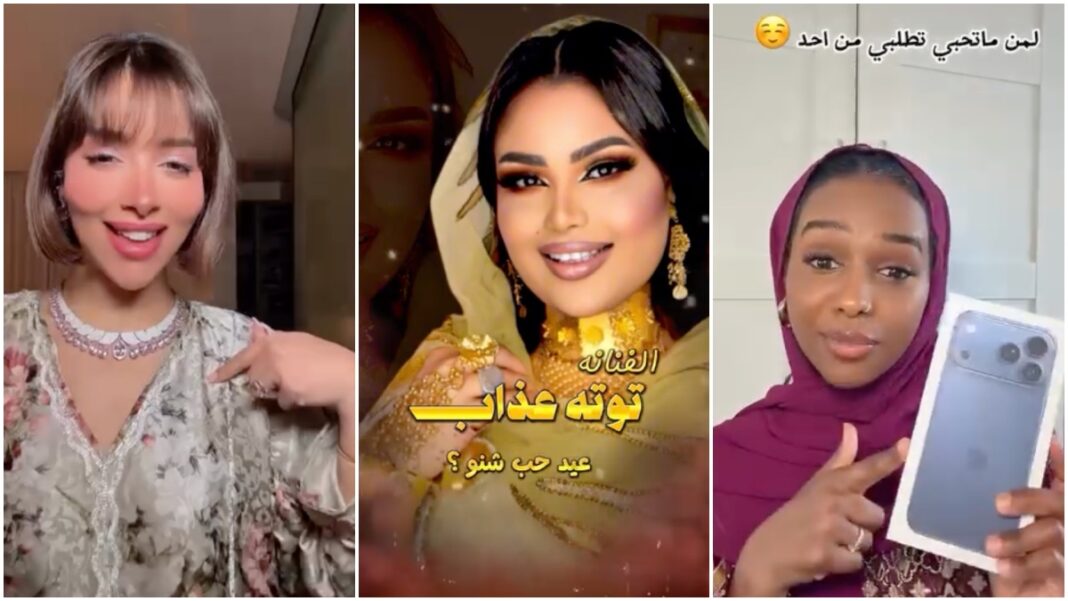
A new Sudanese song is trending on social media — not among Sudanese, but among Arabs, especially women.
On the occasion of Eid Al Fitr and the tradition of gift-giving during the holiday, users picked up the song “Eid Hub Shinu,” released by Sudanese singer Tota Azab on Valentine’s Day (14 February 2026). The song portrays a woman with expensive tastes who prefers money, gold, and jewellery over teddy bears and other inexpensive gifts. Funnily enough, the song was written by a man, songwriter Amjad Hamza.
The trend was even embraced by the popular Yemeni-Emirati singer and actress Balqees Fathi, who frequently performs Sudanese songs and enjoys a massive Sudanese following. During Eid, she joined the trend by sharing a video of herself playfully singing along to the track. The post garnered nearly 90,000 likes and over 1,000 comments, including a note of praise from Tota Azab herself. That high-profile endorsement acted as a catalyst, helping the trend spread like wildfire.
Social media has a significant impact on the success or failure of a song as we’ve seen in recent years. Many singers around the world rely on social media – or even hope for their song to become a social media trend – to ensure its success. In addition, social media drives music popularity and consumption through what are known as short-form platforms like TikTok, Instagram Reels, and YouTube Shorts, sparking virality via trends.
Tota Azab’s trending “Eid Hub Shinu” comes shortly after the success of the Sudanese track “Bega Lik Bambi” (It’s Now Pink to You) by singer and rapper Abdelrahman Omer, better known as A.o.A. Released in November 2025, the song went viral in December 2025, fueled by the Sudanese football team’s impressive performance in the FIFA Arab Cup Qatar 2025™. The track inspired countless covers and recreations across social media, most notably by the popular Egyptian group Oun Choir, whose performance became one of their most-liked videos, reaching nearly 80,000 likes.
Most recent Sudanese songs trending on social media are embraced more by non-Sudanese than Sudanese. For many Sudanese, including myself, we did not know about these songs or singers until the social media trends. We discovered them for the first time, just as non-Sudanese did through these trends. I am often asked about these songs and what they mean, and I have no idea, especially “Bega Lik Bambi.” As it became very popular, people began to ask what it means, which introduced a parallel trend where both Sudanese and non-Sudanese began releasing videos to explain the lyrics. A.o.A recently explained the song’s meaning and its success on Elham; it is basically about a person wanting someone after previously refusing them.
Although these trends can work to the advantage of the Sudanese people and their music, Sudanese have always criticised the trending songs. Songs such as the now-viral “Eid Hub Shino” and “Bega Lik Bambi” are not widely respected or appreciated by Sudanese people, often referred to as “tafha,” “habta,” or “hayfa” — all meaning something along the lines of “distasteful” or “lacking substance.” The songs are often full of slang and colloquial lyrics, targeting younger generations. Therefore, many Sudanese may disapprove of these trends and believe the world is getting a negative or incorrect image and understanding of Sudanese music, especially when we have greats such as Mohammed Wardi, Abdelkarim Al Kabli, Mohammed Amin, Sayed Khalifa, Ibrahim Al Kashif, and more who sing Sudan’s most treasured songs with sophistication and powerful, meaningful lyrics.
I, as with many Sudanese living in the diaspora in the Arab region, have become accustomed to the ridicule of Sudanese songs and music in general. Dealing with many Arabs, they mock songs such as “Al Mambo Al Sudani” by the great, late Sayed Khalifa, and the popular Sudanese comedy skit song “Kuli Zol Bi Zawja Beta’u Ila Ana Ma ‘Endi Mara” (Everyone Has A Wife But Me), which they have mistaken for an actual Sudanese song we listen to.
However, this recently changed — or improved a little — when Sudanese singer Shoukrallah Ezz Eldin released the hit song “Allalah Belil” (“Tonight”) around 2017. The song is probably the most popular Sudanese song to international ears, from its playful and easy lyrics to its upbeat tempo. It was heard on social media, at non-Sudanese parties, weddings, and concerts, and was even performed by Balqees Fathi in her shows across the UAE and Saudi Arabia. While the song improved the opinion of many Arabs regarding Sudanese music, it also reignited some of the ridicule. Furthermore, for a long time, it remained the only Sudanese song many people knew or could point out. On trending Sudanese songs on social media, many Sudanese users commonly comment by saying, “atleast it’s not ‘Allalah Belil‘”.
Sudan’s dance culture has also been garnering attention on social media, specifically the warrior-based Hadandawa dance of the Beja people, a nomadic ethnic group residing in the Eastern Red Sea region of Sudan. They are known for their incredible dance moves with strong endurance movements, ranging from rhythmic neck (ragaba), shoulder, and chest movements to bent-knee walking, often while carrying a sword or stick. Their dance moves have been applauded, admired, and even performed by various social media users, including the Oslo-based dancer Tony. This global engagement highlights how traditional Sudanese culture is transcending borders, moving from Sudan to the international stage. This has become possible because of social media and all that comes it, opening the world’s eyes to Sudanese culture, and making it visible and accessible to the world. Essentially, social media trends has become our primary cultural export, fostering a ‘passive learning’ of our language through catchy songs and distinctive dance movements.
As more Sudanese songs are picked up on social media, awareness of the music is increasing. In recent years, listeners have moved beyond knowing only one or two tracks; hopefully, they can now name several songs and artists. This shift means more people are becoming familiar with the music and, most importantly, the local dialect. Social media is essentially acting as a form of ‘ear training,’ where trends familiarise outsiders with the unique sound of Sudanese music and Sudanese vocabulary once considered ‘foreign’ or ‘difficult’. This linguistic barrier may be one of the reasons why Sudanese music has remained untapped in the region — a gap widened by Sudan’s lack of a dominant media presence.
Music and all that comes with it, as well as movies and series, have always been and will always be among the most powerful ways for people to learn about other languages and cultures, exposing them to people and places they have never met, seen, or been to. This is evident with Western culture, such as that of America; many have learnt English simply by listening to American music and watching American movies and series. It is also evident in how popular K-pop has become, opening the world to Korean music, movies, series, language, and culture. Some have learnt the Korean language solely off of Korean music, anime, movies, and series. In the Arab world, the majority of people are familiar with the Egyptian dialect because of their music, movies, and series. And now, with the popularity of Afrobeats and South Africa’s Amapiano, people can better understand African English and accents.
The hope is that Sudanese music goes beyond social media and social media trends, and that Arabs and people around the world begin to listen and even dance to Sudanese music — that Sudanese songs become part of their music playlists to the point that they know our songs, singers, and most importantly, what the songs say and mean. Most importantly, the hope is that it brings Arabs and other people from around the world closer to Sudan and its people, and helps them better understand Sudanese music and, most importantly, the dialect.

Ola Diab is the new founder and editor of 500 Words Magazine, and the deputy editor of Marhaba Information Guide, Qatar’s premier information guide. Based in Qatar, the Sudanese journalist graduated from Northwestern University in Qatar (NU-Q) in 2012 with a Bachelor of Science in Journalism and has since built a successful career in the print and digital media industry in Qatar. Find her on X (formerly Twitter) @therealoladiab or on LinkedIn.