


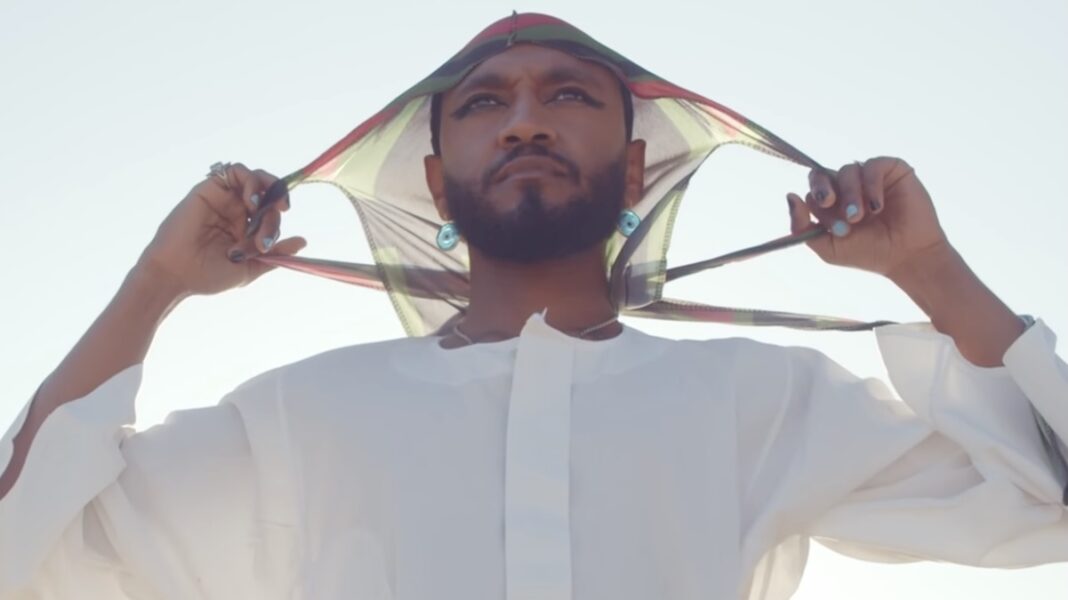
On 13 February 2026, new Sudanese singer Razeen Khattab released “Sudan Nights” with a music video, marking his second song after his debut single, “Ameen,” in April 2025. Both songs are odes to Sudan, carrying patriotic and nostalgic themes, similar to his most recent track, “ANNA AFRIQI.” These songs are part of his debut album, YALLAH NARGUS (Let’s Dance), which was released on 19 March 2026.
However, “Sudan Nights” attracted negative attention for Khattab. The criticism was not only about the song itself and its lyrics but also about his appearance. In the music video, he wears jewellery, colourful nail polish, earrings, a necklace, and makeup such as black eyeliner or kohl — all elements traditionally recognised as feminine. In various scenes, he is also seen wearing a durag with casual black clothing, including a sleeveless top, as well as a Sudanese jalabiya paired with a light orange shawl. In the music video, he demonstrates a fashion sense that is both masculine and feminine, or what is now known as gender-fluid.
As a result, his appearance and nonconforming, gender-fluid fashion sense sparked comments and questions about his sexuality, even within my own circle when we came across the song. I was taken aback by judgments based on his clothing, even from people I considered open-minded and well-exposed. It was a reminder that Sudanese society, both in Sudan and the diaspora, remains largely conservative, influenced by Islamic beliefs, and continues to frown upon public expressions that deviate from traditional notions of modesty and gender norms. Doing so is seen as ‘un-Sudanese’ – not conforming to social and traditional norms.
Their criticism and disapproval of Kattab’s appearance in “Sudan Nights” stems from the belief that in Islam, it is prohibited for men to imitate or dress like women, and for women to imitate or dress like men, whether in private or public. His daring, nontraditional fashion choices, which some see as contradictory to Islamic beliefs, combined with scenes of him praying on a prayer mat and lyrics referencing Islamic phrases such as “Alhamdulillah,” “Astaghfirullah,” and “SubhanAllah,” left many viewers confused and, in some cases, offended. For many Sudanese, the idea of being Muslim while not conforming to traditional modesty and gender norms is considered unacceptable.
Khattab is a unique music artist with a distinctive sound who embraces his Sudanese identity, as well as his gender-fluid fashion sense. However, this discussion is not about his gender and sexuality – or homosexuality in general. It is about gender stereotypes and how Sudanese society perceives gender and appearance. Khattab has yet to speak publicly respond to the homophobic comments he has received or about his gender identity, which many have speculated about. This is entirely his personal choice, as such matters are private. However, having said that, as a Sudanese artist publicly and boldly challenging gender norms — a step that is unprecedented — he is inevitably subject to criticism, particularly because he makes music about Sudan, in Arabic, while defying conventional expectations.
Kattab’s national identity is both Sudanese and Dutch; however, he comes from two countries with polar opposite understandings and openness toward gender norms and identities. In Sudan, as in many countries, gender roles and stereotypes continue to influence daily life. Statements like “men do this, women do that” are still heard in workplaces, homes, and social gatherings. While younger generations are more open to breaking these norms, Sudanese society remains largely traditional, modest, and conservative. Only a decade ago, Sudanese women could be jailed, lashed, or fined for wearing pants under the Public Order Law (Article 152 of the Criminal Code), which punished “indecent acts” or “obscene outfits” in public. Thankfully, this law was diminished by the then new formed Sovereign Council during the Sudanese revolution in 2020. The Sovereign Council also amended the penal code, reducing the sentence for “same-sex relations” or “homosexual sex”. Previously, the death penalty was punishment for individuals accused by committing “homosexual sex” defined by the act of penetration, for the third time. For people found guilty of this offence for the first time, sentences were lashing 100 times or prison up to 5 years. For the second time, the sentence was both punishments combined.
In the Netherlands, where Khattab is based, freedom of speech and expression are strongly guaranteed by the Dutch Constitution and the European Convention on Human Rights, making it one of the world’s freest countries. While generally unrestricted, this freedom is legally balanced against hate speech, discrimination, and defamation. The Netherlands is a global leader in LGBTQ+ rights, being the first country to legalise same-sex marriage in 2001. With roughly 2.7 million LGBTQIA+ individuals, the country offers strong legal protections, including adoption rights, and high social acceptance. It is important to note that this same “free country” is also home to some of the most anti-Islamic expressions of hate. Controversy regarding inflammatory depictions of the Prophet Mohammad (PBUH) from 2018 to 2023 in the Netherlands, primarily been driven by far-right politician Geert Wilders, leader of the Party for Freedom (PVV), has consistently sparked protests in Muslim-majority countries.
Globally, gender expression has become more fluid in recent years, reflected in clothing and fashion. Traditional, rigid binary norms, such as pink and soft for women, blue and structured for men, are being replaced by fluid, androgynous, and inclusive styles. Garments are increasingly organised by type rather than gender, allowing more personal expression. For example, women wearing pants is widely accepted, whereas men wearing pink or purple is still questioned. Today, people increasingly prioritise comfort and style over traditional gender expectations.
This shift is reinforced by gender-neutral, unisex, and fluid fashion, often popularised by LGBTQ communities who have redefined sex, gender, and related stereotypes. It is important to distinguish between sex and gender: sex refers to biological characteristics assigned at birth (male, female, or intersex), whereas gender or gender identity is a social construct encompassing personal identity: man, woman, both, neither, or anywhere along the spectrum. While these concepts remain foreign or even unacceptable in Sudan, they are increasingly recognised globally.
Yet, many, whether in Sudan or elsewhere in the world, fail to understand that clothing does not necessarily define a person’s gender identity. How someone dresses is primarily a form of personal expression rather than an inherent declaration of identity – though it certainly can reflect one’s gender if an individual chooses to express themselves that way. In Sudanese society, however, people are still judged by their appearance. Men who challenge traditional masculine styles are often questioned or attacked. Sudanese-British fashion and lifestyle creator Omer Elsarrag has faced negative comments for this very reason. Similarly, women who dress less modestly are often criticised, with some such as social media personalities such as Ola El Sharef and Tasabih Diab told, “You are not Sudanese,” or “This not Sudanese” effectively questioning their national identity.
“While everyone is entitled to their opinion, we must ask: do we really need to share them so publicly, invasively, and obnoxiously? Much of the public critique we see is invasive and unsolicited. Where do we draw the line between private and public life when sharing our opinions on the lives others lead? Publicly condemning or attacking people, whether online or in conversation, for their personal fashion choices, to the point of questioning their gender identity or morality, crosses that line.

Ola Diab is the new founder and editor of 500 Words Magazine, and the deputy editor of Marhaba Information Guide, Qatar’s premier information guide. Based in Qatar, the Sudanese journalist graduated from Northwestern University in Qatar (NU-Q) in 2012 with a Bachelor of Science in Journalism and has since built a successful career in the print and digital media industry in Qatar. Find her on X (formerly Twitter) @therealoladiab or on LinkedIn.


Seeing the headline of this article immediately brought tears to my eyes. It is so, so painfully rare to find other Sudani people who speak reasonably about these things, especially in such a public way, and I am infinitely grateful to you for having the courage and resolve to write this. Thank you.
I’ve been following Razeen’s work for a while, always with an anxious undercurrent because I remember what happened (and is happening) to Ahmad Umar, the genderfluid visual artist now living in Norway. It’s exciting to see gender-nonconforming Sudani artists be successful and make big names for themselves, but the tradeoff is always massive amounts of senseless vitriol directed towards them, both on- and offline.
>While everyone is entitled to their opinion, we must ask: do we really need to share them so publicly, invasively, and obnoxiously?
I’ve been struggling to articulate precisely this for a very long time. I’ve come across or heard some truly heinous opinions that I have had no power or interest in changing, but I still find myself wondering what compelled the person to share it in that way. Frequently it reveals a callous, even cruel, attitude I find repulsive. There is such an obsession with keeping appearances in Sudani society, but in the presence of a suitable scapegoat all pretenses of cordiality go out the window.
This was an immense relief to come across. Thank you once again, Ms. Diab.