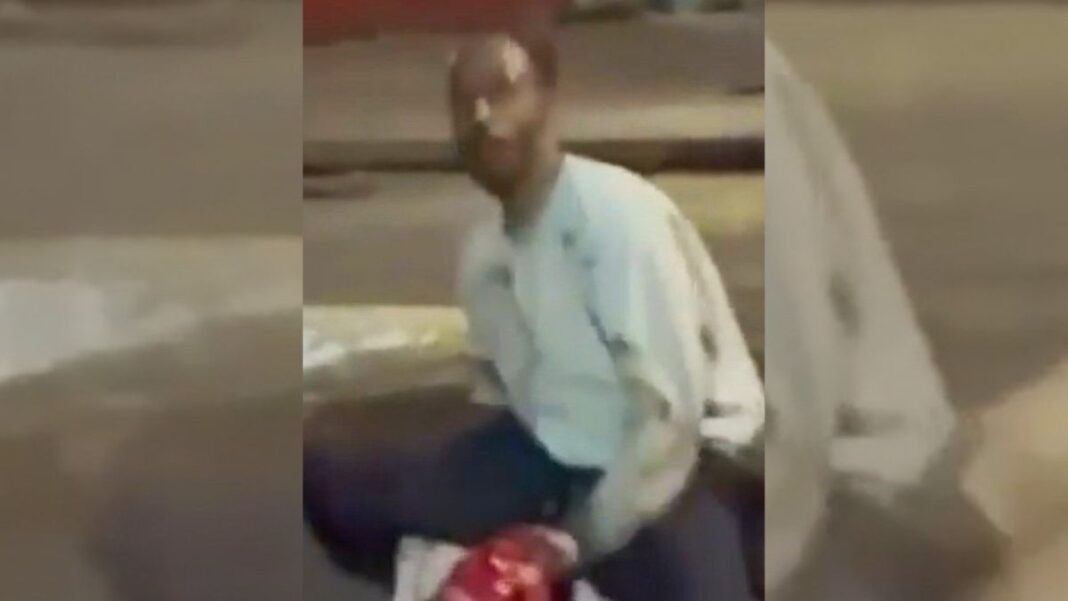
On 9 June 2026, a knife attack in Belfast, Northern Ireland, triggered a series of violent incidents and unrest across Northern Ireland and the UK.
A 30‑year‑old Sudanese refugee, Hadi Alodid, attacked a Belfast resident, 44‑year‑old Stephen Ogilvie, stabbing him in the face, neck and back. Ogilvie sustained serious injuries and has lost his sight. The attack was filmed and widely circulated on social media; footage shows Alodid pinning Ogilvie to the ground and repeatedly stabbing him before passers‑by intervened. Police later recovered what is believed to be a kitchen knife at the scene and have ruled out terrorism as a motive, though the motive remains unknown. Alodid has been charged with attempted murder, possession of a blade in a public place, and threats to kill.
Violence, Fear and Hostility
As a result, anti-immigration demonstrations and disorder broke out in Belfast, with hundreds of masked protesters taking to the streets after the attack and arrest. Several businesses in central Belfast, including premises on Sandy Row, closed and secured their shops as tensions escalated ahead of planned evening protests.
There were reports of attacks on refugees, asylum seekers, and African and Muslim residents, and many in those communities reported feeling unsafe. African communities in Belfast make up roughly 1.2% of the city’s population; they are experiencing fear and displacement following targeted anti‑immigrant arson attacks and other violence.
The family of the victim have appealed for calm after riots erupted across the city. They urged rioters not to use their tragedy to fuel violence.
Sudanese refugees, asylum seekers and residents are particularly affected. This incident is a shock to the Sudanese community in Northern Ireland and the UK. The Sudanese Community Association Northern Ireland, which recently reformed its leadership after a four‑year hiatus, said it is preparing to support community members amid rising tensions. “We are against violence from any group,” a representative told The Guardian. “We want peace. We are part of the community in Northern Ireland.” The actions of one individual should not be used to define or judge an entire community.
Members of immigrant and Muslim communities have historically faced backlash after high‑profile attacks (for example, after 9/11 and the Boston Marathon bombing), and some continue to experience stigma and suspicion.
The case also raises concern for Sudanese people worldwide, especially those seeking refuge amid the ongoing conflict in Sudan. The war between the Sudanese Armed Forces (SAF) and the Rapid Support Forces (RSF), which began in April 2023, has caused one of the world’s largest displacement crises — estimates suggest roughly 12–14 million people have been displaced, with over 4 million fleeing to neighbouring countries and others seeking refuge further afield.
The Fallout of the Attack
Therefore, Alodid’s actions are the last thing Sudanese people around the world needed, heavily adding to the already negative image, travel challenges, and restrictions they already face. It has also severely impacted the lives of thousands of refugees and asylum seekers across the UK. As of March 2026, there were over 76,000 asylum applications made in the UK.
Anti-migrant and anti-immigration opinions, protests, and violence have significantly increased in recent years. Whether in the UK, France, Europe in general, the US, Egypt, Tunisia, or South Africa, this sentiment has been further ignited by far-right disinformation and geopolitical conflicts. All of these factors have triggered widespread turmoil for African migrants and Muslim communities globally. It is now recognised as a worldwide crisis, ranging from violent street riots to systemic displacement.
Xenophobia has become widespread. Both xenophobic and anti-immigration attitudes are often driven by economic anxiety, demographic changes, and political opportunism, frequently leading to systemic discrimination and hate-fuelled violence on a global scale.
These sentiments have been further fuelled on social media by far-right public figures such as American businessman Elon Musk and British political activist Tommy Robinson, as well as media outlets like The Daily Mail. By weaponising the actions of an isolated individual to justify systemic hostility, they have made it more critical than ever to demand nuance. Treating a single, tragic incident as a reflection of an entire nationality is not just flawed logic; it is a dangerous political tool that actively harms the vulnerable.
There is a cruel irony in the fact that Sudanese refugees, who have escaped the horrors of an ongoing war and left behind their homes, livelihood, and heritage, are now being forced to defend their humanity against far-right hostility in the places they sought for safety. They are being victimised twice: first by conflict at home, and now by xenophobia abroad.
Trauma, Displacement, and Mental Health
In addition to the anti-immigration crisis, Alodid’s shocking attack raises critical questions about mental health. As stated, a motive has not yet been identified or disclosed by investigators. What many are asking is: what drove Alodid to commit such a crime? Those who know him described him as quiet and calm, leaving them entirely shocked by the attack.
Mental health is a critical issue. For individuals who have fled war and sought asylum, the dual experiences of trauma and displacement severely affect psychological well-being. War and displacement trigger profound psychological distress, with approximately 22% of conflict-exposed individuals developing conditions such as:
- • Post-traumatic stress disorder (PTSD)
- • Clinical depression
- • Severe anxiety
According to the National Institutes of Health (NIH), displaced populations face significantly elevated risks of psychiatric morbidity due to cumulative trauma. Displacement means losing homes, routines, jobs, land, and vital support networks, causing deep, prolonged grief.
If host nations wish to prevent rare tragedies and foster security, stricter blacklists or xenophobic rhetoric is not the answer. It is to dismantle the barriers to mental health care, address the compounding trauma of displacement, and provide psychological support for asylum seekers who have survived the unspeakable.
Collective Accountability vs. Individual Actions
Alodid’s attack might be rare, but due to the mounting pressures and distress Sudanese people face around the world, there are fears it may not be the last. Crucially, it has provided the exact fuel that anti-immigration supporters needed to back up their claims. Belfast and the wider UK are currently in severe turmoil over the attack. As a result, Sudanese nationals find themselves pushed further up unofficial blacklists, not only in the UK but across various refugee-hosting countries — a devastating blow to those genuinely looking for refuge.
Alodid’s actions must not define the entire Sudanese population, or any other African or Muslim communities, especially refugees and asylum seekers. Throughout history, Sudanese diaspora communities have been recognised for their inherently kind and good nature, and have contributed significantly to their host countries as doctors, teachers, engineers, architects, and so much more. This single, rare incident should not overshadow the immense global contributions that the Sudanese people and other immigrants are known for.
Ultimately, the story of the Sudanese people and refugees in general is not written by the actions of one distressed individual, nor can it be erased by voices of intolerance. It is written by the generations of doctors, scientists, builders, and educators who enrich the societies they join while enduring war, displacement, and prejudice.

Ola Diab is the new founder and editor of 500 Words Magazine, and the deputy editor of Marhaba Information Guide, Qatar’s premier information guide. Based in Qatar, the Sudanese journalist graduated from Northwestern University in Qatar (NU-Q) in 2012 with a Bachelor of Science in Journalism and has since built a successful career in the print and digital media industry in Qatar. Find her on X (formerly Twitter) @therealoladiab or on LinkedIn.