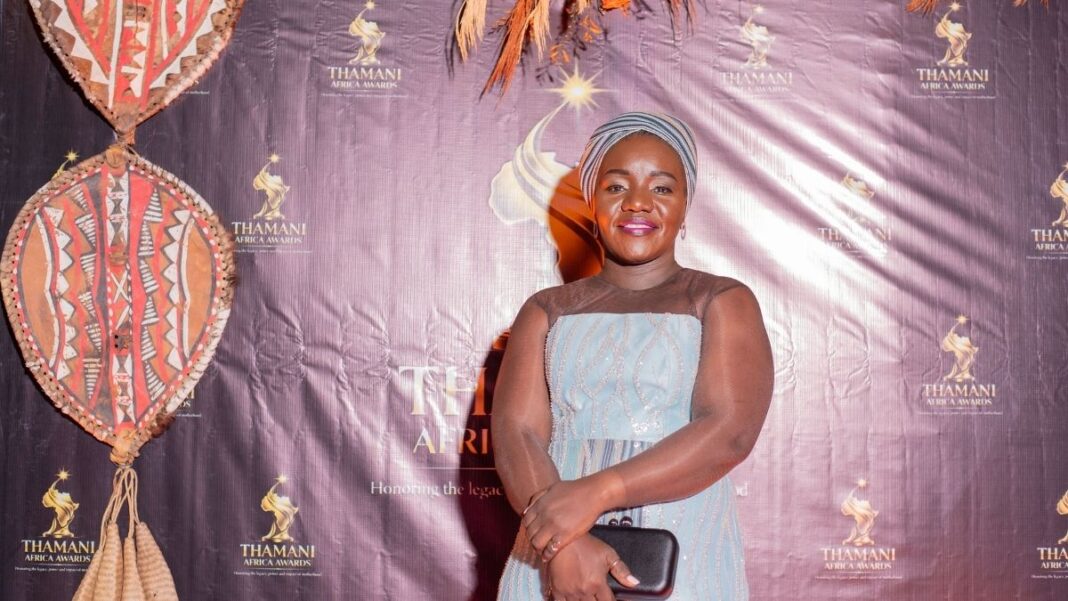
After gaining global recognition, representing South Sudan, a country that is often defined by a scary narrative of bullets and guns, Zabib Musa Loro’s story of success, activism and impact is one of the most profound and revolutionary in the country.
Recently, Loro was named among the TIME 100 Most Influential People of 2026 and received the Humanitarian Leadership Award at the 2026 Thamani Africa Awards.
Known as a human rights and gender equality activist, Loro describes herself as an activist, Muslim, feminist, mother, and mentor. Born in Atlabara, Juba in 1989, to a Bari father and a Nubian mother, she spent her early childhood between Central and Western Equaturia before frequently moving between Congo and Uganda where she completed her primary and secondary education. Despite an early marriage – a survivalist mindset created by war, she pursued higher education and holds a degree in Human Resource Management from Makerere University, a Master’s in Governance, and is currently studying an undergraduate Law degree at Unicaf University. As Executive Director, Loro heads Women for Justice and Equality (WOJE), a grassroots movement founded in 2016 into a nationally recognised voice for feminist action and social justice in South Sudan.
In this exclusive interview with Zabib Musa Loro, The Sudanist‘s Butros Nicola speaks to the activist to uncover the everyday reality of her work.
You were recently recognised on continental and global platforms, including the Thamani Africa Awards and TIME’s influential voices recognition. What did these moments mean to you personally, and what do they represent for South Sudanese women?
I thought I was doing very little. But I think even a little is seen. So I felt appreciated, and when you’re appreciated, you get excited. For me, the recognition was even something that brought a lot of hope again. It actually doubled my courage to do more and do better. Then the other thing, it also taught me that as South Sudanese, we are not less. Sometimes I feel like we think that we are less of human beings, we are not complete, we are in situations where we are the worst people in the world. But then, I felt so proud as a South Sudanese, not to my fellow South Sudanese, but to the world.
We are doing a lot as women, as youth, we are doing quite a lot to help our country. We have challenges, yes, but we also have us who are trying to put our country together. So I feel like the picture of South Sudan through me to other people became clearer.
International recognition often highlights achievements, but not the long journey behind them. What parts of your work and experience do people rarely see?
First, they help civil society in a way that the person who receives the award is not receiving it as Zabib. I’m receiving it as a South Sudanese woman and a human rights activist, a feminist from South Sudan. The recognition is for every woman, every girl who dreams in South Sudan.
What first pushed you toward humanitarian work and advocacy, and was there a defining moment that shaped your path?
In 2013, the conflict erupted. In 2014, many people had left South Sudan due to the 2013 war. For me as a junior staff member at the time, I was having a lot of energy. I requested to go for further studies… and then when I left the Bureau of Standards in the Ministry of Commerce on an open leave, I came out and my ambitions were really different. How do I serve my people?
The defining moment was with an organisation I initiated called the Islamic Development and Relief Agency South Sudan (IDRA). But then, with Islam, and maybe I had brought in people who did not look at South Sudan as a country that is no longer Islamic [Sudan]. And wanted to push it in a direction that this one should just be serving within the mosque and all that. And I said no, it has to be a community thing. An NGO that is non-partisan and non-discriminatory. The organisation did not want me to speak about women’s rights and all that. If you’re saying this is an Islamic organisation, then there are things you cannot be talking about: patriarchy, issues of early marriage, and other gender topics. So I just handed it over. I remember I was even in Holland when I decided to initiate Women for Justice and Equality.
Through your work with Women for Justice and Equality (WJE), what gaps were you hoping to address, particularly for women and girls in South Sudan?
We are addressing gaps within protection first. In protection, we are dealing with issues related to early marriage, ending Gender-based violence (GBV). And our strategy is directly focusing on ending early marriage, the gaps around keeping girls in schools, and then the gaps around economic empowerment.
One of the biggest challenges that we had in the beginning was first of all having communities to accept. Having communities to open up on issues of early marriage, to accept that this is a problem within our communities. Why? Because of the structure that we are in as South Sudanese. We are very patriarchal. Anytime we would start with an issue around early marriage: “Why do you want to spoil our daughters, why do you want to spoil our cultures? Why do you want to pretend like you people who are inheriting foreign behaviours are better than us?”
Your work has focused on justice, peace, and dignity. In a country that continues to face political and humanitarian challenges, what keeps you hopeful?
What we did is we have an initiative that we designed called the Communities Care Initiative. It is an initiative that empowers communities to make their own decisions. How do we help them? We nominate around eight to 12 people in an identified area. These 12 must be six female, six male. We take them through training. We have our own manual… we train this team for two weeks. Then they go back to their communities. They discuss this manual for 13 weeks.
Those communities where we have put this initiative, men have come out as communities that are fighting early marriage, they’re fighting GBV. They’re even discussing intimate partner violence within the communities right now. If they are well-trained, by the end of the manual, most of these men, if their children were sitting at home and they’re not going to school, they’ll send them back to school. And one of them said, “I think I want to go back and bring back my girl whom I had married off a few years ago as a child.” When they learn through this process, then they have such testimonies that come out that give us hope to continue.
Do awards and international visibility meaningfully support activism on the ground, or do they sometimes risk overlooking the everyday realities behind the work?
Sometimes people feel like it can be a source of insecurity, because now you’re visible, people will know what you’re doing, and now you become a target. But I say no. Not when you’re doing the right thing. If you’re speaking about GBV, early marriage, youth/women empowerment — we are speaking about development issues.
I say that visibility can also be a security. Because then the stakeholders, the partners, the fellow activists — people are watching. I met this young lady… She said, “I want to grow and be like you.” So that recognition also empowers someone else out there in South Sudan.
When you think about the future, what kind of South Sudan do you hope the next generation inherits?
I want a South Sudan — for me, one thing that I always cry to God is a South Sudan that is stable. Yeah? A South Sudan that is stable and free from conflict. South Sudanese are coming back home. South Sudan where we have women in leadership making, doing their job. Not because men are bad, but women who sit beside men and make decisions equally.
South Sudan has a good education system where we do not have to take our children to study in Nairobi, Kampala, or elsewhere. South Sudan where I will go to court and I’m sure that my case is going to be handled in a fair way.
Where politics are not biased. Where we don’t say that I’m scared I can’t go into politics. If we have positive politics — like we have politics that are really not biased — I know that we’ll have so many young women, we’ll have so many young people in South Sudan aspiring to be politicians. They will become good leaders of the nation. Then we’ll have development, we’ll have everything that we are dreaming about.

Butros Nicola Bazia, born in Khartoum, Sudan in 2001, is a South Sudanese freelance writer, storyteller, and cultural commentator based in Juba, South Sudan. Nicola serves as columnist at 500 Words Magazine and contributed to multilingual regional and international platforms including The New Humanitarian, Mundo Negro, El Pais, Contemporary&, The Van-Magazine, and among others. His work explores the intersections of arts and socio-cultural dynamics, with a focus on South Sudanese narratives in the global conversations.