



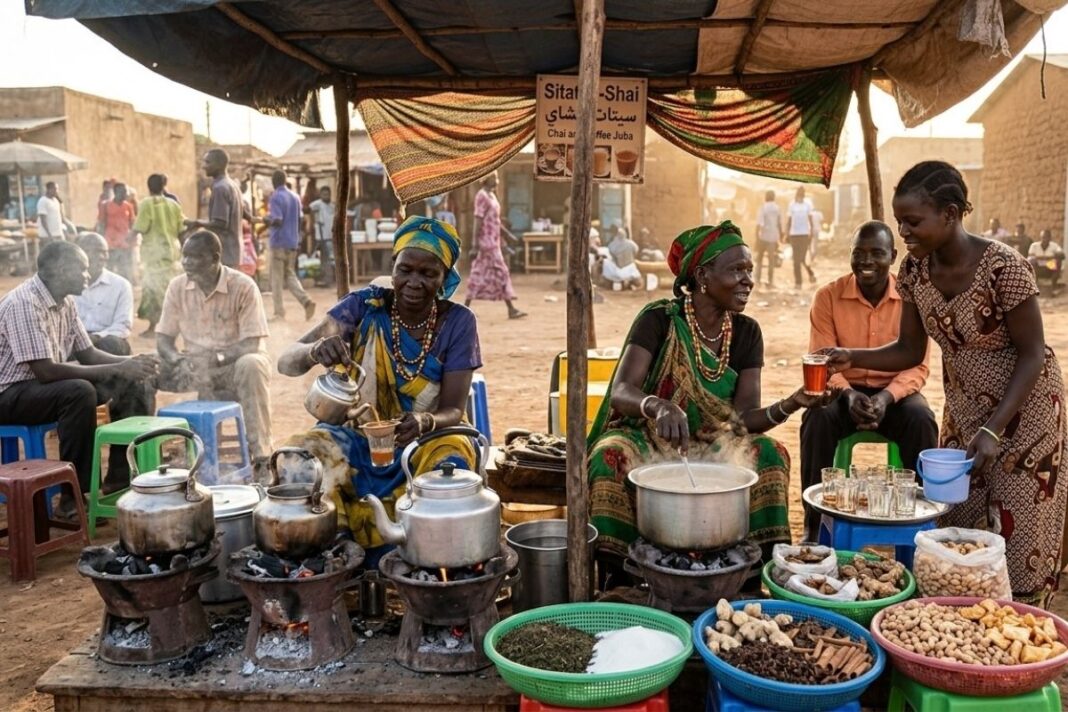
Tea stalls, known as Janba Shai, and the ladies leading them have long been reshaping the concept of the business. Across both Sudan and South Sudan, female tea sellers, known as Stat-shai/St-shai, resemble the hardworking women in countries where opportunities are very limited, forced into it by unjust social structure and dynamics. However, this movement for dignified earning has shifted the space into the most democratic atmosphere in South Sudan.
Public and civic spaces, including spaces such as the parliament, TV panel, and NGOs are highly censored and controlled, filtering who gets to speak, where to sit, and how to act. In contrast, the tea places have never been organised in that manner. The university students, traders, teachers, and engineers all find themselves sitting in place with no protocol arguing about the rising in fuel praises and a politician’s speech from the night before. Interestingly, nobody denied one, opinions are respected, and most of them are led by tea ladies as the arbitrator of public opinion.
More deeply, these stalls are not only a seating arrangement of equals; they are also an information exchange market, ones that run faster and honestly often more than the institutions they sit beside. Everyone is welcome into the space and that includes mid-career officials, drivers who work for directors at ministries, and even their relatives who are regular citizens. Consequently, what is debated behind closed rooms of NGOs and government corridors of power by morning is, more often than not, being repeated over a glass of tea or jabana (coffee) by evening hours, stripped of its formality and complex around it to be opened up for argument. Yet, by the time the tea lady announces the ending hours of service, the market already has a working theory of what the seventh floor is really arguing about, usually before any official statement.
From there, the information ecosystem does not stay at the tea stall. The traders, teachers, and university students repeat it to their customers, neighbours, and colleagues across wider geographical areas, each one retelling less official and more believed than the last. At this point, the tea stall is not just where South Sudan’s public opinion is formed away from censorship; it is the first stop in an entire relay system that formal media rarely manages to catch up with. On the other hand, this information ecosystem has a plus which is reliable internet connection. A handful of stalls, catering to their clients, have quietly installed Starlink — usually a business deal between the tea lady and young person to attract and maintain traffic — turning a wooden bench and a thermos of tea into one of the more dependable access points to the outside world in a city where connectivity is otherwise expensive, patchy, or entirely absent.
As an observer, I consider it as a strange kind of upgrade — the same space that has been carrying Juba’s unofficial word of mouth for a long time is now carrying reliable data and the tea lady, without ever intending to, has become gatekeeper of two networks instead of one. However, this matters more than it might first appear, because almost everything else in South Sudan’s civic life has become gatekept. Social projects through the official state channels arrive with agendas already written, inviting comment only within lines someone else has drawn. Against all of this, the tea places remain almost alone: a space nobody had to apply to enter, where no agenda was set in advance, and where the only credential required is the price of a glass of tea.
Getting back to where everything started, these spaces did not appear by accident. They were built by women who were pushed into this work by an economy that offered them few other doors, in a country and region that has rarely made dignified earning easy for its women. Moreover, what began as a means of survival became, without any of them necessarily setting out to do so, the last functioning civic square left in South Sudan. Finally, the tea ladies did not just serve tea; they held open spaces where everyone could still sit as equals, argue freely, and could still be heard.
In South Sudan, a country where so many formal doors have quietly closed, theirs may be the only one still, deliberately or not, left open.

Butros Nicola Bazia, born in Khartoum, Sudan in 2001, is a South Sudanese freelance writer, storyteller, and cultural commentator based in Juba, South Sudan. Nicola serves as columnist at 500 Words Magazine and contributed to multilingual regional and international platforms including The New Humanitarian, Mundo Negro, El Pais, Contemporary&, The Van-Magazine, and among others. His work explores the intersections of arts and socio-cultural dynamics, with a focus on South Sudanese narratives in the global conversations.