

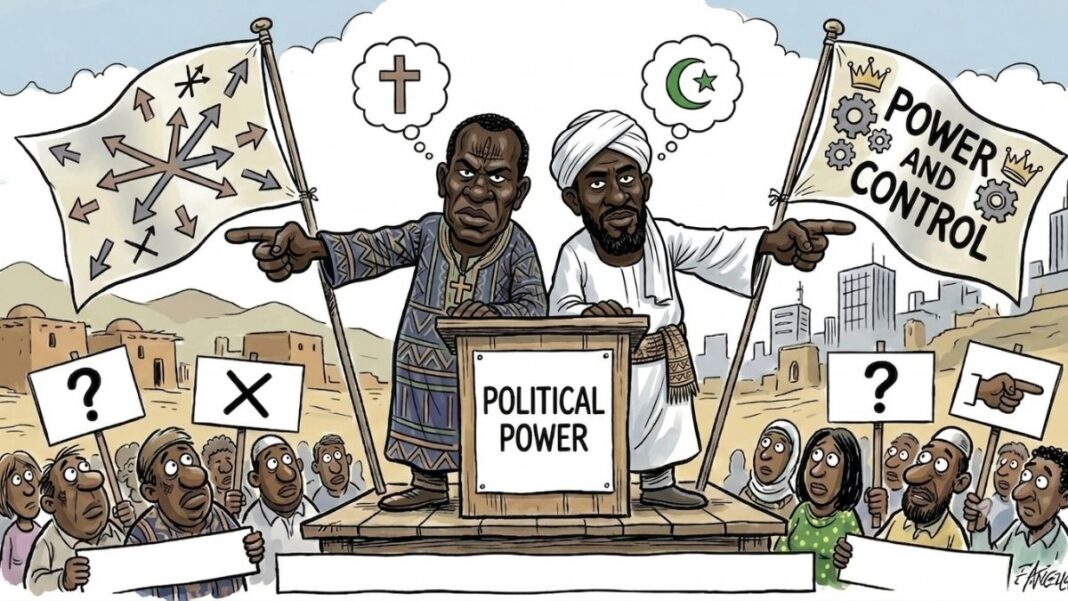
In South Sudan, the socio-political tensions are more often tribal or resource-based than purely religious. However, during recent years, religion has been weaponised to exacerbate divisions and back up political propaganda.
In early June 2026, a video of a South Sudanese Imam called Ayuel Kur from a Muslim Salafi background circulated on social media in which he made statements linking the growing numbers of churches in Renk town, Upper Nile State to deteriorating security and weakening the economy. Consequently, the social reaction provoked by his statements created a massive virtual movement on Facebook calling for him to apologise and retract his inflammatory statements.
People’s opinions and fears were mainly backed up by the collective trauma accumulated since the second civil war (1983-2005), which was also known as Al Jihad war in the south, before South Sudan’s secession from Sudan in 2011. The memories do not justify hatred towards South Sudanese Muslims, but it is giving room for a serious dialogue about preventing the overlap between religion, and the already fragile and tensioned community in South Sudan.
The country’s religious demography is made up of approximately 60% Christians, making South Sudan a predominant Christian country with only 6% Muslims and the remaining 34% practising traditional faiths. This Muslim minority are more likely to be found in towns such as Renk, a point of cross-border trading movement between Sudan and South Sudan. Despite representing a small fraction of the population, they are not peripheral to the country’s social fabric, they are embedded in its border economies and its cross-cultural negotiations.
The attempt to weaponise religion comes out from the integration we have in South Sudan, as uniforms that identify people are grounded in blackness and more into everything that is not Arabised. Moreover, it is hard to tell who is Christian and who is Muslim, unless you spot someone entering a church on Sunday or a Mosque on Friday. This integration is now being targeted to destabilise the connective tissue that holds fragile local economy and intercommunal relationships.
In a very similar context, during Eid Al Adha prayers in Awiel, Northern Bahr El Gazal, HE Hussain Abdulbagi Akol, the Vice President for Service Cluster and a prominent Muslim figure in the country, rallied Muslims vote for South Sudanese President Salva Kiir in the general elections, which are due to be held on 22 December 2026, the first since independence. His statement was clearly propagated to serve his political interest as an elite. “We do not want any Muslim vote to go to anyone other than Salva Kiir, because Salva Kiir gave us freedom of religion in South Sudan,” he said. Interestingly, this 6% Muslim population are part of extended families of Christians and traditional followers, and they all have coexisted for a long time.
Oral histories of societies across the greater three regions, Bahr El Gazal, Upper Nile, and Equatoria have always proven that religions and traditions harmonically merged together in different rituals. Similarly, during the liberation movement, the late revolutionary leader and founding father of South Sudan, Dr John Garang, once said, “The country is for everyone and religion is for God.” Therefore, the public has found Akol’s statement very heavy to swallow and contradict the lived social experience.
These two recent incidents must be understood not as isolated provocations, but as symptoms of a growing pattern where religion is being consciously deployed as a political instrument. Moreover, the dynamics here are going bidirectional, top-down and bottom-up, and each one supports the other – using a religious platform to stoke socioeconomic and security anxieties against churches in Kur’s scenario, while in Akol’s case, using his senior state profile to mobilise Muslim identity for electoral gain. Together, they show the weaponisation is not opportunistic or accidental; it suggests that religion is becoming a reliable instrument deployed to deepening division, acknowledging that Christian population will be badly provoked emotionally and would take defensive steps.
As South Sudanese, we need to reconcile with our memory and rename many inherited terms. Arabisation is totally different from forced Islamisation, and religions have no colour. These are ideologies that were long imposed on South Sudanese people by the Sudanese government when the country was still united.
Furthermore, we have to understand that religion-based mobilisation for political gain is a dirty game that has been used over decades to install division and support segregated narratives (a wealthy religious majority versus a poor religious minority). Our religious leaders from their respective background should have particular responsibility here – their authority is borrowed from their faithful communities, not from the politicians who seek to use them. Equally, social media reactions and push back against Kur’s statement demonstrated that our society has its own immune response to religion-based manipulation.
With the same force, we should work to end tribalism from the same bidirectional methods – the basement level and from within the state itself. South Sudan’s diversity is not its vulnerability, the deliberate exploitation of that diversity is.

Butros Nicola Bazia, born in Khartoum, Sudan in 2001, is a South Sudanese freelance writer, storyteller, and cultural commentator based in Juba, South Sudan. Nicola serves as columnist at 500 Words Magazine and contributed to multilingual regional and international platforms including The New Humanitarian, Mundo Negro, El Pais, Contemporary&, The Van-Magazine, and among others. His work explores the intersections of arts and socio-cultural dynamics, with a focus on South Sudanese narratives in the global conversations.