


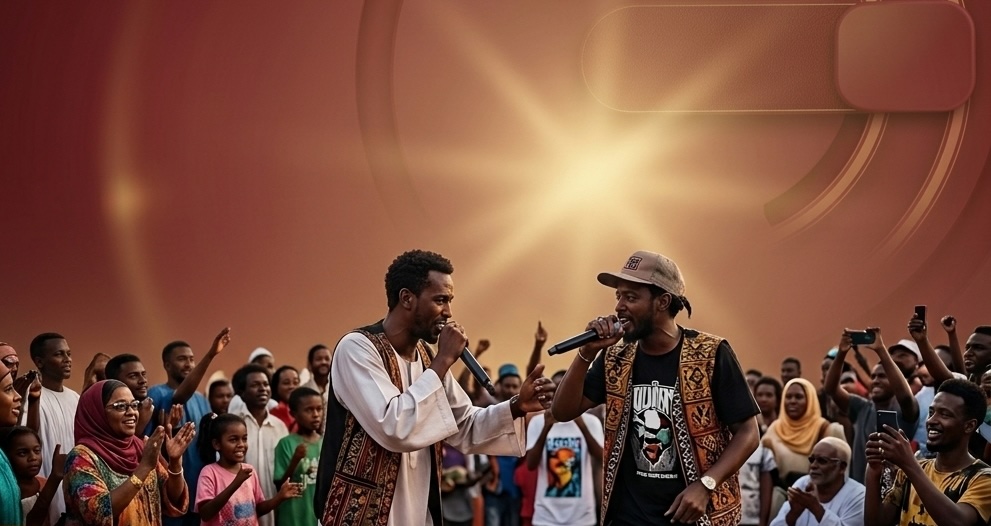
In the early 2000s, when the rap scene first began blooming in Sudan, it was centred around storytelling, resistance and wordplay. Hip hop became a medium for self-expression, resonating with thousands of youth through empowering lyrics. Today, the rap scene evolves to become more rooted in energy and the ability to bring listeners to their feet.
The rap scene in Sudan rose to life in the early 2000s, when rappers such as Ayman Mao and Ali G.X used their music as coded resistance against the dictatorial regime of former Sudanese president Omar Al Bashir. This cemented the place of hip hop in the Sudanese music scene, and it became a medium for creative expression.
The style of hip hop that was introduced to the Sudanese music scene initially was much simpler than what is seen today. Producers created beats that were more straightforward and minimalistic, a style that was driven by the percussion and focused on loops and piano-driven samples, much like the style of Western hip hop at the time. What the beats lacked in that era, the lyrics made up for. Rappers at that time were known for their poetic and meaningful lyrics that were rooted in creative wordplay. Rappers’ flows also leaned into an aggressive style, and lyrics were delivered in anger and sharpness.
The modern rap scene as we know it today began to take shape after 2015, when rappers such as Altayeb Hajo “Too Dope”, Rotation, Flippter and Maman rose to the scene. Their rise to fame was greatly influenced by their innovation in the hip hop scene, with new production styles, softer flows and more playful lyrics framing their styles at the time. While innovative, traditional influences in sound and production were not seen at the time. The lyrics, however, began to lean into Sudanese slang, displaying Sudanese youth’s lingual culture.
The start of the 2020s marked a new era for Sudanese hip hop. Innovative producers such as Mshakil and Flac began to rise in fame, contributing to the fusion of traditional elements with contemporary sounds in the rap scene. Both producers experimented with the production of tracks that brought Sudanese sound at the forefront, while rappers redefined their flows to better suit the newer production styles.
Recently, it became common practice for rappers to release zanig-driven tracks, both in production and rapping style. Zanig is a percussion-rich genre in the Sudanese soundscape that began as an underground genre, and is now quickly becoming front and centre in the mainstream. The incorporation of zanig in production is taking Sudanese hip hop to a new realm of dance-oriented rap. Relatively newer names in the scene such as Colo, Kordofani, and the globally recognized rapper Soulja are the agents of change behind this movement, constantly releasing tracks defined by the sounds of zanig and Sudanese party music.
While zanig is making its mark in hip hop, other genres such as Afrobeats and dancehall music are dominating the scene as well. What all these genres have in common is one thing: rhythm. Production of rap tracks is now defined by the ability to make the audience move, and hip hop in Sudan has quickly changed from songs one would listen to, to songs one would dance to.
Now, the question becomes: is this contributing to the evolution of the Sudanese rap scene or setting it back? The answer is simple. It is determined by the audience, and the audience is now bigger than ever and growing more than ever, meaning this is likely the right direction for Sudanese hip hop.
While the number of listeners is vast, the truly profound point here is the diversity of the listeners. Following the war that began in April 2023 between the Sudan Armed Forces and the Rapid Support Forces, many rappers have relocated to different countries around the world, introducing more non-Sudanese people to Sudanese rap. Rap Shar3 (Street Rap), for instance, is a platform that shines the spotlight on Arabic hip hop through collaborative performances between famous rappers. Sudanese rappers including Awab The Rapper, Hyper and Maman have been featured on the platform at least once. Saudi radio host Hass Dennaoui “Big Hass”, who hosts Saudi’s first and only hip hop radio show, has been a huge supporter of Sudanese rap, which contributed to tracks being played on international radio platforms.
Today, hip hop is arguably the defining sound of the Sudanese music scene, taking the soundscape from Sudanese fame to global recognition. Because of the genre’s growing popularity, the hip hop sound in Sudan is constantly evolving to cater to the interests of its fanbase. What began as a rendition of Western hip hop is now changing into an experiment of genre fusion, with rappers competing on the grounds of innovation, releasing hit after hit and bringing people together on dance floors.
Samar Bengawi is a medical student by day, and a literature and music enthusiast by night. She was born and raised in the UAE and is now based in Georgia. She is never without a cup of coffee in hand, and is always “on the go,” chasing after one hobby or another. Passion in Sudanese politics runs in her blood and she considers herself a patriot who hopes to leave a memorable mark in the world.