


At a time when Sudan’s music scene is right in the centre of the spotlight in the Middle Eastern and North African (MENA) region, it is impossible to imagine that there was an era of lost music in Sudan’s rich history. Much like the story of Sudan itself, many melodies of Sudan’s music evolution have been erased through the decades.
My column piece Echoes of A Nation: The Evolution of Sudanese Music marked the start of my Sudanese music column on The Sudanist. While that piece was one I felt honoured to write, the work behind it was immense. I was looking for songs and musician biographies on Facebook, doing deep-dive searches on YouTube and calling my father, a music enthusiast, with a notepad in hand, ready to write down all he had to offer. On some occasions, I was lucky to find high quality records and well-documented information about musicians, but most times, it was a collection of what I had gathered from family members and Facebook groups that helped me complete that piece.
While it may sound exaggerated, that is the reality of the history of Sudanese music. It is mostly a network of human archives, poorly documented on digital platforms, if any documentation exists at all.
Sudan’s oldest documented songs date back to the 1930s-1940s, the era that introduced haqeeba music, a genre that consisted of stripped down songs, performed with vocals and percussion, occasionally accompanied with one melodic instrument. Songs that survived from that era often have recordings with poor audio quality, most of which require extensive online search. While the evolution of Sudanese music contributed to an improvement in archiving, it is heartbreaking to think about the songs that have not survived through the decades. How far back does Sudanese music truly date? How many music styles before haqeeba have gone unrecognised as a result of an archive system that failed?
The official archiving system in Sudan exists in the form of platforms dedicated to Sudanese music, including the Sudan Radio and Television Corporation (SRTC), which was launched in the 1940s in radio. The SRTC houses an extensive archive of radio and video recordings dating back to the 1940s, but it is crucial to understand that it is possible many songs did not make the cut as a result of the informal nature of Sudanese music at the time, where many songs existed only in the form of undocumented live performances.
Official archiving platforms further plummeted in the era of censorship that began in 1989 under the rule of former Sudanese President Omar Al Bashir, where many musicians were persecuted for performing music that did not align with the Al Bashir’s Islamist regime, whether it was because of its secular nature or its messages of resistance. Late journalist and writer Altayeb Mustafa, also known as Khal Al Ra’ees (The President’s Uncle), was the head of national television at the time of Al Bashir’s rule, specifically in 1992. He not only restricted the preservation of music, but made decisions to erase existing songs and video recordings from the national archive at the time.
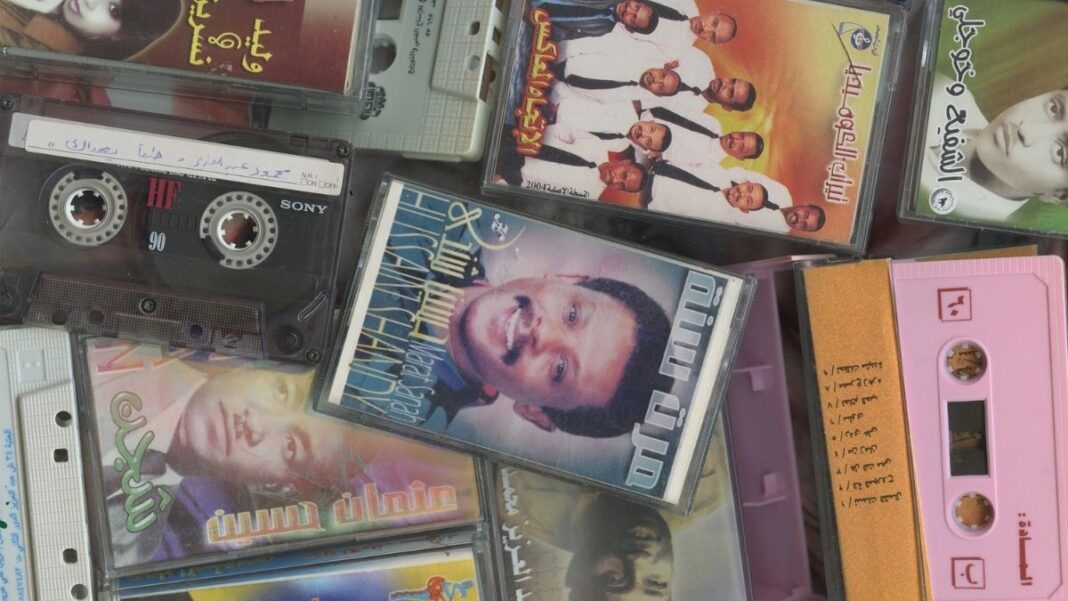
If the official archive failed to be inclusive of all Sudanese music, how did the classics we now know and love survive through decades? The answer is simple: the living archive. The living archive is an interactive collection of cultural memory and community knowledge that is constantly evolving, and in Sudan, the living archive is endless. Sudan’s rich music culture can be found in the cassette collection of a grandfather’s old cabinets, across wedding tapes dating back to the 1980s, and through the sharing of old lyrics and melodies between people.
Despite the limitations on archiving, Sudanese communities around the world contribute to keeping the culture alive, sharing old music, lyrics and short biographies about musicians from past decades, making the archive easier to access by the general public. On Facebook, countless groups exist that post song lyrics, old video recordings of performances, and forgotten songs from the haqeeba era and the golden era of Sudanese music (1950s-1980s). Several TikTok and Instagram accounts revive older music by posting video edits with songs and their lyrics, introducing younger generations to older Sudanese music. In 2018, The Sounds of Sudan, a YouTube channel was launched by The Sudanist’s very own columnist Hatim Eujayl to share classic Sudanese songs with alliteration, English translation and aesthetic visuals to match, contributing to the archiving process while introducing non-Arabic speakers to the meanings of Sudanese songs.
Further contributing to the living archive is the Sudan Tapes Archive, an initiative founded in 2020 by Sudanese-American multimedia artist and archivist, Haneen Sidahmed. The initiative serves as a digital archive of over 50 Sudanese albums by various musicians including late youth icon Mahmoud Abdelaziz, king of Sudanese jazz Sharhabeel Ahmed, legendary sister trio Al Balabel, and many more.
While efforts of culture preservation are immense, not all music has an equal chance of survival. The type of music that survives versus the music that will eventually disappear greatly depends on the era in discussion and its preferences. During Sudan’s golden music age, centralisation of Sudanese music and the extent of regional inclusivity led to a risk of losing music from different regions of Sudan. Abdelgader Salim, for instance, is one of the few musicians from western Sudan, particularly Kordofan, whose music is preserved to this day.
Today, with the help of recording studios, YouTube and digital streaming platforms such as Spotify and Apple Music, the archiving process becomes much simpler with modern Sudanese music. However, despite these advancements, there are still groups of Sudanese music at risk of being lost without proper archiving. Songs sung in ragees aroos, the bridal dance wedding ceremony held in strictly female-only presence, have been shared as recordings online, but the archive is not updated regularly, and the archive process relies on these songs being passed from one generation to the next. Another genre that is at risk of incomplete preservation is zanig, Sudan’s percussion-rich genre, which has thrived underground until the 2020s. Many unofficial archives exist for both those genres, with low quality recordings from performances, but it is likely that there are many tracks that are not available to the general public, because while the living archive is powerful, there are some melodies that remain undocumented.
Today, more than ever, digitisation efforts must be made by people on an individual level, especially those with old cassettes, wedding tapes with rare performances, and recordings from live performances. The archiving process is detrimental to the music culture of Sudan, because archives do not just preserve culture, they also shape how future generations perceive it. The simple decision to exclude a song from the archives, official or living, may make it seem as though the song never existed.
The reason we know the classics, the reason most Sudanese music survived, is not because it was fully protected by official archives, but because a family saved their grandparents’ cassette collection, someone decided to tape a wedding party, or because a member of a Facebook group shared lyrics that no one remembered. The living archive thrived because people cared enough not to let Sudan’s music history disappear.

Samar Bengawi is a medical student by day, and a literature and music enthusiast by night. She was born and raised in the UAE and is now based in Georgia. She is never without a cup of coffee in hand, and is always “on the go,” chasing after one hobby or another. Passion in Sudanese politics runs in her blood and she considers herself a patriot who hopes to leave a memorable mark in the world.