


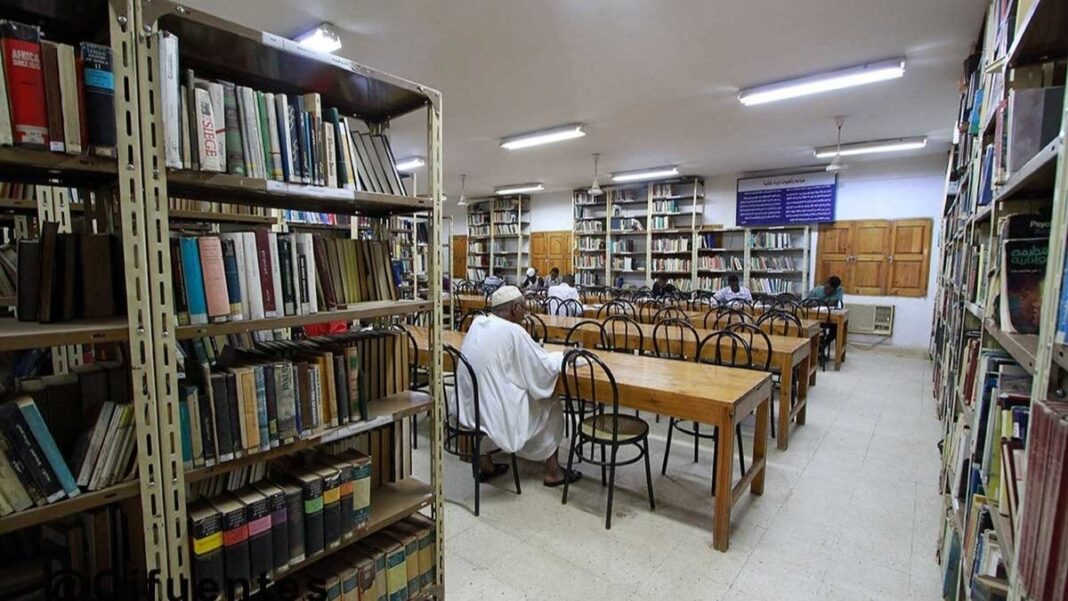
The heavy iron doors of the Abdel Karim Mirghani Cultural Centre in Omdurman used to swing open to the sound of clinking teacups, the rustle of turning pages, and the vibrant, intellectual debates of Sudan’s brightest minds. For exactly 25 years, from its inauguration in May 1998 until the devastating outbreak of war in April 2023, this non-profit institution was the premier independent sanctuary for the country’s written culture.
It was named in honour of a legendary mid-century Sudanese diplomat and political thinker, Abdel Karim Mirghani, designed to capture the spirit of the lively, philosophical salon gatherings he once hosted. Under its guiding motto of “Unity through Diversity,” the centre became a multi-generational cornerstone where seasoned historians, underground journalists, and university students huddled over rare bilingual manuscripts, while neighbourhood children animated the vibrant youth lending library next door.
This was the engine room of the Sudanese imagination, a place that hosted the prestigious Al Tayeb Salih Prize for Creative Writing and was actively digitising the priceless archives of the nation’s historic labour movement when the shelling began.
For decades, places like this were the heartbeat of a nation that practically worshipped the written word. There is an old, proud proverb whispered across the continent: “Cairo writes, Beirut prints, and Khartoum reads.” It was a badge of honour worn by generations of Sudanese who viewed literacy not just as a skill, but as a sacred heritage, a legacy passed down from the ancient scribes of Meroë to the independence-era poets who weaponised education against colonial rule.
Today, that heartbeat is faint, muffled by the relentless thud of artillery. The universities that lined the Blue Nile stand as charred, hollow monuments to a shattered peace. Their libraries plundered and their classrooms transformed into military outposts. The Abdel Karim Mirghani Cultural Centre itself lies silenced, its physical operations evacuated, its meticulously curated research collections and irreplaceable audio-visual records scattered or destroyed by looters. Millions of children have been cast adrift. Their futures suspended in the dust of displacement camps. The formal education system of Sudan has collapsed, but beneath the rubble of this institutional ruin, a quiet, defiant revolution is taking place.
In the stark, sun-bleached expanse of an informal settlement outside of Al Gedaref, far from the burning streets of Khartoum, stands Zeinab. She is a 24-year-old a former primary school teacher who fled her home with nothing but a backpack and a memory full of lesson plans. In the sweltering heat of a makeshift shelter constructed from torn tarpaulins and woven palm branches, she has established a sanctuary. It is an emergency safe learning space, though the children simply call it Al Madrasa – the school.
There are no desks here. There are no glossy textbooks or neatly printed blackboards. Instead, 30 children sit cross-legged on plastic mats, their eyes wide with a mixture of residual terror and sudden, fierce focus.
Zeinab holds up a stick, tracing the elegant curves of the Arabic alphabet in the loose sand at her feet. The children mimic her, scraping their fingers through the dirt, etching letters into the very soil of the land they are fighting not to lose.
This is education stripped to its absolute essence. It is survival.
In a world that measures educational success by standardised testing and digital connectivity, Zeinab’s dirt-floor classroom feels like a dispatch from another century. Yet, it is the most vital frontline in Sudan today. When the conflict erupted, the international community naturally focused on the immediate, desperate mechanics of keeping people alive: food, water, medicine. But as the months stretched into years, a secondary, deeper starvation set in — a starvation of the mind. Parents realised that while bread keeps a child alive today, education is the only thing that gives them a tomorrow.
Without these informal spaces, the alternative is a terrifying abyss. For a young boy adrift in a displacement camp, an empty day is an invitation to the armed recruiters roaming the peripheries. For a young girl, the closure of her school is often the final nudge towards an early, desperate marriage arranged by a family unable to feed her. Zeinab’s classroom is a shield against these invisible casualties of war.
To witness this is to understand that the Sudanese passion for learning was never dependent on government ministries or bureaucratic funding. It is woven into the cultural DNA of the country. For centuries, before modern schools even existed, the Khalwa, the traditional Quranic schools, served as centres of literacy and community cohesion across Sudan’s vast geography. When the state failed, the community always stepped in.
What Zeinab and hundreds of volunteers like her are doing across Sudan is resurrecting that ancient, communal self-reliance. They are proving that a classroom is not defined by bricks and mortar, but by the sacred contract between someone who knows and someone who longs to learn.
As the afternoon sun begins to dip, casting long, golden shadows across the camp, Zeinab closes her lesson not with a test, but with a song. It is “Azzah fi Hawak” — Azzah, in your love — the timeless anthem of Sudanese longing and belonging that has echoed through the nation’s valleys since the 1920s. The children’s voices rise, thin and slightly out of tune, but clear enough to pierce the heavy air. They sing of a homeland many of them are too young to remember intact, a land of wide-open courtyards, the cool evening breeze off the Nile, and the comforting scent of freshly baked gorrassa, a traditional, pancake-like flatbread originating from Sudan, drifting from a neighbour’s kitchen.
For a fleeting moment, the stark, dust-choked expanse of the displacement camp fades away. The melody carries them back to the Omdurman they lost, to the chaotic beauty of Khartoum’s afternoon traffic, and to the quiet dignity of grandparents who stayed behind to guard empty family homes.
It is a bittersweet symphony. The music holds the sharp ache of a generation scattered across borders and deserts, yet it also carries the stubborn, beautiful weight of a heritage that refuses to be bombed out of existence.
There is a profound nostalgia in the way their small chests expand on the high notes, a collective remembrance of a life that was soft, safe, and rich with community.
Omdurman’s grand library doors may be barred, the great universities may be silent, and the Khartoum that read so voraciously may be asleep in the dark tonight. But out here in the dust, under a ceiling of torn plastic and open sky, Sudan’s children are singing their way back home, learning how to write the future in the very soil that birthed them.

Nasreen Mukhtar is a writer and educator who believes that words are never just ’empty’ — they are the most powerful tools for transformation we possess. With 23 years of experience in educational leadership and a deep specialisation in ESL (English as a second language), she blends technical structure with a passionate commitment to the ‘soul’ of every message. Her mission is to bridge the gap between clarity and emotion, using her passion for storytelling to spark meaningful change and foster authentic self-expression. She doesn’t just write to inform; she writes to reach others on a deeper level.