The memory of teaching the Sudanese Board Exam curriculum series remains a sharp, uncomfortable thorn for many educators. It was a period defined by forced convergence, where the Ministry of Education mandated that every educational system — regardless of its specific focus or methodology — bow to the middle school board exam. For those of us advocating for digital fluency and modern pedagogy, that moment wasn’t just a logistical hurdle; it was a profound disappointment that signalled a deepening rift between national policy and global reality.
I vividly remember the only time I taught the Sudan Practical Integrated National English (SPINE) series for the Sudanese Board Exam curriculum. My disappointment was, and remains, beyond reconciliation. The points recently raised by teachers on social media highlight a discontent that hasn’t just stagnated; it has arguably worsened given the current regional challenges. When an exam pulls from materials that students simply cannot access due to active conflict, it ceases to be an assessment of merit. Instead, it becomes an assessment of luck — or, even worse, “connections.”
Looking back from the vantage point of April 2026, that disappointment has curdled into a broader systemic crisis. The discontent shared by teachers across social media is no longer just a murmur of academic disagreement; it is a desperate outcry against a system that has remained stubbornly stagnant while the world — and the region — has been upended. When a national examination continues to lean on the SPINE series, a relic of the early 1990s, it does more than just fail to teach modern English. It anchors students to a pedagogical ghost.
The reliance on obsolete formats, such as rigid formal letter-writing in an era of instant digital communication, reveals a curriculum that has lost its pulse.
As of this year, regional educational assessments confirm that SPINE 5 and 6 remain the gatekeepers for the Sudan Certificate, despite their total lack of alignment with international standards like the Common European Framework of Reference for Languages (CEFR) is an international standard used to describe language ability. It’s the scale used worldwide to rank how well you can speak, read, and write a foreign language.
They are essentially asking our youth to navigate a high-speed digital world using a map drawn thirty years ago.
However, the tragedy is no longer confined to the quality of the ink; it is now about who even gets to hold the pen. The education system has transitioned from a flawed meritocracy into what can only be described as an assessment of luck, or worse, political and financial connections.
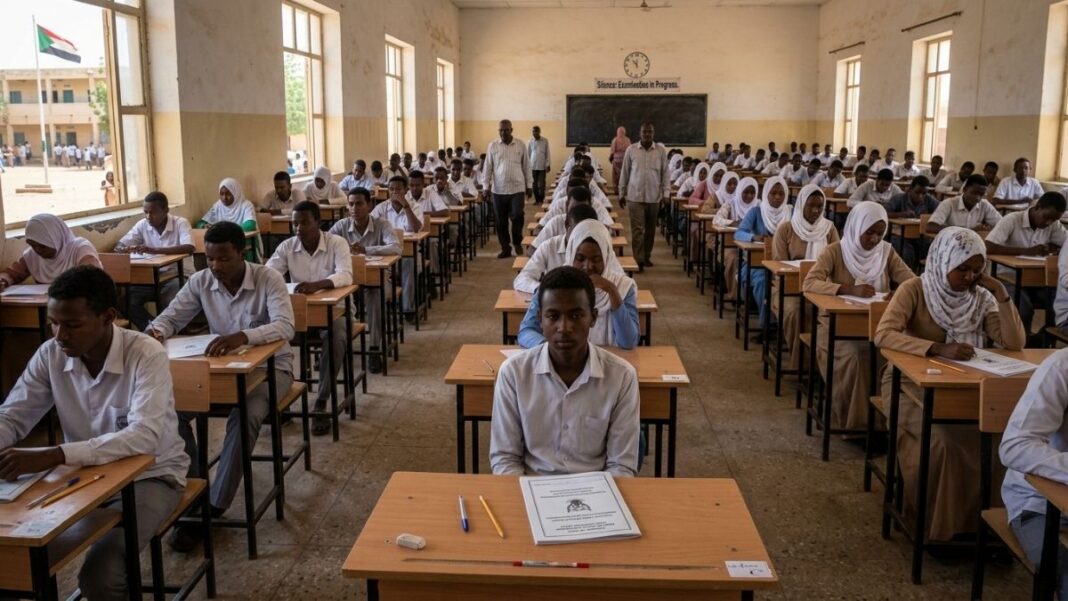
The ongoing war in Sudan has birthed a brutal two-tiered reality. While exams are administered in states controlled by the Sudanese Armed Forces (SAF) (like the River Nile and Northern State), students trapped in Darfur and Kordofan controlled by the Rapid Support Forces (RSF) are effectively erased from the national record.
The statistics for 2026 are staggering and heartbreaking. Nearly nine million Sudanese children see their schools not as halls of learning, but as memories or, more often, as repurposed shelters for the displaced. With over 280,000 secondary students unable to even reach an exam centre this April, the merit of the Sudan Certificate is being hollowed out. When a student must travel 2,000 km from a refugee camp in Chad just to find a safe testing site, the exam stops measuring knowledge and begins measuring sheer survival and the depth of a family’s pockets.
This erosion of integrity is further compounded by the looming threat of dual certification. With one administrative body operating from Port Sudan and another emerging in the west, the Sudanese student is caught in a political pincer movement. The “shame” of this situation lies in the fact that a student’s hard-earned grades are now secondary to the political validity of the paper they are printed on.
For over a decade, the signs were clear. The SPINE series and the examination board have failed to evolve, refusing to provide the fairness and rigour that our students deserve. We are witnessing the collapse of a national standard into a fragmented system that rewards those who can escape the chaos while systematically punishing those left behind. For the Sudanese educator, this is more than a professional grievance; it is the witnessing of a stolen future. The same mistakes are being made, the same flaws are being ignored, and as always, it is the Sudanese student who pays the ultimate price.

Nasreen Mukhtar is a writer and educator who believes that words are never just ’empty’ — they are the most powerful tools for transformation we possess. With 23 years of experience in educational leadership and a deep specialisation in ESL (English as a second language), she blends technical structure with a passionate commitment to the ‘soul’ of every message. Her mission is to bridge the gap between clarity and emotion, using her passion for storytelling to spark meaningful change and foster authentic self-expression. She doesn’t just write to inform; she writes to reach others on a deeper level.