


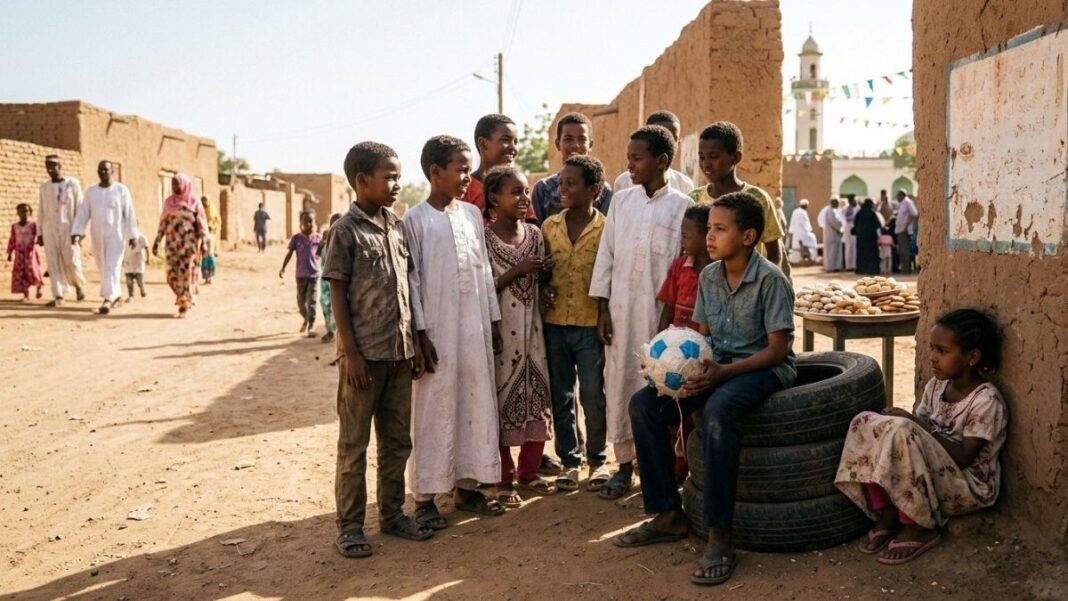
Eid unlocks a massive vault of core memories, beginning from smelling the incense (bakhour) mixing with the scent of freshly pressed cotton to the enticing aroma of lamb being cooked on a crisp Eid morning.
It just isn’t the same anywhere else in the world.
Let us begin with the ‘Great Eid Jalabiya Hunt.’
Finding Eid Jalabiyas for the children is basically an Olympic sport. You’re navigating crowded markets, arguing with tailours who swore on their lives it would be ready three days ago, only to end up doing a midnight pick-up. But, when they put them on, they look like a million bucks — before they inevitably spill shai be laban, which is traditional Sudanese milk tea enjoyed with biscuits or Eid fatoor grease on it roughly 12 minutes later.
Next, the ‘Eidiya Financial Summit’. Nothing matches the pure, unadulterated capitalism of children counting their Eidiya, a cherished tradition where older family members and friends gift money to children and younger relatives during the celebrations of Eid Al Fitr and Eid Al Adha. It’s the only time where children around the age of seven and older sound like Wall Street brokers.
But it’s really all about the ‘Legendary Eid Fatoor coma’. Waking up at the crack of dawn, sprinting to the mosque for prayers, and then rushing back for the real main event: the Eid Fatoor. Eating your weight in kabda (liver), shaya (grilled or pan-fried meat) and various types of lamb cooked to perfection, with the traditional ‘kisra and mullah’ — all at 8 am, surrounded by a house so full of shouting, laughing aunts, uncles, and neighbours that you can barely hear yourself think.
We might not be there right now, but those memories are how we carry a piece of that Sudanese warmth with us wherever we are.
Despite the war.
Despite displacement.
But overshadowing it all is the shift in reality for those children who still reside in Sudan now, residing heavily in our hearts; making it impossible to truly experience pure joy.
The collision of war, displacement, and sacred traditions has completely altered what childhood and celebration look like for Sudanese children. Marking Eid while living through a conflict that has entered its third year, means navigating a reality where joy is hard-won, safety is fleeting, and normalcy has been shattered.
Now Sudanese children are coping with Eid under dire circumstances as the holiday intersects with their current, deeply fractured school schedule.
Coping with Eid in the Midst of Displacement
For millions of displaced children inside Sudan and in neighbouring refugee camps such as in Chad and Egypt, Eid no longer carries the familiar sights, sounds, and security of home. However, the ways they cope reveal incredible resilience alongside immense sorrow.
The traditional excitement of Eid — new clothes, Eiddiya and baking traditional sweets (ka’ak) — has been heavily stripped away by extreme financial hardship and severe food insecurity. Instead, families and local volunteers try to create moments of joy out of nothing, using simple handmade toys, singing traditional songs, and gathering in collective shelters or camp courtyards to maintain a sense of community.
For children carrying the weight of trauma, sounds of Eid such as fireworks or loud communal gatherings can frequently act as triggers, sounding terrifyingly similar to the drones, shelling, and gunfire that forced them from their homes. The psychological toll is heavy; while they try to play, the underlying anxiety of ongoing conflict is never far away. In safer areas or refugee communities, the emphasis of Eid has shifted from material celebration to pure survival and family solidarity. The holiday is heavily marked by the bittersweet reality of missing separated loved ones, honouring those who have been lost, and praying for an end to the violence.
How Eid Fits into the Current School Schedule
To ask how Eid fits into the school schedule assumes a functioning academic calendar but the reality on the ground is that Sudan is facing one of the worst education emergencies in the world. The intersection of Eid and school is characterised by a deeply fragmented and non-traditional landscape.
The Reality of the Out-of-School Crisis
For nearly half of Sudan’s school-aged children (estimates range between 8 to 11 million children inside the country), there is no school schedule to fit Eid into. Formal education has essentially ceased in high-conflict territories like Darfur, Kordofan, and parts of Khartoum.
Thousands of school buildings are completely non-functional, having been structurally destroyed, caught in active crossfire, or repurposed as emergency shelter hubs for internally displaced families. For these children, Eid is just another day in a protracted gap of over 500 days of lost learning.
The Fragmented Reopening of Schools
In safer, stable states such as parts of eastern or northern Sudan, local authorities and administrative bodies have made immense, exhausting efforts to gradually resume classes and organise national examinations to save an entire generation from total academic collapse.Where formal or informal schools are operating, Eid is observed as a critical, much-needed break. Because regular semesters have been completely upended by irregular closures, curfews, and shifting frontlines, the academic schedule is highly fluid. Eid breaks are not standard calendar vacations; rather, they are brief pauses utilised by families to rest and by educators to recalibrate.
Alternative Learning Spaces and Psychosocial Support
International organisations like UNICEF and Save the Children, alongside deeply dedicated local grassroots initiatives and Sudanese teachers’ committees, have been establishing emergency initiatives such as the recently launched BRIDGES programme, and the Building Resilience to Improve Development and Growth in Education in Sudan programme, which was launched by UNICEF and Save the Children, alongside partners such as the Global Partnership for Education (GPE). The programme is actively funding the reopening of hundreds of schools, setting up nearly 1,800 alternative learning spaces, and training thousands of teachers to deploy remedial curriculums.
In these informal learning spaces, the timing of Eid is intentionally woven into the curriculum not just for religious observance, but as a framework for psychosocial support, coinciding with Mental Health Awareness Month, observed every May since 1949. Teachers and facilitators use the holiday period to conduct organised play, art therapy, and storytelling sessions, using Eid as a ‘Therapeutic Tool’. This allows educators to help children process their trauma through the familiar, comforting rhythms of cultural tradition, even when a standard classroom is entirely out of reach.
The Scale of the Education Emergency
According to data from the Global Education Cluster and UNICEF, an estimated 8 to 11 million school-aged children have been completely deprived of learning since the war began, making it one of the largest academic disruptions globally. In early 2026, Save the Children confirmed that millions of Sudanese children had officially crossed the threshold of nearly 500 days of lost classroom time since April 2023, surpassing the length of the worst global COVID-19 pandemic school closures. Roughly half of the school buildings in the country are non-functional, with thousands actively being used to house internally displaced families.
The contrast between high-conflict zones and safer territories is a striking contrast which creates parallel worlds. While formal schooling is virtually impossible in places like Khartoum, Darfur, and Kordofan, safer states in eastern and northern Sudan such as the River Nile or Kassala states, have made gruelling administrative efforts to hold local sessions and salvage national exams.
Because these safe learning spaces double as protection hubs, international and local organisations intentionally use cultural rhythms like Eid to provide informal, therapeutic support. Weaving memory, art therapy, and storytelling into these brief pauses is a recognised strategy to help children process severe trauma in a comforting, familiar framework. Ultimately, Sudanese children are holding onto Eid as a vital anchor to their identity and past life, while the adults and educators around them battle overwhelming odds, as well as their own ghosts of the traditional Sudanese Eid that once was, to stitch together whatever remnants of a legacy they can pass down to the next generation.

Nasreen Mukhtar is a writer and educator who believes that words are never just ’empty’ — they are the most powerful tools for transformation we possess. With 23 years of experience in educational leadership and a deep specialisation in ESL (English as a second language), she blends technical structure with a passionate commitment to the ‘soul’ of every message. Her mission is to bridge the gap between clarity and emotion, using her passion for storytelling to spark meaningful change and foster authentic self-expression. She doesn’t just write to inform; she writes to reach others on a deeper level.