


Growing up in Sudan meant living among the distinct, overlapping thumbprints left behind by various political regimes. As children, our understanding of the country was shaped entirely by the nostalgic stories our elders shared, painting vivid pictures of a beautiful, simple, and seemingly more refined time.
In those family tales, the structural damage of colonialism was invisible, masked by fond memories of a peaceful past. It was not until much later, as we began to unpack our history, that the unpleasant and deeply entrenched residue of a colonised nation finally began to take shape.
The Colonial Blueprint on Sudan’s Education System
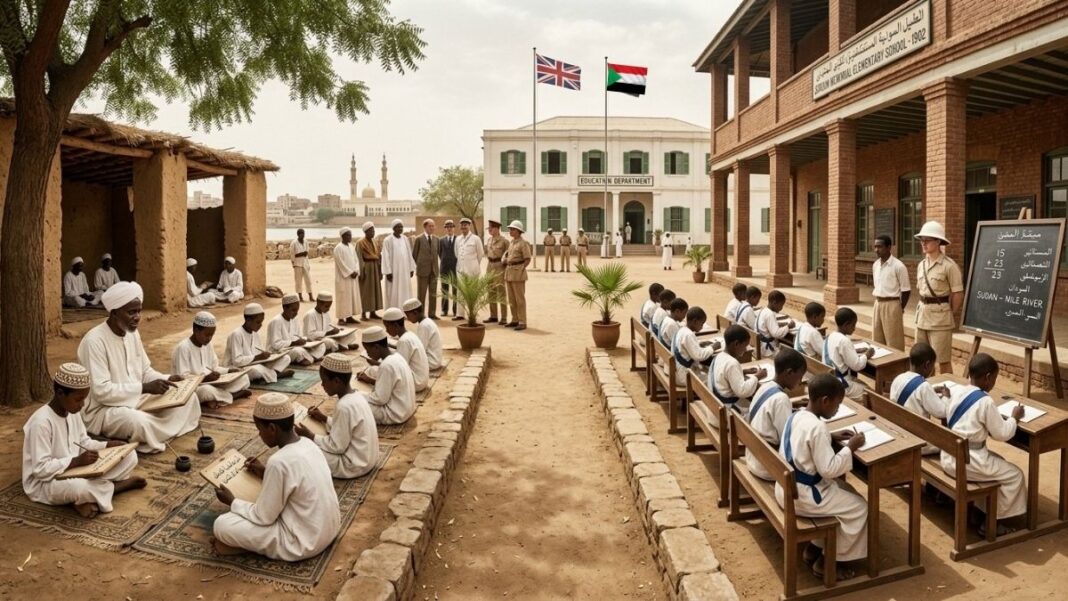
The problems in Sudan’s education system started long before the country’s independence in 1956. During colonial rule, the British administration deliberately kept the north and the south separate They sought to isolate the south from northern Islamic influence and secure it under a distinct colonial administration aligned with East Africa.In the north, state-run schools such as Gordon Memorial College, which is now the University of Khartoum, were established to train a small group of local men for government jobs, while traditional Quranic schools (khalwas) were largely sidelined. In the south, education was handed over to Christian missionaries, ensuring students learnt in English rather than Arabic. This created a profound divide between the two regions, leaving the South without comparable state resources and setting the stage for future civil wars.
After gaining independence, national leaders attempted to unify the country by forcing everyone into an Arabic-medium curriculum. The state took over missionary schools in the south and systematically phased out English in public schools across the country.
While state schools were quickly transitioned to Arabic, private, church-run, and community institutions, particularly in Khartoum, remained vital sanctuaries, offering English-medium education. For decades, these private schools allowed non-Arab populations, southern families, and middle-class students to learn in a language that felt familiar and connected them to the wider world.
The 1990 Educational Revolution
Everything shifted when former Sudanese President Omar Al Bashir took power in 1989 and launched the 1990 ‘Educational Revolution’, as I like to call it, for it was indeed just that. The regime targeted the remaining pockets of independence in the sector, forcing private schools to drop English and adopt a strictly Arab-Islamic curriculum. British IGCSE and O-Level systems were suspended, and all local private schools were forced to adopt the national Sudanese Board Exam. As a victim of such an absurd, overnight shift, I found myself suddenly struggling to decipher advanced science and mathematics concepts in a language I had never studied them in. It was a sudden harsh reality that could not be escaped.
The Pain of Arabisation: A Student’s Experience
For students such as myself in these private classrooms during the early 1990s, the political decree was a sudden personal tragedy. Having built their entire academic foundation in English, they were abruptly thrown into turmoil.
For a brief, fragile reprieve – a precious couple of years from 1994 to 1995, the government allowed students to sit for the new Sudanese Board Exam in English. While far from ideal, this grace period gave students a fighting chance to translate their hard work into results without losing their academic footing overnight.
However, the door slammed shut just as abruptly. By 1996, the system was aggressively Arabised yet again. The option to take exams in English was completely stripped away, leaving subsequent cohorts with no way to escape the full weight of the decree.
Imagine spending years preparing for British qualifications, only to be forced into an entirely different examination board taught in a language you had never used for academic subjects. Young people who had previously excelled saw their marks crash as they struggled to memorise complex scientific terms in Arabic under intense pressure. Classrooms became places of acute stress. Teachers and students alike were caught in the crossfire of forced cultural shifting, leaving a generation of bright minds feeling stripped of their voice, confidence, and academic identity.
The Shift Towards International Sanctuaries
As local private schools were absorbed into the national Arabic board system, a new divide opened up. Families who could afford it scrambled to move their children to elite, foreign-accredited international institutions in Khartoum, which managed to retain international examination options despite heavy state surveillance and mandatory Arabic and Islamic studies modules for local students. Other families chose to leave the country altogether, seeking a more stable education abroad.
This policy created a painful split. Those who could afford elite international schooling or emigration managed to protect their children’s educational path, while students in local private schools were left to endure the jarring reality of sudden Arabisation.
The Lasting Failure of Colonial Foundations
Sudan’s ongoing educational crisis is not simply the result of one regime’s missteps, but the natural culmination of a system built on colonial fault lines. By designing an educational model intended to segment populations rather than empower them, British rule planted the seeds of institutional exclusion. Successive post-independence regimes, culminating in the radical centralisation of the 1990s, merely inherited and repurposed these colonial tactics of control, swapping foreign administrative dominance for state-enforced ideological compliance.
In treating education as a weapon of statecraft rather than a public good, Sudan’s rulers continuously failed its youth. The structural inequality established in the colonial era, combined with decades of reactionary counter-policies, broke the country’s educational backbone. To this day, the legacy of that initial divide haunts Sudan, leaving an educational landscape fractured by class, geography, and political trauma – a stark reminder that a nation cannot build a stable future on a foundation designed to keep its people apart.

Nasreen Mukhtar is a writer and educator who believes that words are never just ’empty’ — they are the most powerful tools for transformation we possess. With 23 years of experience in educational leadership and a deep specialisation in ESL (English as a second language), she blends technical structure with a passionate commitment to the ‘soul’ of every message. Her mission is to bridge the gap between clarity and emotion, using her passion for storytelling to spark meaningful change and foster authentic self-expression. She doesn’t just write to inform; she writes to reach others on a deeper level.