


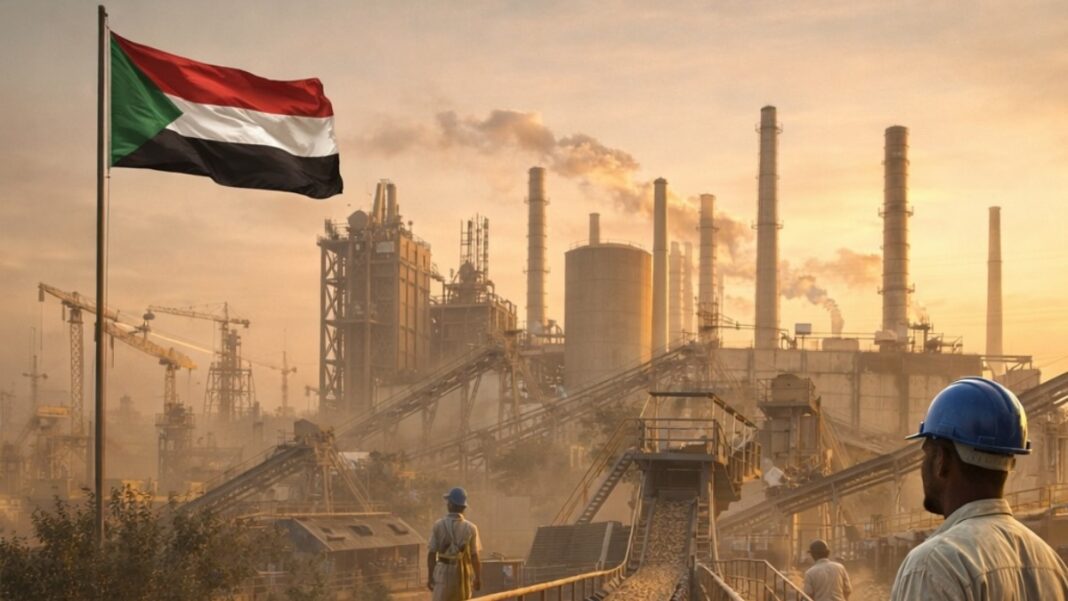
Sudan’s exports of its finest expertise and resources goes far beyond the current war. For seven decades since independence, the country has struggled to shed the economic legacy of British colonisation. Huge numbers of human capital, the Sudanese people, migrate due to economic and political reasons. Yet, it’s not only human resources that are the country’s treasure.
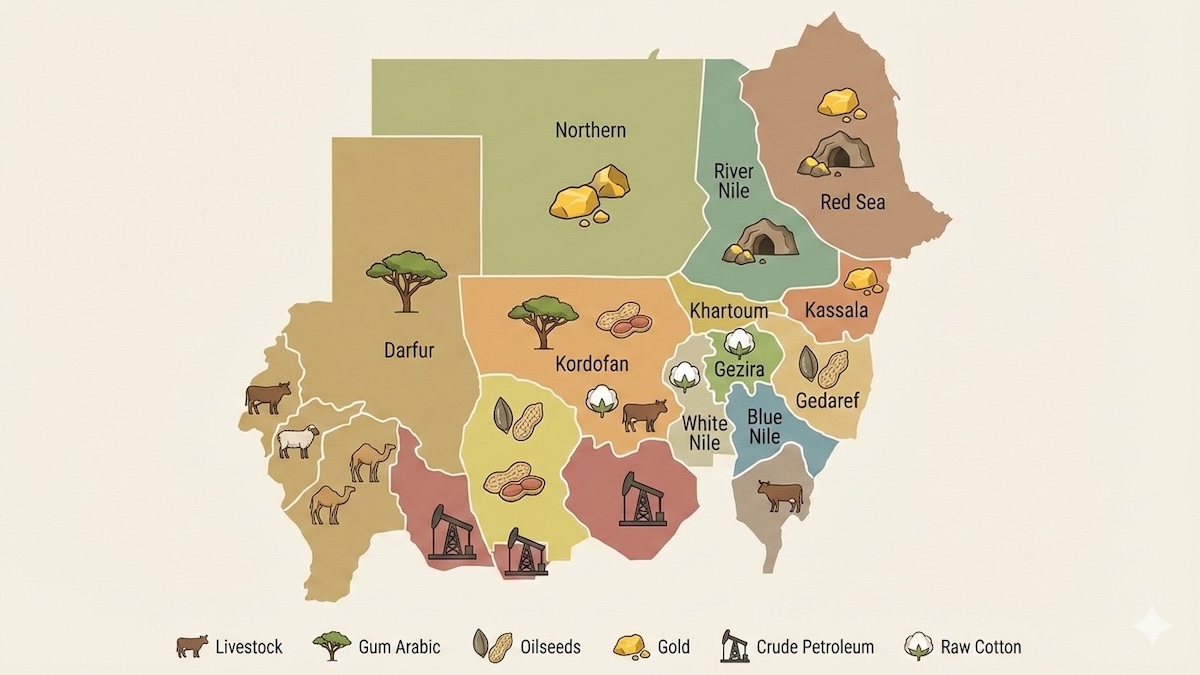
Most Sudanese people deeply believe that Sudan is not a poor country. In fact, they believe it’s rich with tremendous natural resources. However, this perception of abundance is starkly contradicted by global economic indicators. Is it only because of mismanagement or corruption? This gap exists because Sudan’s acknowledged wealth is trapped in a ‘Conveyor Belt’ of extraction.
The Trap Evidence
Before the current war began in April 2023, Sudan unemployment rate was 17.60 million in 2022 before jumping to 20.80 million in 2023. The poverty rate pre-war was %61.1 of the population, and in 2022, the country’s Gross Domestic Product (GDP) was $51.67 billion.
GDP = C + I + G – net (C-M)
To simplify, using the Expenditure Approach, a country’s GDP is “the total dollar value of everything a country makes (goods and services) in a specific time”. It’s the sum of private consumption (C) plus investment (I) plus government spending (G) minus net exports (X-M). Taking into consideration that Sudan’s economy heavily relies on exporting raw and unprocessed resources with over 90% of its non-oil exports in natural raw form (including gold).
These numbers shaped the narrative of poverty despite the abundance of wealth.
Then the question is how do we unlock this treasure?
If we rush into answering this question, we will keep scratching the surface. Nothing fundamentally will change – just another revolutionary noise such as the High Education Evolution in the 90s that was driven by ideological and political gains. It contributes to the employment rate by not aligning with a whole integrated vision crafted around the country’s wealth, an absence of a vision that acknowledges the power beneath the abundant natural resources.
We need to re-examine the economy with a fresh eye, questioning why the existing ecosystem is dysfunctional, and deeply contemplate this question: how was the existing ecosystem built in the first place?
Sudan Economic History
Pre-Colonial Economy
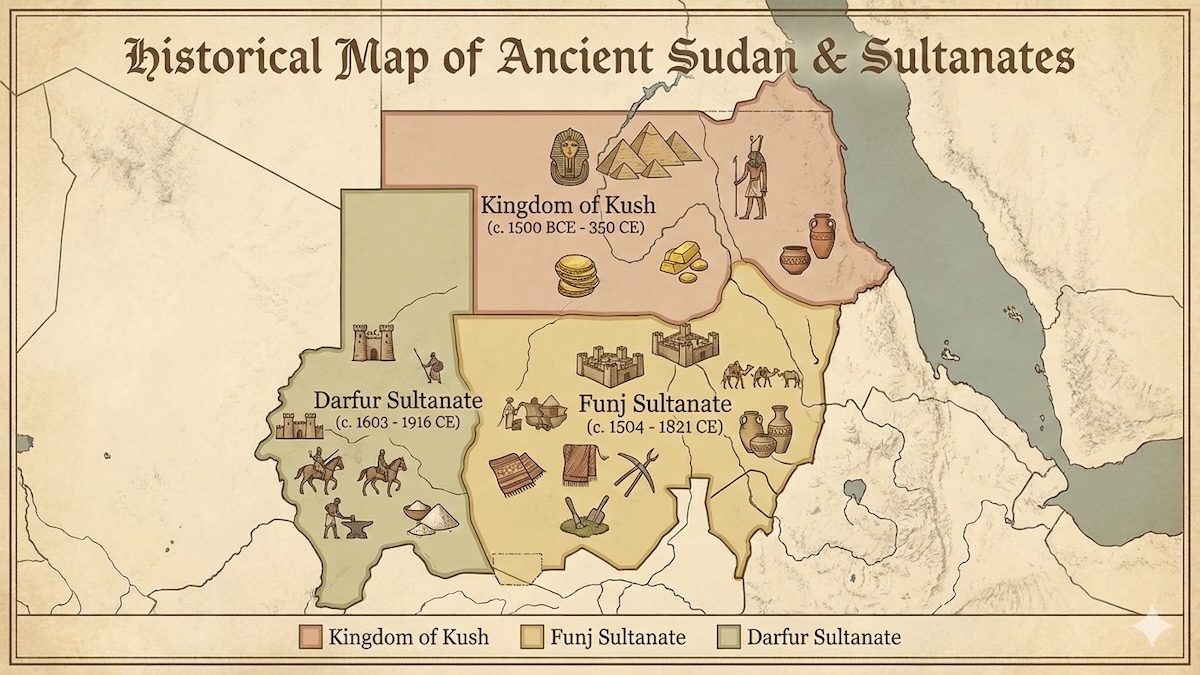
Before the colonisation era of what is currently known as Sudan, this land was governed by fragmented Sultanates and Kingdoms each dominated a reign; the whole land was a global hub for specialised tools craft smith and manufacturing, particularly in textiles and leather.
The Nubians
Archaeological evidence from Meroë (400 BC) shows that North Sudan had a flourishing textile industry long before European contact. Spinners and looms “wool-bearing trees”, which is cotton, were cultivated for local consumption and regional trade.
Ancient Nubians were the world’s leading leather specialists. They produced “grain-off” leather (like suede) so fine it was used for complex “net-structure” garments and breathable loincloths.
The Funj Sultanate
During the Blue Sultanate the economy was decentralised and trade-based where merchants traded processed leather, iron tools, and gold along the “40-Day Road” to Egypt and the Red Sea.
It’s interesting to notice that power was shared between the kings, Sultans and tribal leaders; there was no centralised “national” economy, but rather a network of thriving local markets.
The Shift to Colonial Extraction
During the British colonisation, the coloniser intentionally overrode the existing economy and replaced it with a whole ecosystem that served the industrial needs of the British Empire. The coloniser simply created a conveyor belt. It is very clear that the infrastructure built at that time was to serve this purpose; just like the railroads and seaports were built not to carry passengers and connect the massive land. That was mainly to carry the raw resources from its origin to the exportation ports, including The Khartoum-London air bridge.
The following are living examples of the conveyor belt crippling some industries. These examples do not cover oil and gas, although those represent a big percentage of the country’s import and export prior to the separation of South Sudan (2011). These examples are just for demonstration, but applicable to every industry.
The Gezira Scheme: The “Great Extraction”
In 1925, during the colonisation era, Al Gezira Scheme was one of the world’s largest irrigation projects, located in Al Gezira State between the Blue Nile and White Nile rivers, covering over 2 million acres (approximately 0.9 million hectares). Historically served as the economic backbone of Sudan. It was designed solely to provide raw long-staple cotton for the textile mills of Lancashire, England.
As a result, Sudan’s economy became monocultural, dependent on a single crop. Instead of weaving its own cotton as it had for thousands of years, Sudan began exporting raw cotton and importing final clothes products.
The same business model was replicated in other industries, like sesame, and Gum Arabic, and later oil and gold. I’m sure it will be the same model for any new discovered natural resource. This business model still dominates the economy, where the whole nation’s economy intentionally shifted from industrial to relying on exporting raw material and resources. This colonial trap is crippling the country’s growth since before its independence in 1956.
Sudan’s Value Chain Traps
According to the UN Trade and Development (UNCTAD), a country is “commodity dependent” when more than 60% of its export revenue comes from raw materials. Sudan, with over 90% of its non-oil exports in raw form, is a textbook case of being “trapped.
This value chain trap and the conveyor belt built by the coloniser has a significant impact on Sudan’s economy today. Since Sudan exports raw commodities, it’s a “price-taker.” It must accept whatever the global market offers and then import the final products at a higher cost. Mathematically, this is a great loss.
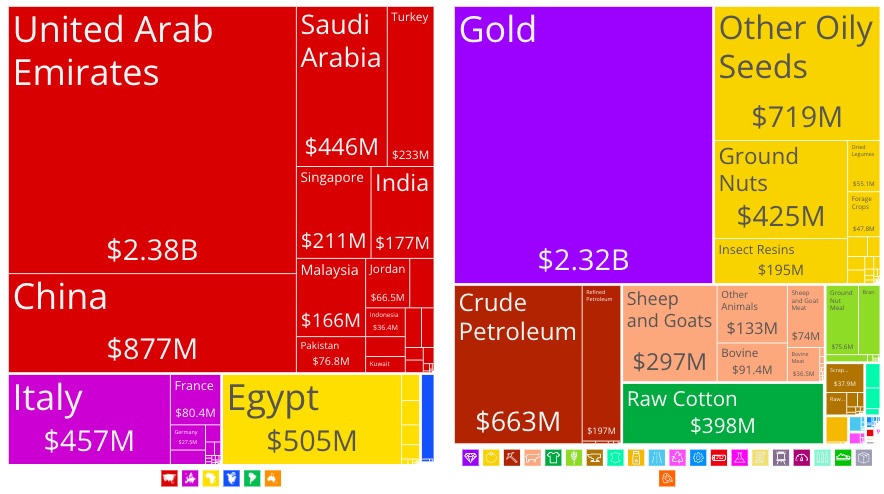
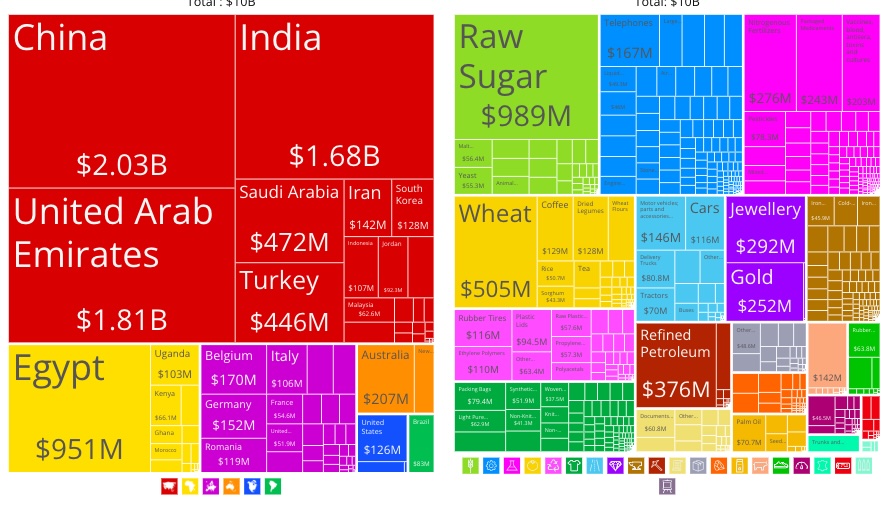
It simply means the supply chain is not a profitable national revenue stream. Pre-war, and according to The Observatory of Economic Complexity (OEC), and specifically in 2022, the total export revenue was $6 billion, while the total import cost was $10 billion. Sudan loses annually $4 billion for the absence of its industrial economy.
Sudanese Economic Evolution
After 70 years of experiments, Sudan’s economic evolution won’t be funded through producing and exporting more. It’s not a matter of volume. But by capturing the lost values due the coloniser’s legacy, by breaking the conveyor belt.
For Sudan to break free from the conveyor belt, integrated long-term strategies are needed to rip off the conveyor belt and to tackle the main barriers. Yet, it’s easier said than done, here is a quick insight into the gravitational pull on some industries.
The Impact of The Coloniser’s legacy
Gold: Beyond Inflation Relief
In a stable economy, a country’s currency is effectively a “receipt” for its gold reserves. For Sudan, Gold is the true value behind the Sudanese Pound (SDP).
In 2022, Sudan exported a total of $2.32 billion of raw gold, mostly to the UAE. Some statistics estimated that at least 400 tonnes of gold have been smuggled out of Sudan between 2012 and 2024, mostly to Russia, and the UAE.
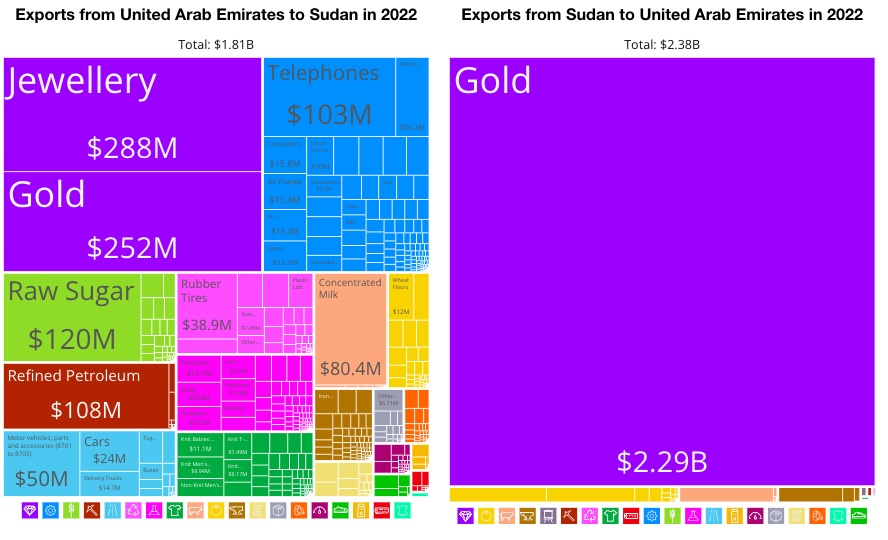
The UAE has no known domestic gold mines or significant raw underground gold, yet Sudan imports jewellery and refined gold from the UAE valued at over $500 million in 2022 alone. In 2025, the UAE’s gold reserves were $237,93 billion. The UAE functions as a global hub for gold transformation; with its high-end gold refineries, it reproduces the raw gold doré into jewellery. The same trend happens with processing and importing sugar cane.
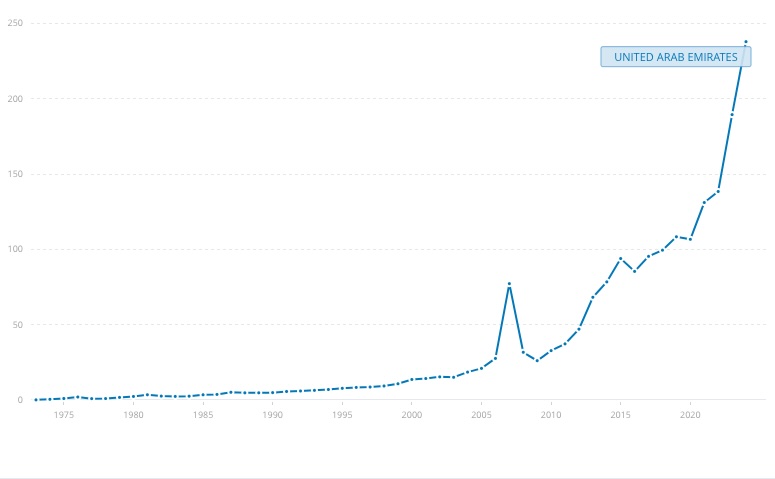
Sudan is among the top international producers of raw gold in Africa, but what is missing?
Sudan heavily suffers from gold smuggling, ISO-certified gold refineries, prevalence of traditional production (small-scale) and manual instead of industrial manufacturing, lacks consistent 24/7 stable power, and international Sanitary and Phytosanitary (SPS) certifications.
In short, Sudan suffers from a refining and transparency gap that prevents it from reaching its true economic potential.
Gum Arabic: The Technology and Certification Trap
In 2022, Sudan was on top of the world’s raw Gum Arabic producers, with $184 million. Surprisingly, France, which doesn’t have the natural resources (Hashab tree), is the world’s leading exporter of processed gum with a total export $181 million that cost a total of $80.1 million import.
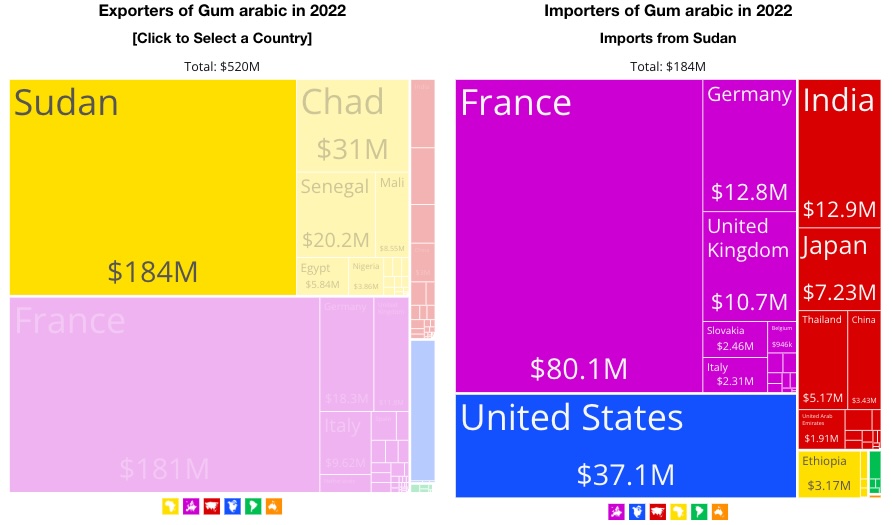
But why can’t Sudan export processed Gum Arabic?
Sudan cannot bypass French middlemen because it lacks the ISO-certified facilities and the stable electricity required.
Cotton: The Infrastructure Trap
A natural product that the country has been abundant with for centuries has still not met its full potential. The strategy here also is the same, quick wins by relying on raw exportation, instead of building the transformative ecosystem that is in alignment with the country’s resources.
The below Product Complexity Index and relatedness graph shows that raw cotton has a high growth opportunity against the industry systemic rigidness, readiness, or agility towards that growth. The old conveyor belt wasn’t developed to make this possibility a reality.
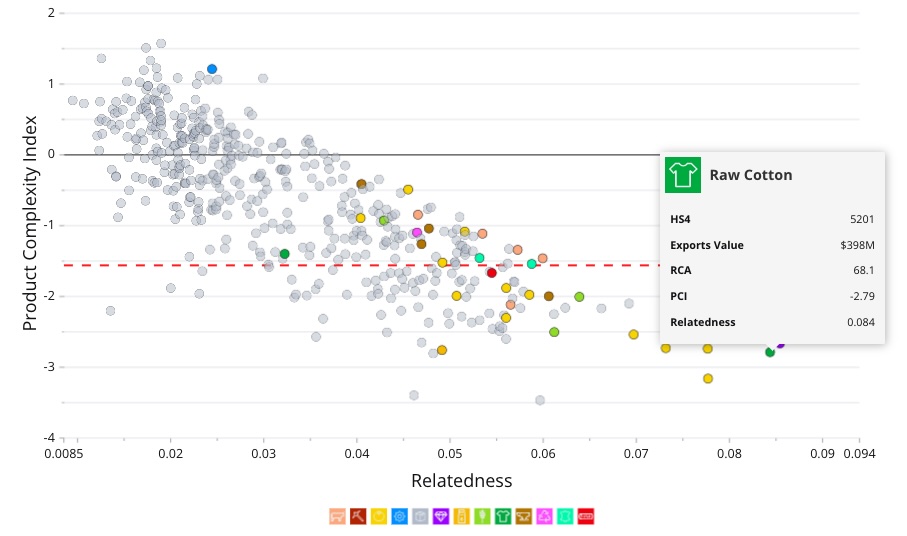
In 2022, Sudan exported $398 million of raw cotton. Imagine the wasted opportunity not only in terms of revenue, but the impact of prosperous production, manufacturing, and supply chain businesses that will flourish over strong and evolving infrastructure, the job opportunity, and academic research and know-how wealth.
Why can’t Sudan capture the loss of value in cotton?
Because of the weak infrastructure, unfair taxation and policies, and absence of manufacturing facilities that set Sudan as a “price-setter”.
Livestock: Cold Supply Chain
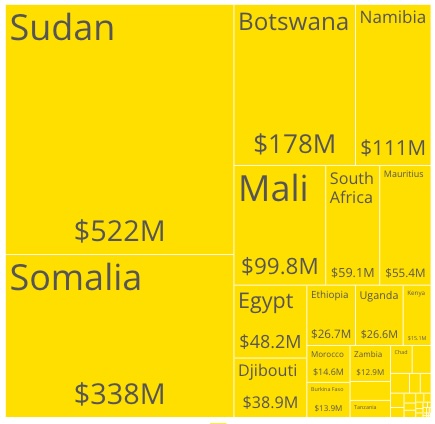
Sudan possesses one of the largest livestock populations in the world, with 111 million head of cattle, sheep, and goats. Yet its contribution to the national treasury is significantly lower compared to its potential. Sudan is the top producer of livestock in Africa. According to the Observatory of Economic Complexity OEC), in 2022, the total export of livestock was $522 million.
Sudan exports live sheep to Saudi Arabia for roughly $150 – $180 per head. Once slaughtered and processed, the retail value of that same animal exceeds $350 – $400. There’s a minimum loss of $200 per head.
It is often cheaper and safer to live export than it is to process and transport 1,000 carcasses in refrigerated trucks. Because of the lack of cold chains, a seamless link of refrigerated production, storage, and distribution activities. If the “chain” is broken at any point such as a power outage at a warehouse or a truck without cooling, the product can spoil, lose its effectiveness, or become dangerous, which forces the private sector to export the animal alive, losing the value of the leather and meat processing.
If Sudan processed just 20% of this herd into chilled meat, leather, and gelatin, the export value would be a breakthrough.
Why can’t Sudan seize the loss value in the livestock industry? Because of the unsustainable electricity power, the limited cold supply chain, lack of certified laboratories and cold chain infrastructure to prove to global markets that its processed meat is disease-free.
The Evolution Barriers
If we want to summarise this in a simplified way, the Sudanese people should be aware of the lost treasure and identify and admit the limitations of the British legacy. This is the first step towards a profound shift, even before removing the barriers. Setting the collective mindset free from the slavery economy is very crucial not only to fight poverty, but to manifest prosperity and intergenerational national wealth.
Breaking free from the conveyor belt and transforming the existing supply chain is not a recovery plan, it’s a holistic life changing vision, to build sustainable intergenerational wealth for the Sudanese nation.
For a country to generate wealth, it must create the ecosystem and infrastructure needed for that evolution. The main ingredients are strong infrastructure, sustainable and affordable electricity power, advanced and smooth logistics, governance (law, policies, and rewarding and incentive systems), and innovative education system.
How do we fund Sudan’s industrial evolution?
If you look at all of this as a one-project, you missed the point. The overall ecosystem revamping is a tedious process; it doesn’t happen overnight. We are not only addressing specific sectors, but every revenue stream that currently relies on exporting raw production.
Here, we are introducing a holistic model, which requires a staged strategic planning and gradual implementation. In this case, we are talking about smartly and intentionally allocating the available resources for the essential developmental programmes first, then gradually rolling the next phases.
The funding tactics are many but mainly start with rationalising government spending and redistributing the country’s budget. Establishing investment and trading policies and aiming towards incentivising and empowering the private sector in the manufacturing, supply chain, and industrial research and development domains. All of this coupled with attracting national and foreign investors to a national industrial vision. For instance, the government could provide a First-Loss Guarantee to banks so they feel safe lending the private sector and cooperative unions. First-Loss Guarantee (FLG) is a risk-mitigation tool where a guarantor agrees to absorb the initial, or portion of losses in a loan or investment portfolio, protecting senior investors.
Cooperative Union: Society Economic Mobilisation
The Cooperative Union architecture starts with building Cooperative Society, a simplified business gears that collectively forms the industrial engine in a domain.
The cooperative society is owned by its members (who use the services). It’s a grassroots entity where the members put their labour together, such as a collaboration of Arabic gum producers in villages or cotton farmers in a Hallal. On the other hand, the Cooperative Union is the federation of these cooperative societies, it’s the strategic level.
The union has the collective capital and legal weight to invest in high-end certified facilities. This is how to transition society from being raw material producers to industrial owners. It is this union that possesses the financial muscle to build $2 million manufacturing facilities, a cooled supply chain, solar power mini-grid and central certified laboratories.
Instead of individual small-scale investment, a collective investment in a Cooperative Union will have a greater legacy and butterfly impact on multiple levels.
Post war, rebuilding Sudan is a rare opportunity. Seized not by returning to the normal, not to fight over who will be controlling the slavery economy, but by collectively destroying it and building the long awaited industrialised wealthy nation.
Striving for this radical transformation will have a profound impact on decreasing the unemployment and poverty rates, increasing the Sudanese community’s wellbeing, and a steady economy with increasing GDP growth. A small mind-shift is enough to unlock intergenerational national treasures.
This is more than an economic recovery; it is the blueprint for a sovereign, industrialised Sudan that no longer exports its future, but manufactures its own prosperity.