


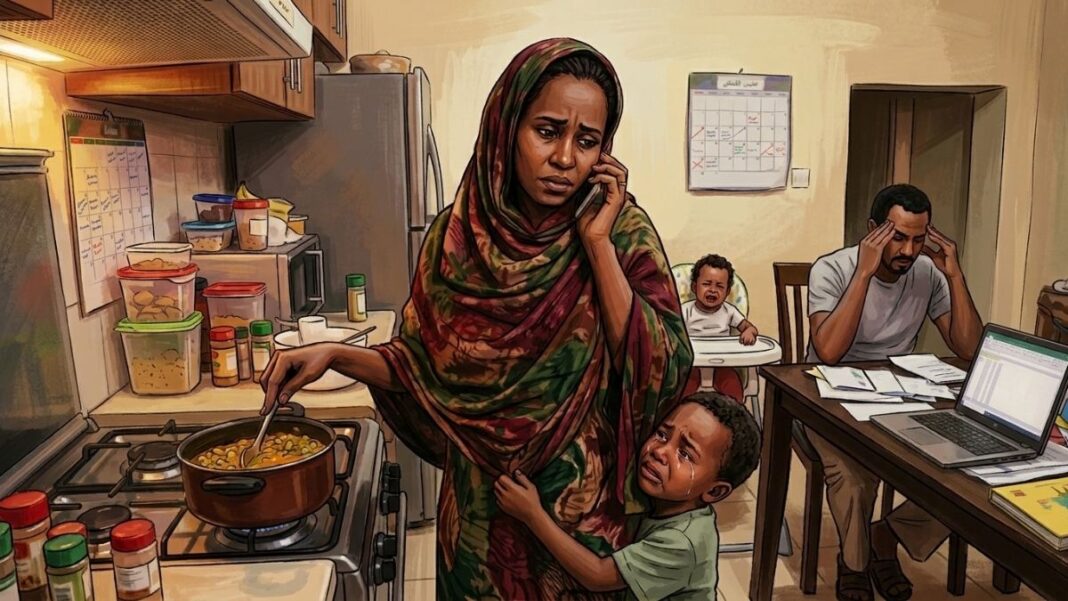
This question is asked of both men and women, whether posed as a question or made as a statement. It was recently highlighted in Sudan’s War Has Made Women More Vulnerable — and Men Less Accountable, a personal opinion article written by Hala Mousa and published on The Sudanist. More recently, I heard the same sentiment in Egypt, from Sudanese people who said they had also heard it from Egyptians.
An Egyptian Uber driver asked my brother-in-law, “Why don’t Sudanese men work as hard as their women? They do so much while the men just sit at home?”
The question itself reflects an assumption that Sudanese men are less willing to work than Sudanese women. But what may look like a difference in work ethic can also be a difference in access to employment.
Having said that, it is important to note that Sudanese women have always played significant and vital roles in Sudanese society. They have long been recognised for their hard work, leadership and strength. Sudanese women have historically held prominent roles, famously represented by the ancient Nubian queens known as Kandakas.
Since the early 1900s, even before Sudan gained independence in 1956, Sudanese women have fought for their rights and demanded social and political equality. Since the 1950s, Sudanese women have been pioneers in fields including education, science, politics and activism. In fact, Sudan has a long history of “female firsts”. The country had one of the earliest and most active women’s movements in the Middle East and North Africa (MENA) region during the 1960s and 1970s. Sudan was also among the first countries in the region to have a female parliamentarian, judge, television presenter, police officer and more.
Yet, the fight for women’s rights in Sudan continues. Women such as Khalda Zahir, Fatima Ibrahim and Fatima Abdel Mahmoud will be remembered for generations for breaking barriers and achieving historic firsts, both in Sudan and in the wider region.
In Egypt today, there is a perception that Sudanese women work more, and harder, than men. Some attribute this to women finding it easier to access employment. But the apparent difference in employment between Sudanese men and women in Egypt cannot simply be explained by a difference in willingness to work. Legal restrictions, access to employment, the types of work available, economic circumstances and the ability to work from home all play a role. Many displaced Sudanese in Egypt face restrictions on employment depending on their visa or residency status. As a result, for some Sudanese, working from home has become one of the few available options for earning an income.
Many Sudanese have turned to home-based businesses to support themselves. Women can perform various types of work from or at home, including cooking, baking, cleaning, henna, hairdressing, making accessories, and producing bakhoor, dilka and other beauty products – work that has traditionally been associated with women. These are only some of the ways Sudanese women are earning an income. They are not the limits of what Sudanese women are capable of doing.
Men and women can also face restrictions on taking up employment outside the home because of their residency status, including informal work such as driving for Uber or other ride-hailing services, food delivery and courier work. These may be low-income jobs, but they can provide relatively quick and accessible sources of income, which many people rely on. Many Sudanese who made their way to Egypt simply do not have the means to do much more.
When formal employment is not an option, people may have to resort to informal work, home businesses, freelance or remote work, and domestic and care work. Among them are people who were doctors, pharmacists, teachers, professors, lawyers and engineers – highly educated professionals whose careers have been disrupted by war, displacement and unemployment.
The war did not just displace people geographically – more than 12 million people have been displaced within and outside Sudan, including an estimated 1.2 to 1.5 million Sudanese who have sought refuge in Egypt. It displaced people in every sense of the word. It destroyed livelihoods, taking away people’s homes, jobs, businesses, savings and professional networks – and, perhaps most importantly, documents and qualifications that can be essential to rebuilding a career in a new country.
But people do not have to be limited to these types of work. The internet and the wider online world have opened up opportunities to work remotely through freelance or contract work. Teaching, writing, sales, marketing, technology and many other fields can now be done from almost anywhere.
The skills people had before the war did not disappear because they crossed a border. The challenge is now finding a way to use those skills in a new environment.
People with the right skills and experience can seek remote roles ranging from software engineering and data analysis to sales, translation, copywriting and business development. Many Sudanese influencers, both male and female, who are now based in Egypt are using social media and digital marketing to generate income. Fitness trainers and health coaches are using social media to expand their reach and book sessions online, while life coaches and therapists are also using online platforms to find clients and hold sessions remotely.
The online world offers many opportunities for those unable to find full-time employment, once they know how to access and use them. Most things do not come easily, but with the right skills, effort and goals, it is possible to build an income or career outside the traditional workplace.
Working from home can open many doors, particularly when people learn how to tap into the online world. It is vast and offers countless opportunities, but the challenge for many is knowing where to look, how to access those opportunities and how to turn their existing skills into an income. Sometimes, people simply need to be shown the door and given the tools to walk through it.
It is also important to note that some Sudanese, both men and women, with residency permits that allow them to work have established businesses ranging from schools and beauty salons to fashion stores, cafés and restaurants. In doing so, they have also created employment opportunities for other Sudanese to earn a living.
Whether men or women, Sudanese people today cannot afford to be jobless. Many are trying to earn a living after losing almost everything. They have had to restart from scratch, take whatever work they can find or settle for jobs they never imagined doing simply to get by. Some are not looking for a handout; they are simply looking for someone to give them a chance or an opportunity. Some do not have the skills, while others have the skills but do not know how to put them to use. They are asking for a chance – an employer willing to look beyond their circumstances, someone willing to recognise their skills, or simply someone willing to show them where an opportunity exists.

Ola Diab is the new founder and editor of 500 Words Magazine, and the deputy editor of Marhaba Information Guide, Qatar’s premier information guide. Based in Qatar, the Sudanese journalist graduated from Northwestern University in Qatar (NU-Q) in 2012 with a Bachelor of Science in Journalism and has since built a successful career in the print and digital media industry in Qatar. Find her on X (formerly Twitter) @therealoladiab or on LinkedIn.