


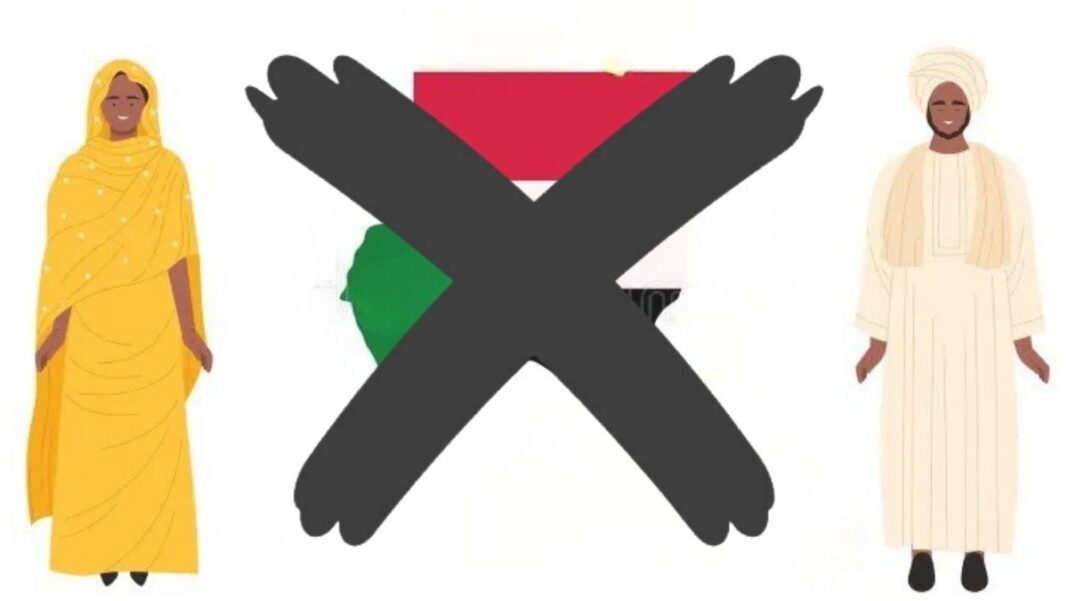
For as long as I can remember, whenever a Sudanese person behaves in a non-Sudanese manner, whatever that means or entails, we are quick to declare that they are not Sudanese, almost as though it were an established fact.
By ‘non-Sudanese’, we mean anything that falls outside what we consider acceptable Sudanese norms. Anyone who behaves outside these norms or does something deemed taboo is immediately regarded as non-Sudanese. Anyone or anything eccentric, unconventional, odd or peculiar, or perceived as deviating from established social norms, is met with disapproval, rejection, judgement and scrutiny.
As a Sudanese society, we tend to think, act, judge and function collectively. We place considerable value on conformity and shared identity, often leaving little room for individualism, independence or self-expression. Individuality and uniqueness are rarely embraced or celebrated; instead, they are often viewed with suspicion or frowned upon.
We see this play out in everyday life, from casual conversations to social media, across both social and political discourse. A recent example is the Arabic reality dating show Quwet El Hob (Power of Love), featuring Rim, a 21-year-old Sudanese woman and one of the first Sudanese participants in a reality dating show. Like many of the other female contestants from Morocco, Tunisia, Egypt, Syria and Lebanon, she has tattoos, dresses less modestly and is openly affectionate with her Lebanese-Palestinian match, Khalid. In response, many Sudanese social media users have resorted to insisting that ‘she is not Sudanese’, seemingly convinced of this because they find it inconceivable that a Sudanese woman would appear on such a show, or dress and behave in such a manner.
We see this rhetoric used by Sudanese people since the war began in April 2023, with many repeatedly referring to the paramilitary Rapid Support Forces (RSF), led by Mohamed Hamdan Dagalo (Hemedti), as non-Sudanese because of their brutal and violent attacks against the Sudanese people. This is often accompanied by claims that the RSF are originally from Chad, stemming in part from the widespread belief that Hemedti himself is an outsider and has origins in the neighbouring country.
While these claims may be true or have some basis, they do not change the fact that the majority of RSF fighters are, in fact, Sudanese. The RSF evolved from the Darfur-based Janjaweed militias that emerged in the early 2000s. Its commander, Hemedti, and a significant portion of its core fighters belong to Arab, semi-nomadic tribes, including the Rizeigat of Darfur, whose members are native Sudanese citizens. Born in Darfur around 1973/74, Hemedti’s family and clan are part of the Mahariya branch of the Rizeigat and have historically inhabited the borderlands between Chad and Darfur. Some reports have noted that his family or clan had connections to Chad before settling or living in Darfur. (Sources: Al Jazeera English, The Guardian)
Given that the Rizeigat and other Arab and Sahelian nomadic communities have historically moved across territories that now span Sudan, Chad, Niger, Libya, Mali and the Central African Republic (CAR), some RSF members have familial and historical ties extending beyond Sudan’s present-day borders.
At the same time, investigative reports and UN monitoring have documented the RSF’s recruitment of fighters and mercenaries from neighbouring countries, including Chad and South Sudan, as well as from further afield, such as Colombia, to reinforce its ranks during the ongoing war. While the force includes foreign fighters and mercenaries, they represent only a portion of its overall membership.
An individual’s or a group’s thoughts, beliefs and actions do not always have to be defined by their nationality. They can be independent, deeply personal and entirely subjective. Even within the same country, people grow up in different environments, have different experiences and are shaped by different influences, all of which contribute to their individual identities, ways of thinking and behaviour.
This way of thinking is not only contradictory but also arrogant, as though we, as Sudanese, are somehow incapable of being flawed. The reality is that we are far from perfect, and our history, if anything, has repeatedly demonstrated that. We should be able to acknowledge our own shortcomings without feeling that they diminish who we are as a people.
There is nothing wrong with being proud of who we are, how we live and what we stand for. Our identity, culture and traditions, including our values around modesty and conservatism, are worth appreciating and celebrating. But why can we not also accept that some Sudanese people may behave in ways that fall outside our social norms and what we collectively consider acceptable, and still be Sudanese? We do not all have to think, behave or live in the same way to share a national identity. Being Sudanese does not mean having to conform to one uniform way of thinking, behaving or existing. There is room for individuality, difference and diversity within our shared identity.

Ola Diab is the new founder and editor of 500 Words Magazine, and the deputy editor of Marhaba Information Guide, Qatar’s premier information guide. Based in Qatar, the Sudanese journalist graduated from Northwestern University in Qatar (NU-Q) in 2012 with a Bachelor of Science in Journalism and has since built a successful career in the print and digital media industry in Qatar. Find her on X (formerly Twitter) @therealoladiab or on LinkedIn.