On 30 April 2026, 14 people were killed and 16 injured in a major bus collision on the Western Khartoum–Madani Road near Al Hilaliya station. This tragic event is one of the deadliest traffic accidents in Sudan so far in 2026 and highlights a serious, often overlooked road safety crisis in the country.
When The Sudanist published the news about this tragic accident, one of our readers commented on our Instagram page, “What’s sadder then this accident is absolutely nothing will be done to prevent the next one.”
Sudan has one of the highest traffic fatality rates in the world: an estimated 26.8 deaths per 100,000 people (2019), or over 36 per 100,000 in adjusted estimates, placing it among the top 30–35 countries for road deaths. Road traffic accidents are a leading cause of death for people aged 21–60, accounting for 61% of fatalities in that group. The fatality rate is about 35 deaths per 10,000 vehicles, with annual deaths often exceeding 11,000 despite low vehicle ownership (roughly 1 vehicle per 100 people), indicating very high risk per vehicle. Pedestrians account for over 40% of casualties, followed by vehicle collisions and rollovers.
Sudan has lost some of its greatest cultural icons to road accidents, including prominent Qur’an reciter Sheikh Noreen Muhammad Siddiq, singer Nadir Khidir, and members of the once-popular Firqat Al Sahwa (Al Sahwa Band). Many victims were taken far too young, including children, teens, and young adults, underscoring the human toll of fatal road crashes.
The high accident rate is primarily attributed to reckless driving, poor infrastructure and road conditions, and weak enforcement or lack of compliance with safety measures, including speed limits and seatbelts. Although reckless/careless driving is a huge factor in traffic accidents in Sudan, poor road conditions and infrastructure, as well as a lack of or weak traffic law enforcement, play an even more major role in traffic accidents and traffic accident fatalities.
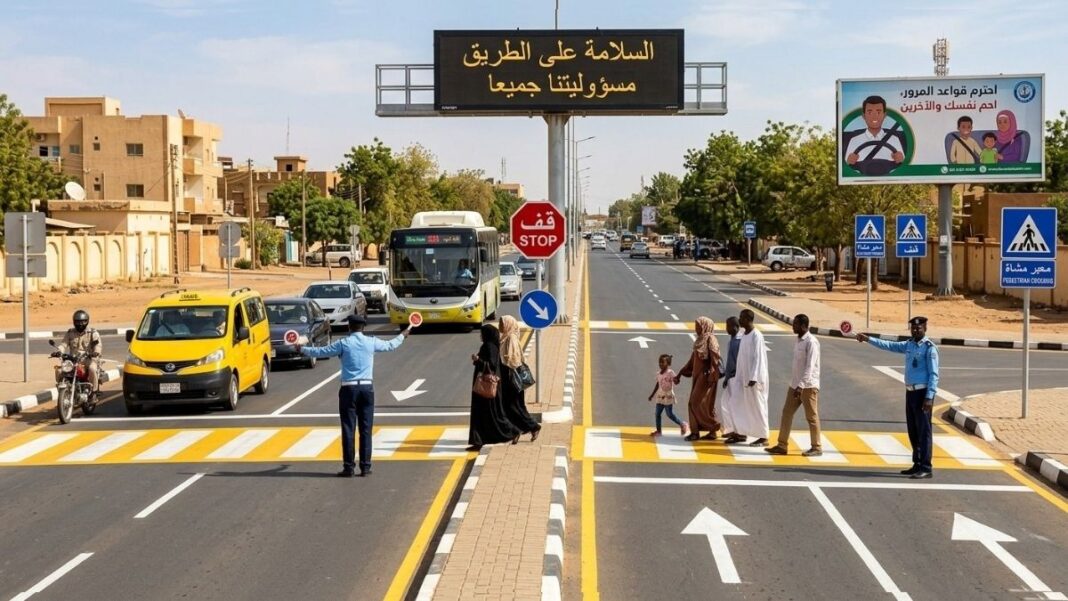
Sudan has one of the poorest road infrastructures in the world, with a lack of asphalted roads/streets, widespread potholes, weak foundational layers, poor drainage, substandard materials, and insufficient maintenance. The absence of clear signage, proper lane markings, safe, sustainable design, and proactive maintenance to ensure long-term functionality and reduce accidents — all contribute to the high traffic accident and traffic accident fatality rates. Annual heavy rains have further damaged parts of the country’s road network.
Moreover, major roads linking several states have also been affected or even damaged in recent years (since 2023) by ongoing clashes between the Sudanese Armed Forces (SAF) and Rapid Support Forces (RSF). These conflicts have further degraded a transportation network already suffering from poor foundational layers, substandard materials, and a lack of proactive maintenance.
As Sudan begins to rebuild from the damages caused by the ongoing war in Sudan, the restoration of the country’s road network must be treated as a critical humanitarian and developmental priority. Roads need to be improved and properly asphalted roads/streets need to be widespread, reducing the chances of potholes, weak foundational layers, poor drainage, and substandard materials. Clear signage, proper lane markings, and proactive maintenance are essential to ensure long-term functionality and reduce accidents. Roads need to be designed and built with safety — and sustainability — in mind to ensure traffic accidents and traffic accident fatality rates are massively reduced.
Once proper road infrastructure is established, strict traffic laws and regulations must be implemented to ensure everyone abides by the rules for their own safety and the safety of others. Only once road infrastructure and traffic laws provide safety and security will drivers be wary of their conduct and commit to driving safely.
An average Sudanese person is faced with many challenges and various life-threatening issues such as the current war and its impact, widespread disease and hunger. Being on the road, whether as a driver or passenger, should not be an additional challenge and threat to the lives of Sudanese people in Sudan. Roads and public transportation are meant to be passageways delivering people to their desired destinations, whether they are returning home, seeing family and friends, or seeking employment and education, but death is never the desired destination.
Sources: The Global Academy, Science Direct

Ola Diab is the new founder and editor of 500 Words Magazine, and the deputy editor of Marhaba Information Guide, Qatar’s premier information guide. Based in Qatar, the Sudanese journalist graduated from Northwestern University in Qatar (NU-Q) in 2012 with a Bachelor of Science in Journalism and has since built a successful career in the print and digital media industry in Qatar. Find her on X (formerly Twitter) @therealoladiab or on LinkedIn.