


Before the war in Sudan began in April 2023, the country’s population was estimated at approximately 45 to 46 million. Since then, Sudan has faced a massive humanitarian crisis, with nearly 11 to 15 million people displaced, including over 4 million who have fled to neighbouring countries such as Chad, South Sudan, and Egypt. This conflict between the Sudanese Armed Forces (SAF) and the Rapid Support Forces (RSF), which began in April 2023, has created one of the world’s most severe and largest humanitarian crises.
Sudan, however, has long struggled with political and economic instability, which has historically led to the migration of at least one million people. In most cases, Sudanese left the country due to forced migration or displacement, commonly moving to the US, the UK, Canada, Australia, and GCC countries such as Saudi Arabia, the UAE, and Qatar.
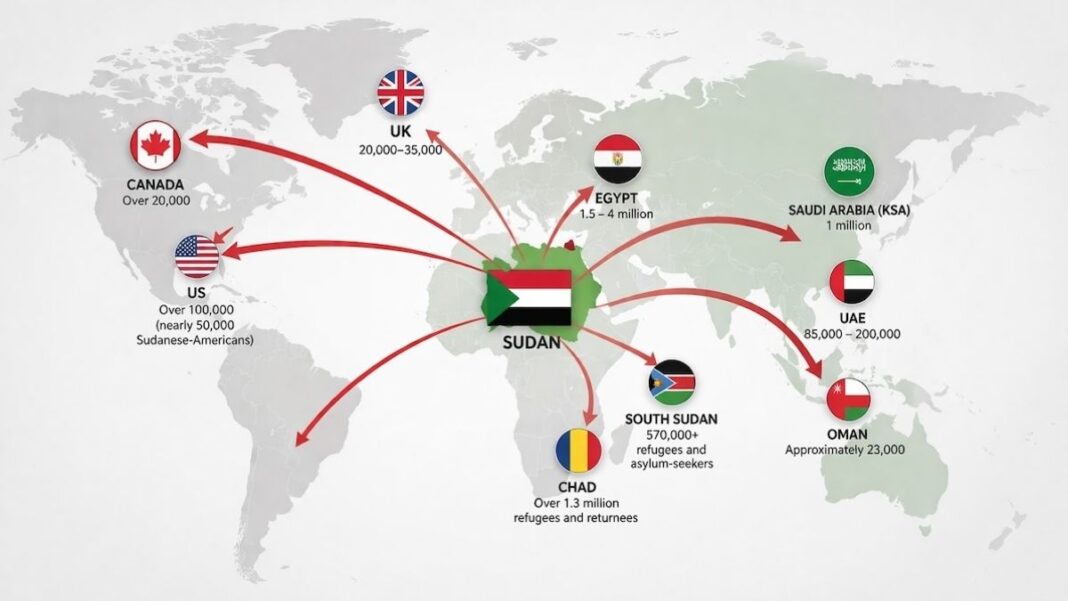
Today, over 5 million Sudanese live outside Sudan, either by choice or as a result of displacement. The largest Sudanese population abroad resides in Egypt, with over 1 million, followed by nearly one million in Saudi Arabia.
🌍 Middle East
The Middle East hosts the largest concentration of Sudanese living abroad, with Saudi Arabia accounting for the largest Sudanese population in the GCC and one of the largest globally. As of early 2026, approximately 1.1 million Sudanese nationals reside in GCC countries, making them one of the region’s largest expatriate communities.
- Saudi Arabia (KSA) – Estimates vary between approximately 500,000 and 1 million Sudanese, constituting one of the larger expatriate communities in the kingdom, roughly 6% of Saudi Arabia’s population. It remains one of the largest Sudanese populations abroad, with long-standing migration ties.
- United Arab Emirates (UAE) – An estimated 85,000 to 200,000 Sudanese nationals.
- Qatar – An estimated 50,000 to 60,000 Sudanese, making them one of the largest expatriate communities in the country.
- Kuwait – Over 50,000 Sudanese, representing a significant expatriate population in the country.
Bahrain – Approximately 14,000 Sudanese, representing a smaller segment of the expat population in the country. - Oman – Approximately 23,000 Sudanese, a number that increased significantly following the war.
🌍 Africa
Most African countries, including Sudan, host significant refugee populations. Countries such as Chad and the Central African Republic (CAR) were already accommodating Sudanese refugees in camps due to pre-war civil crises, and are now hosting even more Sudanese refugees following the 2023 conflict. Before the war, Sudan itself hosted over 890,000 refugees and asylum-seekers, primarily from South Sudan, Ethiopia, Eritrea, the Central African Republic (CAR), and Syria.
- Egypt – Hosts an estimated 1.5 to over 4 million Sudanese nationals, making it the largest host country for those fleeing the war in Sudan. Prior to the conflict, Egypt was already home to over one million Sudanese, with an additional one million arriving after the war began. While 1.5 million is often cited, some estimates, including pre-war residents, place the total Sudanese population as high as 4 million. Egypt remains a major destination due to its geographic proximity and cultural ties.
- South Sudan – Formerly part of Sudan until its secession in 2011, South Sudan currently hosts over 570,000 registered Sudanese refugees and asylum-seekers. Since April 2023, more than 810,000 people have crossed from Sudan, including returning South Sudanese nationals. Movement between the two countries remains significant.
- Ethiopia – Estimates vary, with reports ranging from at least 31,000 to over 60,000 Sudanese, most of whom are refugees.
- Chad – Hosts over 1.3 million Sudanese refugees and returnees, driven by the conflict in Darfur (since 2003). Since April 2023, over 900,000 new arrivals have further strained resources, particularly in the eastern region, where one in 14 people is now a refugee.
- Central African Republic (CAR) – Hosts 30,000 to 60,000 Sudanese refugees fleeing the war, primarily concentrated in the northern Vakaga prefecture around Birao, placing significant pressure on local resources.
- Uganda – Hosts a large population of Sudanese refugees, with over 100,000 from Sudan and more than 1 million from South Sudan, totaling over half of Uganda’s nearly 2 million refugees. Most reside in northern, rural, and urban settlements, with thousands continuing to arrive in 2025.
- Rwanda – Hosts a small but growing population of Sudanese refugees and asylum-seekers, currently estimated at over 1,000.
- Libya – Hosts between 412,000 and 500,000 Sudanese, mostly refugees and asylum-seekers, concentrated primarily in the city of Kufra.
- Morocco – Hosts over 3,000 Sudanese, a population that has grown significantly since the war began. Many are new asylum seekers arriving from Libya or directly seeking passage to Europe, with increasing numbers attempting sea crossings to Italy from Morocco and Tunisia.
- Tunisia – Nearly 4,000 Sudanese refugees and asylum-seekers reside in Tunisia. Many are arriving from Libya or seeking passage to Europe, including sea crossings to Italy.
🌍 Europe
Sudanese migration in Europe is highly concentrated in Northern and Western Europe, driven primarily by humanitarian migration and access to protection systems. The United Kingdom (UK) has emerged as the main center of settlement and asylum, while Switzerland, Finland, Malta, Belgium, and Austria host notable but smaller communities. In Southern, Central, and Eastern Europe, including Spain, Greece, Poland, Portugal, Romania, Czechia, and Hungary, Sudanese populations remain limited, and Baltic and smaller European states host very few.
- United Kingdom (UK) – Approximately 20,000–35,000 Sudanese-born people reside in the UK, with significant concentrations in London and regional hubs such as Birmingham. Many are refugees and asylum seekers, with over 18,000 seeking asylum in the last five years. The Sudanese-British community is one of the most established Sudanese diasporas in Europe.
- France – Around 35,000 Sudanese, primarily refugees and asylum seekers fleeing conflict, particularly from Darfur and the ongoing war. They constitute a notable portion of migrants in northern French transit camps, such as Calais, with many aiming to reach the UK. The community has grown significantly, from fewer than 1,000 in 1990 to tens of thousands today.
- Italy – Over 30,000 Sudanese. Migration has increased sharply due to the war, with many arriving via Mediterranean routes, peaking in late 2023 and 2025. By late 2025, Sudanese migrants accounted for 31% of over 12,000 recorded Mediterranean arrivals in Italy, many being young men seeking asylum after traversing Libya.
- Ireland – Over 20,000 Sudanese, most of whom are medical professionals. They are supported by the Sudanese Association of Ireland, a registered community organisation founded in 2015.
- Germany – Approximately 8,500–11,000 Sudanese, with major concentrations in cities such as Berlin, Frankfurt, Hamburg, and Kamen. The community includes refugees, asylum seekers, and expatriates, and has grown due to the ongoing war.
- Sweden – Over 8,372 Sudanese, representing a small fraction of the country’s foreign-born population. The community includes individuals who migrated for work, family reunification, or humanitarian reasons.
- Netherlands – Over 7,700 Sudanese, including refugees and migrants, with recent asylum requests recorded between 2023 and 2024, particularly following the war.
- Norway – Over 7,600 Sudanese, including approximately 5,606 immigrants and 1,996 residents born in Norway to Sudanese parents. Many are refugees, particularly from Darfur, and the community continues to grow, including students and asylum seekers.
🌍 North America
- The United States (US/USA) – The combined Sudanese and South Sudanese population in the US is estimated at over 100,000, with significant communities concentrated in Nebraska, Virginia, Texas, California, and Minnesota. Major hubs include Omaha, which hosts a large South Sudanese refugee population, as well as Dallas, Alexandria, and cities in Arizona. The community is diverse, including refugees, professionals, and naturalised citizens, with nearly 50,000 holding US citizenship.
- Canada – Over 20,000 Sudanese reside primarily in Ontario and Alberta, including cities such as Toronto and Calgary. Due to the ongoing war in Sudan, Canada introduced special measures in 2025 to resettle thousands more through family reunification and refugee programmes.
🌍 Australia
- Australia – Estimates range from 16,000 to 50,000 Sudanese, while broader figures suggest over 130,000 people of Sudanese ancestry reside in the country. Some statistics may overlap between Sudanese and South Sudanese populations due to migration timing around South Sudan’s 2011 independence. The community primarily arrived through humanitarian programs and is concentrated in Victoria, Sydney, and Perth, with a particularly large Sudanese and South Sudanese population in Melbourne. Many Sudanese-Australians are of Coptic background.
- New Zealand – Over 500 Sudanese reside in New Zealand, though numbers may overlap between Sudanese and South Sudanese populations. Most arrived as former refugees, often resettled via Kenya’s Kakuma Refugee Camp.
Note: These figures are estimates and should not be considered exact. They have been compiled using Google’s AI-powered search tools.


Thank you for this — the most comprehensive mapping of the Sudanese diaspora I’ve seen in one place.
I’m Sudanese, based in Dubai, and I recently registered a company in Rwanda called Masarat Talent Limited, trading as BridgeWork Africa. The premise is simple: Africa doesn’t have a talent problem — it has an access problem. BridgeWork connects displaced Sudanese and African professionals with remote work opportunities in the GCC and Europe, covering CV preparation, job matching, and end-to-end placement support.
Your data is striking. Over 5 million Sudanese abroad, 1.1 million in the GCC alone, 4 million in Egypt — and almost no structured pathway for those professionals to access the global remote work market. That is exactly the gap BridgeWork is built to close.
I would love to connect with anyone in your network who:
— Works with Sudanese professionals in Egypt, Uganda, Rwanda, or the UAE
— Has experience placing refugees or displaced talent into remote roles
— Knows of active pipelines, NGO partnerships, or community organisations supporting employment for Sudanese nationals abroad
Any leads, introductions, or even conversations would be genuinely valuable at this stage. You can reach me at [email protected]
Keep doing this work — it matters.
Sudan