


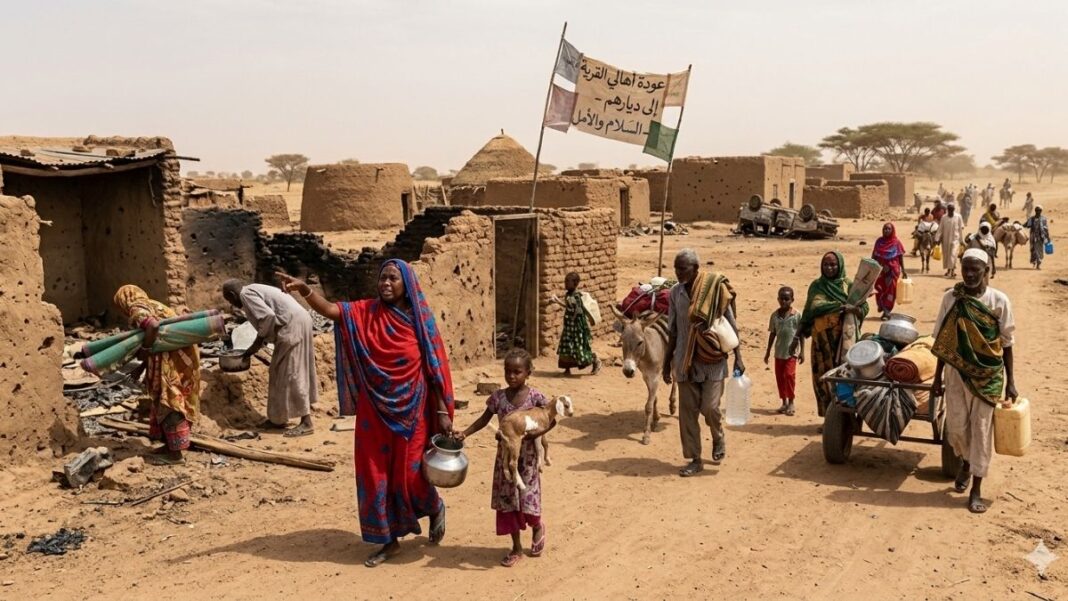
Three years into the war in Sudan, nearly 4 million people have returned across the country, the International Organization for Migration (IOM) announced on 21 April 2026.
Approximately 3.99 million people have returned to their areas of origin after fleeing, with most concentrated in the capital, Khartoum, and neighbouring Al Gezira State. These returns have been largely driven by improved security conditions in some areas.
“Many are returning because they believe security has improved,” said the IOM’s Deputy Director General, Sung Ah Lee. “Others are returning because life in displacement has become unbearable.”
This follows an earlier IOM announcement in January 2026 that more than 3.3 million Sudanese, both internally and externally displaced, returned to their homes across nine states in November 2025.
Earlier this year, Khartoum International Airport reopened, and Sudan Airways resumed operations, offering both domestic and international flights. The IOM also indicated that more than 2 million additional people are expected to return to Khartoum alone in 2026.
However, many are returning to areas where homes and critical infrastructure, including water, healthcare, and electricity, have been heavily damaged. Without urgent investment to restore essential services, rebuild infrastructure, and revive livelihoods, these returns risk becoming unsustainable.
The war in Sudan began on 15 April 2023 between the Sudanese Armed Forces (SAF) and the paramilitary Rapid Support Forces, resulting in the displacement of between 12 and 14 million people and the deaths of more than 150,000. Sudan is now facing the world’s largest displacement crisis and one of its worst humanitarian crises.
Of the country’s 18 states, the RSF controls all five states in the western Darfur region, except for parts of North Darfurthat remain under army control. The SAF holds most areas across the remaining 13 states, including the capital, Khartoum.
More than 4.5 million people have crossed into neighbouring countries, primarily Egypt, South Sudan, and Chad, while nearly nine million remain internally displaced.
“Host communities across eastern and northern Sudan, including Kassala, Gedaref, Red Sea, Northern, and River Nile states, have carried much of this burden, welcoming displaced families while already facing economic hardship and climate-related pressures,” said Lee. “This has stretched the available infrastructure almost to the limit.”
In Khartoum, rising returns have placed additional strain on war-damaged urban infrastructure. In Al Gezira, a major agricultural region, returnees are encountering levels of destruction that may jeopardise their ability to grow food.
“Farmers are returning to fields where irrigation systems and equipment have been damaged,” Lee said, “threatening livelihoods and food production at a critical moment for the country.”
While the humanitarian response remains severely underfunded, she warned that “without urgent investment to restore essential services, rebuild infrastructure, and revive livelihoods, safe and sustainable returns are at serious risk.”
For more information, visit iom.int/news/4-million-returns-sudan-risk-amid-fragile-conditions-iom-warns.
Ongoing Concerns and Struggles
- Hunger remains widespread with over 21 million in acute hunger, from Khartoum to Al Gezira to Darfur.
- Water and electricity services are only slowly returning.
- Internet and telecommunications remain unstable.
- Healthcare services are severely limited across the country.
- Damaged education infrastructure has led to three years of disruption, with an estimated 8 to 17 million school-aged children out of school. Since April 2023, nearly 500 days of learning have been lost, with 54% of schools either in conflict zones or used as shelters.
- Access to basic goods (groceries, household necessities) remains inconsistent.
- Disease (cholera, dengue fever, malaria, etc).
- Burglary, theft and robbery.
- Recovering lost, damaged or stolen property.
- Uncovered and active military mines, along with unexploded ordnance (UXO).
- Thousands of bodies continue to be recovered from streets, homes, and makeshift graves across Sudan, particularly in Khartoum and Darfur – over 15,000 bodies have been exhumed in recent months.
- Rape and sexual violence – over 4,000 reported cases of sexual violence affecting men and women, and children (boys and girls) as young as one year old.