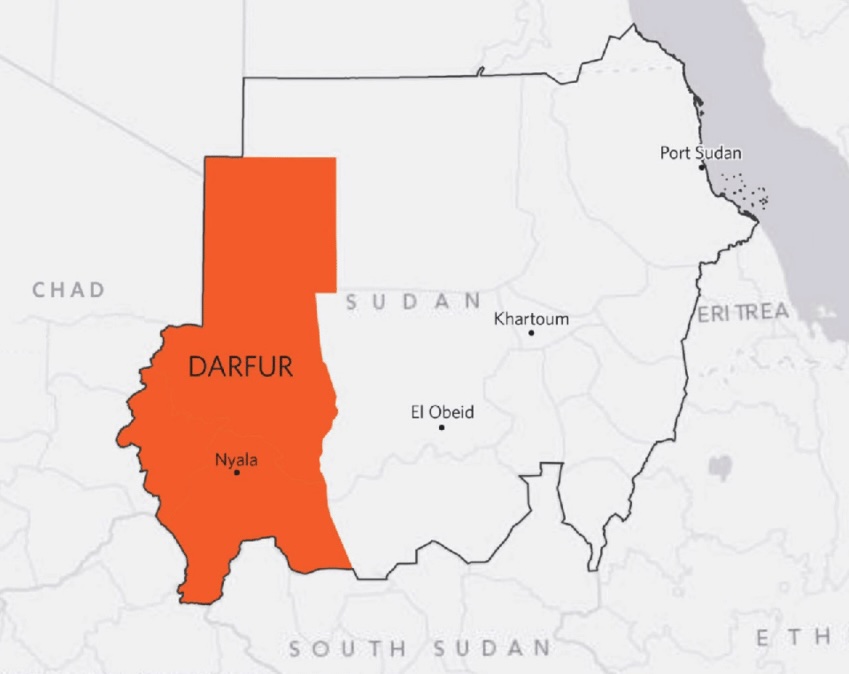
After more than two years of ongoing war, global attention has finally turned to Sudan, specifically to Al Fasher in North Darfur, where the Rapid Support Forces (RSF) has imposed a full siege and is committing atrocities: ethnic cleansing, torture, starvation, and the killing of civilians, including women and children. This intensified assault began after the Sudanese Armed Forces (SAF) withdrew from the area on 28 October 2025.
“All eyes are on Darfur. But what about the rest of Sudan?” These are the questions many Sudanese are asking now that the world has finally begun paying attention to Sudan. And while this attention is focused almost entirely on Al Fasher and the wider Darfur region, and rightly so, it often overlooks the reality that what is happening there is an extension of more than two years of violence across the country. Many now ask: where was the world when the RSF and SAF began fighting in Khartoum on 15 April 2023, before the conflict spread to Wad Madani and beyond?
But these are not the questions I seek to answer. Instead, I turn the table and ask a different one: where were the rest of the Sudanese people and the world when Darfur, Kordofan, and other marginalised regions endured the same suffering for decades?
This sentiment has been echoed by many Sudanese from marginalised regions, particularly western and southern Sudan, who say that people in Khartoum and northern Sudan have long turned a blind eye to their suffering. For years, places like Darfur, Kordofan, and what is now South Sudan endured devastation while the rest of the country looked away. That feeling is even stronger today because, to them, the people of Khartoum and the north are only now experiencing what those in the west and south have faced for years, even decades: disrupted lives and livelihoods, death, displacement, sexual violence, and the absence of healthcare, food, water, and safety. When the fighting reached Khartoum in April 2023, it triggered the world’s largest displacement crisis, uprooting 12 to 14 million people and killing more than 150,000.
In light of the RSF’s recent attack on Al Fasher, Sudanese-American stand-up comedian, writer, and researcher Samir Abdul – who is based in Chicago and is originally from Darfur, as well as a survivor of the Darfur War (2003–2021) – shared a video on social media reflecting on the violence in his hometown. In the video, posted on 3 November 2025, he said: “It’s nice that the world is talking about what’s happening in Sudan. But the crazy thing is, it literally took drone footage of people dying for the world to be like, ‘Maybe something is not right.’ People say what is happening in Sudan is a civil war. It’s not a civil war. It’s a proxy war that has been happening for 20 years. It is sponsored and funded by the UAE. In the early 2000s, it was happening only in the Darfur area, and when it was happening there, the rest of the capital was pretty quiet, you know, because it wasn’t affecting them. Now, this affects everyone — so now, everyone is talking about it, which is beautiful.”
The words that resonated with me most were when Abdul said, “In the early 2000s, it was happening only in the Darfur area, and when it was happening there, the rest of the capital was pretty quiet… because it wasn’t affecting them.” And that is painfully true. The RSF destroying Sudan today is the same Janjaweed that committed atrocities in Darfur, Kordofan, and the former South Sudan for decades.
Now, just as the world’s eyes are fixed on Al Fasher, so too are the eyes of the people of Khartoum, for the very first time. Only now, through the devastation of the ongoing war, are many beginning to understand the suffering that the people of Darfur have endured for years. Even before the current war, Khartoum briefly glimpsed the ferociousness of the RSF or Janjaweed militia, and what Darfur had endured for years during the Khartoum Massacre on 3 June 2019. During the 2018–19 revolution, the RSF, alongside the SAF, violently dispersed peaceful protesters staging a months-long sit-in at the army headquarters known as Al Qeyada, killing more than 100 civilians. It was a moment that exposed the brutality long familiar to Darfur, now unfolding in the heart of the capital.
The painful truth is that we do not see ourselves as one people. The roots of Sudan’s political, economic, and social conflicts have long stemmed from tribalism and racism. For decades, leaders have divided Sudanese based on ethnicity and tribes instead of uniting them, and as a result, we have never formed a cohesive national identity. We inherited the discriminatory ideologies of past governments and regimes, internalising them until they became part of how we see one another. We take pride in our identities, but the pride is selective, sometimes even within our own communities.
The atrocities the RSF is committing today in Al Fasher are a devastating reflection of this discriminatory ideology. Their current campaign of ethnic cleansing and genocide in Al Fasher has primarily targeted non-Arab groups, especially the Masalit and Zaghawa. Sudan’s population is incredibly diverse, roughly 70% Arab and 30% African, including numerous Indigenous peoples such as the Fur, Beja, Nuba, and Fallata. Within the broader “Arab Sudanese” identity are multiple sub-groups, while across Sudan there are over 500 African ethnic groups.
Darfur itself is home to the Fur (the largest group and the region’s namesake), alongside Arab Baggara tribes like the Rizeigat, Habbaniya, Beni Halba, and Ta’isha, and non-Arab groups such as the Masalit and Zaghawa. These communities have rich, distinct cultures, and have also been placed at the centre of decades of conflict. The RSF, largely from Arab Baggara tribes such as the Rizeigat, are the perpetrators of systematic violence against non-Arab ethnic groups in Darfur. As Abdul said, this is renewed ethnic cleansing has been taking place for years, especially under the regime of the former Sudanese President Omar Al Bashir, who encouraged Mohammad Hamdan Dagalo (Hemedti), the leader of the RSF, and his militia, the RSF or Janjaweed, to commit heinous acts in the Darfur War until a comprehensive peace agreement was signed on 31 August 2020.
The deadly “us versus them” mentality has long permeated all aspects of life in Sudan. Even with the RSF, many are quick to label its members as non-Sudanese, which is partly true, as some are nomadic men from eastern Chad, yet others are of Sudanese origin, particularly from Darfur, including members of the Rizeigat tribe, as previously mentioned.
The question of Sudanese identity has always been fraught. Some insist we are Arab. Others insist we are African. But the truth is that Sudanese are Afro-Arab — African and Arab — and we cannot deny either heritage. What we can choose, however, is how we identify within that spectrum, and whether we allow our differences to be used against us.
Khartoum and the surrounding states have long celebrated their Arab identity, often neglecting the African tribes in other regions of Sudan. This has led many in the west and south to accuse them of turning a blind eye to decades of suffering. Yet now, with the ongoing war, the people of Khartoum are experiencing, for the first time, the hardships long endured by others, and are beginning to understand the struggles of communities across Sudan. As a result, many have spoken out against the RSF’s atrocities in Al Fasher.
The hope is that once this war comes to an end – and I sincerely hope that is soon – we, as a people, will move beyond discriminating against one another based on ethnicity or tribe. Even without the support of corrupt leadership, we should come together to build a unified national identity that embraces Sudan’s rich diversity, uniting all its ethnicities, tribes, and religions. If we unite, the “us versus them” ideology will no longer harm us, instead, it will be powerless against those who choose to act against the collective interests of our people.
If you’re familiar with column writing, you know that empathy is key, as I always say. For those who have experienced suffering, empathy often comes naturally. But unfortunately, even those who have endured hardship may still lack empathy and humanity at times. History is full of examples where hurt people hurt others, and this is evident in the now independent South Sudan, which continues to struggle with the same cycles of tribalism, civil conflict, and discrimination that Sudan imposed on it for decades. Similarly, on a global scale, we have seen Israel’s actions toward Palestinians echo the horrors of Nazi Germany’s persecution of European Jews during the Holocaust from 1941 to 1945. History has a tendency to repeat itself. Yet empathy remains, and will always remain, the key to preventing these cycles and stopping people from repeating the tragedies of the past.

Ola Diab is the new founder and editor of 500 Words Magazine, and the deputy editor of Marhaba Information Guide, Qatar’s premier information guide. Based in Qatar, the Sudanese journalist graduated from Northwestern University in Qatar (NU-Q) in 2012 with a Bachelor of Science in Journalism and has since built a successful career in the print and digital media industry in Qatar. Find her on X (formerly Twitter) @therealoladiab or on LinkedIn.


