


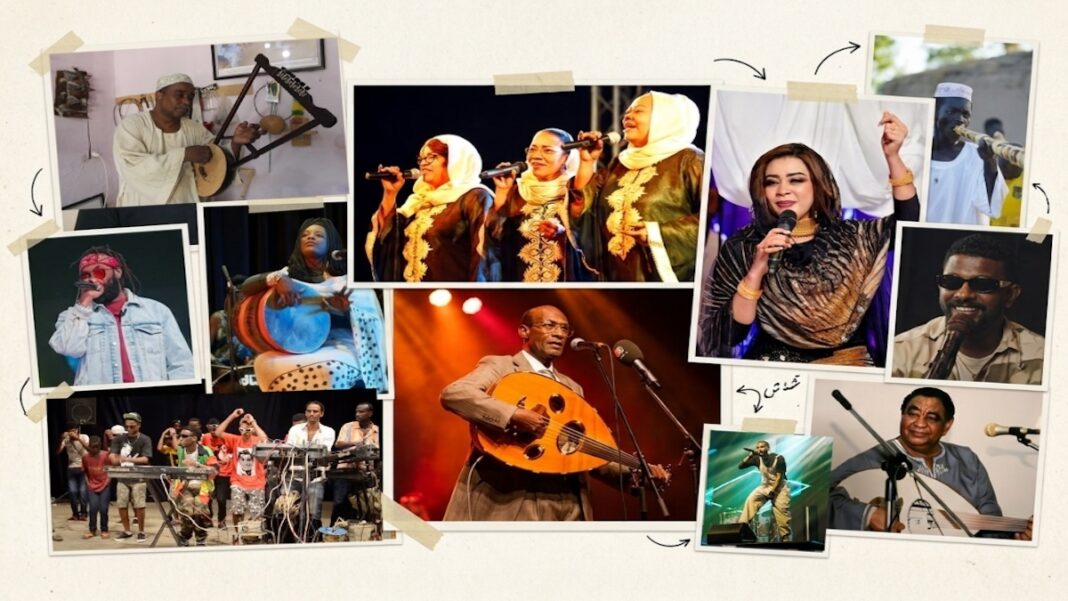
Since the birth of the Sudanese sound between the 1930s and 1940s, Sudan’s music scene witnessed a profound evolution. The sounds diversified and the music grew richer with time, with more and more musicians adding their own touch to the ever-changing Sudanese sonic identity. With the growing variety of genres and sounds, it becomes challenging to identify what sounds define Sudanese music. Despite that challenge, however, a listener can almost instantly recognise a Sudanese song, and so the question becomes: what truly makes a song Sudanese?
Sudanese music as we know it today branches into a variety of genres from traditional music with its many subgenres to contemporary music, which is dominated by Sudanese hip hop and Afrobeats. From this vast archive of genres, the one that is easiest to recognise as Sudanese is traditional music with its use of specific percussion styles – using dalouka, a Sudanese percussion instrument that is known for being rhythmic and hypnotic. What makes the music even more traditional is also the incorporation of melodies – typically using oud, flutes, or violins – in the pentatonic scale, which is known to be used in the music of several regions in East Asia and Africa.
However, is that enough to make a song Sudanese? If not, then what is the feature of a song that makes it fall into the Sudanese soundscape? Is it the Sudanese Arabic in the singing, the content of the lyrics, the melodies, or the percussion? While these characteristics contribute to the identity of a song, they are not the full definition, because the reality is: Sudanese music has never been framed by a single sound.What makes music belong to a specific country, region, culture or people may be a unique combination of many things including language, instruments, scales, rhythms, and melodies.
Sudan’s broad soundscape makes it so the term “Sudanese music” is an umbrella, rather than a single genre, encompassing diverse music forms. From the source of Sudanese music, haqeeba, a a stripped down genre that forms majority of Sudan’s classic music, to modern-age hip hop, contemporary music and Afrobeat influences, the music scene witnessed continuous hybridity and dynamicity, making change and experimentation a constant part of the music history.
As a result, many factors become deciding agents as to whether or not a song falls under the umbrella of Sudanese music. For instance, there are several Sudanese musicians, such as Sudanese-Dutch singer Ghaidaa and Sudanese-British singer Elmiene who make music, but not necessarily Sudanese music, meaning that being a Sudanese singer may not always mean the music made by them is Sudanese. On the other hand, there are Sudanese rap icons such as Altayeb Hajo, better known as TooDope, and Rotation who rap in English, but does their music qualify as hip hop in general, Sudanese hip hop, or both?. So, what is the deciding factor?
Personally, I think it becomes a matter of what the musician is telling us through their songs. When a musician releases music, their songs tell a story, often about them or their background, and it may not even be through words, but through what the song makes a listener feel, whether it is through subtle traditional sounds in the production or the use of Sudanese melodies in a rapper’s flow or the references to Sudanese culture.
If there are so many deciding factors as to whether or not a song is Sudanese, then who gets to make that decision? Is it the older generations? Qualified critics? Cultural institutions? Or, could it be the audience the song appeals to? And in that case, who is really listening to the music? Because the identity of a song reflects differently on listeners from different backgrounds.
The truth is, music does not need dalouka, oud, Arabic lyrics and pentatonic melodies to qualify as Sudanese. Maybe that is the beauty in Sudanese music, or today’s music in general; the diverse nature of its sound and the inability to put it in a neat box. Maybe a real checklist does not exist, and Sudanese music is whatever Sudanese musicians put out as long as we, as listeners, recognise a part of home in it.
Samar Bengawi is a medical student by day, and a literature and music enthusiast by night. She was born and raised in the UAE and is now based in Georgia. She is never without a cup of coffee in hand, and is always “on the go,” chasing after one hobby or another. Passion in Sudanese politics runs in her blood and she considers herself a patriot who hopes to leave a memorable mark in the world.