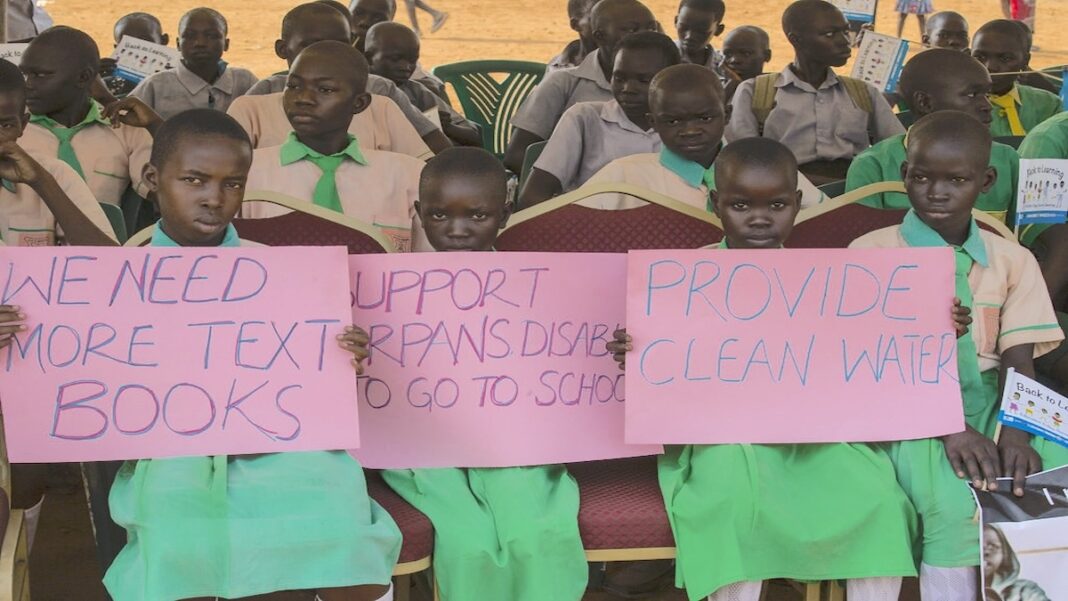
The month of February in South Sudan always marks the beginning of a new academic year for schools. However, unlike other back-to-school seasons, we used to know why children are happy to start new classes and new learning journeys. However, due to the harsh economic situation it has become a collective burden between parents and children. This back-to-school season 2026-2027 for residents of Juba, according to my observation, even at the country level, based on the online reactions, is no longer a schedule of learning, rather a ledger of loss as the government prepared its budget with inadequate fortune for education.
In the last two years, the state fund for general education has been declining from an already meagre 4.5% to 2.7% in 2024-2025 financial year to more alarming figures for the upcoming 2025-2026 cycle suggest a further drop to a microscopic 1.7% according to experts’ predictions. In this light, the message to the nation’s 2.8 million out-of-school children is not a priority for now.
To put this in regional comparison, the average for basic education in East Africa is 11.9%. While neighbouring countries are recognising that the classroom is the engine of the economy, our country is effectively dismantling its engine although still on the runway. Here, the moral betrayal can be seen obviously. The General Education Act of 2012 mandates that the government allocates at least 10% of the national budget to education. The same administration therein settled with 2.7% of the education fund.
In such situations, the burden falls on those least able to carry it: the regular citizens. Public schools, once a beacon of hope for the post-independence generation, have become another reminder for their former selves. Where parents are forced to cover indirect cost, usually called additional cost for processing and in many cases it could exceed the school fees itself. For contemporary South Sudanese families grappling under inflation and depreciation of South Sudan Pound (SSP) by over 400%, the choice between bringing something to the table for a meal and a child’s school fees is a daily moral battle.
On the other hand, the most tragic casualty of this funding crisis are the teachers. “I am a teacher by profession, but I am teaching” is a statement I usually hear from people who experienced a career shift simply because there is nobody to pay salaries. If we look at it from another angle, we can see the double dimension crisis: those qualified educators are leaving schools to work as drivers, security guards, or office assistants for NGOs. Therefore, even those children who can afford school fees will not find the professionals to teach them.
The profound loss of educators means the loss of the ability to think, innovate, and produce generations of creatives. South Sudan is witnessing a brain drain to the sheer necessity of survival.
To put in mind, investing in education is not an act of charity, it is a state’s duty and the most sophisticated security strategy a nation can employ. Children in the classroom are not the ones to be recruited into a militia and girls who finish high school, preparing for university life is a woman who will raise healthier generations.
The budget cycle of 2024-2025 must be seen for what it is: a crossroads. South Sudan can continue to map its future to pay for the mistakes of its past and specially the pre-independence period, or it can honour its laws and its children. The fund crisis is now a reality. The question now is, whether anyone in the power position or in the presidency is listening. If they are not, the silence of a generation that never learnt to read will be the loudest indictment of all.
Cover/Feature imaged image courtesy of Isaac Billy/UNMISS

Butros Nicola Bazia, born in Khartoum, Sudan in 2001, is a South Sudanese freelance writer, storyteller, and cultural commentator based in Juba, South Sudan. Nicola serves as columnist at 500 Words Magazine and contributed to multilingual regional and international platforms including The New Humanitarian, Mundo Negro, El Pais, Contemporary&, The Van-Magazine, and among others. His work explores the intersections of arts and socio-cultural dynamics, with a focus on South Sudanese narratives in the global conversations.