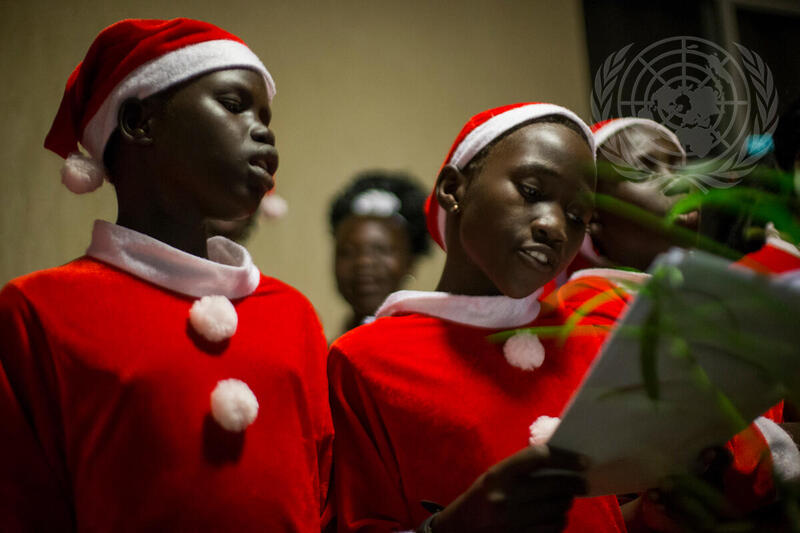

© UN/JC McIlwaine
For centuries, the Christmas season, or what is now known as the festive season in the Western world, has signaled a wave of a profound longing. Christians across the globe prepare their hearts to receive the “son of the manger,” according to the Holy Bible narrative, a tradition steeped in the warmth of liturgy and the familiar glow of the nativity.
Yet, the beauty of Christmas has never existed in a vacuum. From its very inception, the Christmas season has been framed by the shadows of the era it inhabits. In today’s world, we approach the season through the lens of modern struggle – a reality where celebration itself has become an act of quiet, defiant resistance.
Traditionally at the midnight Christmas mass, the readings from the prophetic words of Isaiah 9:6 proclaims, “For to us a child is born, to us a son is given; and the government shall be upon his shoulder, and his name shall be called Wonderful Counselor, Mighty God, Everlasting Father, Prince of Peace.” This scripture, while giving a promise of divine sovereignty, stands in stark contrast to the earthly “governments” and systems currently weighing upon the shoulders of the common South Sudanese citizen.
In our current landscape, the joyful preparations are contested by harsh mechanics of an unprecedented economic crisis. The air is thick with anxiety of a collapsing financial order. Looking at the regular South Sudanese citizen’s relationship with local banks, where liquidity issues have turned life savings into mere numbers on a screen. People gather at the banks from around 4 am just to get SSP50,000, which is less than $10. This reality made the simple act of preparing a Christmas biscuit for hospitality or purchasing modest clothes for children a strategic feat of survival.
Furthermore, the political landscape has undergone a seismic shift, the unstable power dynamic at the presidency, which started with the Vice President Riek Machar house arrest and his ongoing trial, the ever-changing people’s presence at the corridor of power have all contributed to reshape the social fabric, creating a climate of uncertainty that trickles down household, questioning the possibility of realising sustainable peace.
When the “government shall be upon his shoulder,” it implies a relief from the mismanagement and volatility of human rule. In contrast, the impact of the earthly rulers shifts the sense of the Christmas dinner table to heavy silence and forced migration of youth seeking a better opportunity abroad.
However, it is precisely within this crucible of hardship that Christmas regains its original, revolutionary meaning. Christmas during the first ages of Christianity did not take place in a place of plenty, it occurred under the weight of Roman occupation, census-driven displacement, and poverty. Therefore, today’s celebration is not an act of denying the past, instead, an act of resistance.
In South Sudan, to decorate a tree when the currency is failing is to say that our value is not dictated by the market. However, gathering in Christmas prays despite political upheaval is to declare allegiance to the Kingdom that is above the terrestrial powers. Human wisdom has failed us. That is why we look to the “Wonderful Counselor,” we lean on the “Mighty God,” because our own strength is spent.
This year, and as always, the manger is going to be more than just a religious symbol, it is a sanctuary for the weary. As we navigate liquidity issues and domestic socio-political instability, we find solace in the “Prince of Peace.” The light of the star, according to the Holy Gospel,does not flicker based on the economy. Christmas will remain a stubborn flame of hope, reminding all wounded nations and South Sudanese in particular that even the leanest of times, the gift given in Bethlehem is a wealth that no bank can freeze and crisis can devalue. In this resistance, we find our truest joy.

Butros Nicola Bazia, born in Khartoum, Sudan in 2001, is a South Sudanese freelance writer, storyteller, and cultural commentator based in Juba, South Sudan. Nicola serves as columnist at 500 Words Magazine and contributed to multilingual regional and international platforms including The New Humanitarian, Mundo Negro, El Pais, Contemporary&, The Van-Magazine, and among others. His work explores the intersections of arts and socio-cultural dynamics, with a focus on South Sudanese narratives in the global conversations.