I have been part of the Sudanese diaspora in Qatar for more than 30 years, where the community has long been rich, vibrant, and active.
Qatar is home to more than 60,000 Sudanese who came seeking a better life, working across the country’s most thriving sectors such as healthcare, education, and oil and gas, as doctors, pharmacists, teachers, professors, and engineers. At the same time, many Sudanese are also employed in lower-income jobs, including animal herding and security work, an occupation that has seen a rapid increase among Sudanese since the outbreak of war in Sudan.
As a result, numerous Sudanese spaces have emerged in Qatar, ranging from restaurants and cafés to cultural centres such as the Sudanese Cultural Centre, as well as associations like the Sudanese Women Association (SWA). The community also organises a variety of public events, including exhibitions, conferences, and concerts.
Many prominent Sudanese figures have lived in Qatar at different points in time. Acclaimed writer, novelist, and journalist Tayeb Salih (1929–2009) moved to Qatar in the 1970s after working with the BBC Arabic Service in London, England where he was appointed Director-General of Information and later served as UNESCO’s representative in the Arab Gulf States. Renowned modernist artist Ibrahim El Salahi also spent 17 years in Qatar during his self-exile following his imprisonment in Sudan in 1975. While in Qatar, he worked as a government translator, exhibited his art, and later featured in the landmark exhibition Ibrahim El Salahi: A Visionary Modernist at Katara Cultural Village in 2012. Today, Qatar Museums holds several of his works, including The embryo, the child and the bird
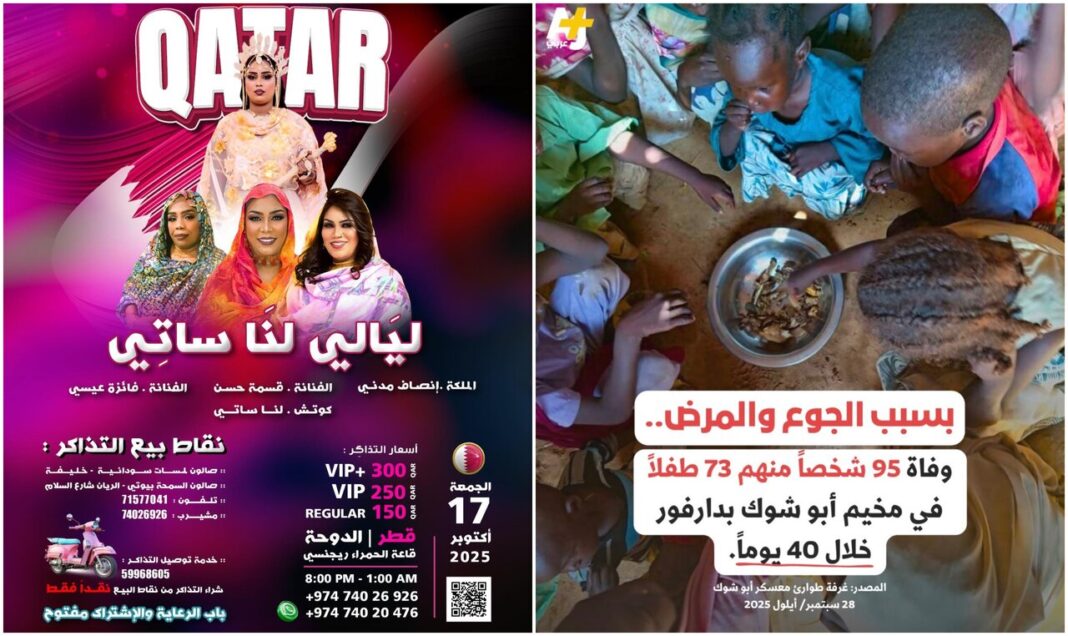
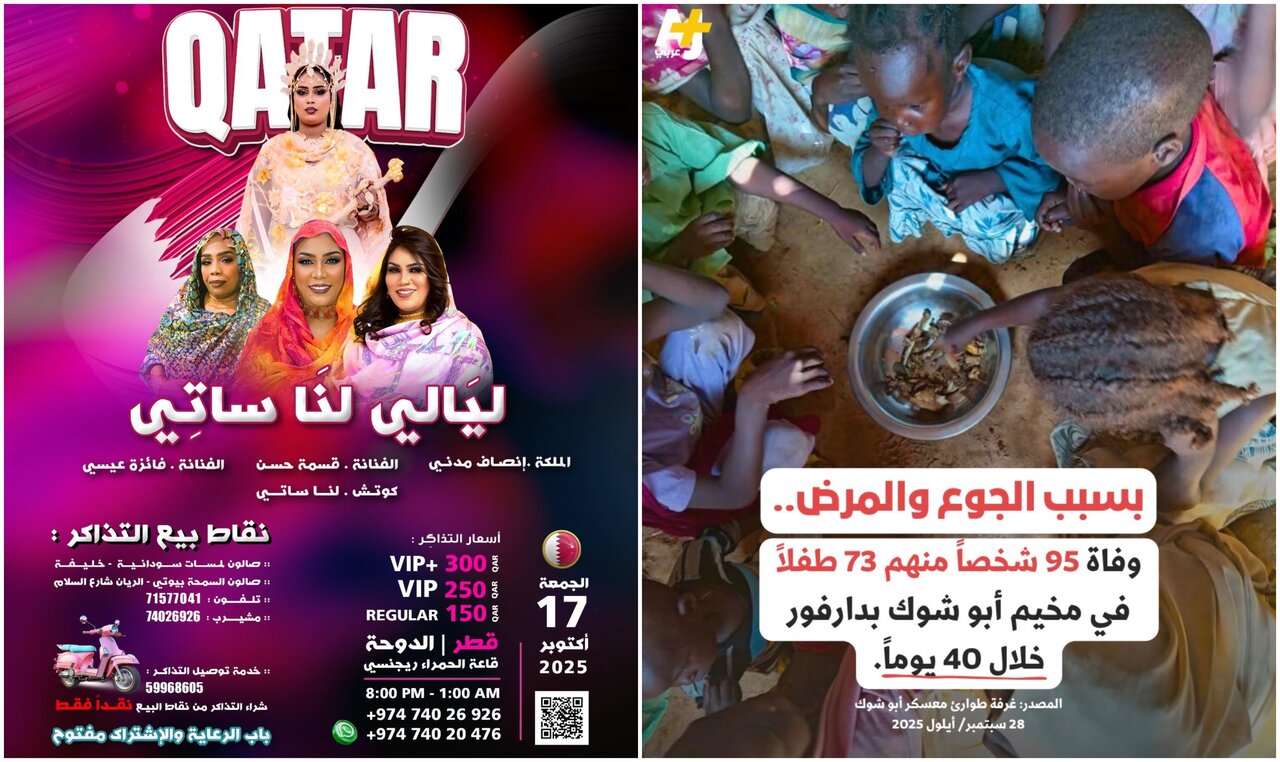
Sudanese musicians regularly travel to Qatar to perform, whether at public concerts or private celebrations such as weddings. In November 2024, Sudanese-Canadian singer and songwriter Mustafa, better known as Mustafa the Poet, performed on the opening night of the Ajyal Film Festival. More recently, American-Sudanese artist Alsarah participated in Seeing Sudan: Politics Through Art, held in Doha from 18 to 20 September 2025. For traditional Sudanese performers, Qatar has long been a familiar stage, with appearances now an annual tradition. On 17 October 2025, Doha will host Layali Lana Satti, a women’s-only event featuring renowned singers Gisma Hassan, Ensa Medani, and Fayza Essa. The performance of the traditional bridal dance is organised by dance coach Lana Satti, who hosts the event annually in Qatar and across the wider MENA region. Tickets are price at QAR150 (Regular, approx $41), QAR250 (VIP, approx $69), and QAR350 (VIP+, approx $96).
While celebrating Sudanese culture and tradition is vital, there must also be sensitivity about what we celebrate and when, both in Sudan and abroad, especially as the war in Sudan continues. In the same week that Satti announced her event, AJ+ Arabi reported, citing Abu Shouk Camp Emergency Room in Al Fasher, Darfur, that 95 people had died within just 40 days. Among the victims were 73 children under the age of five and 22 elderly people, their deaths caused by the lack of basic necessities such as water and food, worsened by insufficient funding and the Rapid Support Forces (RSF) blocking aid into the region.
The Integrated Food Security Phase Classification (IPC) confirmed famine in Sudan in August 2024. It has been confirmed in 10 locations across Sudan, reaching IPC Phase 5, the highest level of food insecurity. The hardest-hit are Al Fasher’s Zamzam and the adjoining Abu Shouk camps, and the Nuba Mountains in South Kordofan. An additional 17 areas are at risk. Nearly half the population — 24.6 mn — are facing acute hunger, with 638,000 experiencing catastrophic levels of food insecurity. This means at least 20% of households face extreme food shortages, 30% of children are acutely malnourished, and two in every 10,000 people are dying daily from starvation or related causes.
An event like Satti’s is untimely, tasteless, and deeply inconsiderate, turning a blind eye to the suffering in Sudan. Hosting such an event is shameful, and so is attending it. The money spent on tickets could instead save lives. Even if only a portion of the proceeds were donated, the impact would be significant: for example, 1,000 attendees at regular ticket prices would generate QR150,000 (approx. $41,194). In stark contrast, during the same week Satti announced her event, American YouTuber, songwriter, and educator Ms Rachel donated $50,000 to the Sudanese American Physicians Association (SAPA) to aid those in need in Sudan. According to UNICEF, $100 can provide over 4,348 iron supplements to prevent anemia in pregnant women; $135 can supply 252 sachets of therapeutic food for children with severe malnutrition; and $500 can provide 83,334 water purification tablets, enough to create up to 5 litres of clean drinking water per tablet. https://thesudanist.com/sudan-news/ms-rachel-donates-50000-to-sapa-for-sudan/
It is natural to continue living and celebrating life when one is not personally suffering or surrounded by hardship; however, it is crucial to show empathy and consideration for those who are. We must remain mindful of the struggles and suffering of others.
Ironically, in a previous column, I discussed the guilt many Sudanese in the diaspora experience while witnessing the suffering of their countrymen from afar. I highlighted what is often called diaspora survivor’s guilt or exile guilt, the sense of guilt felt for being safe while others in one’s homeland remain at risk. Related emotional responses include vicarious trauma, the emotional residue that comes from empathically engaging with survivors as they recount their pain, and secondary trauma, or secondary traumatic stress (STS), which is the psychological impact of indirectly witnessing or hearing about another person’s traumatic experiences.
However, events like Satti’s, and those behind them, represent overindulgence, bordering on gluttony. They are excessive and even smug, celebrating personal fortune and privileges while others, often nearby, suffer from misfortune and disadvantage. This is a common failing among many privileged members of the diaspora.
For many in the diaspora who had loved ones in Sudan when the war first broke out, most of those relatives managed to leave, mainly to Egypt and the wider Middle East and Africa region. As a result, while Sudan remains their home country, they are not as deeply concerned about the ongoing war. Historically, too, Sudanese people have shown less concern for conflicts outside Khartoum, particularly in the West and East, a pattern rooted in longstanding discrimination and marginalisation.
The people of Darfur and other marginalised regions in Sudan, now under RSF control, need to be humanised. Their lives matter just as much as those in Khartoum. What is happening to them now is the same, if not worse, as what the people of Khartoum and nearby cities endured when the war first broke out – and it can happen again at any time. We forget how quickly our lives can be turned upside down, anywhere, at any moment. If the war in Sudan has taught us anything, it is that.

Ola Diab is the new founder and editor of 500 Words Magazine, and the deputy editor of Marhaba Information Guide, Qatar’s premier information guide. Based in Qatar, the Sudanese journalist graduated from Northwestern University in Qatar (NU-Q) in 2012 with a Bachelor of Science in Journalism and has since built a successful career in the print and digital media industry in Qatar. Find her on X (formerly Twitter) @therealoladiab or on LinkedIn.