
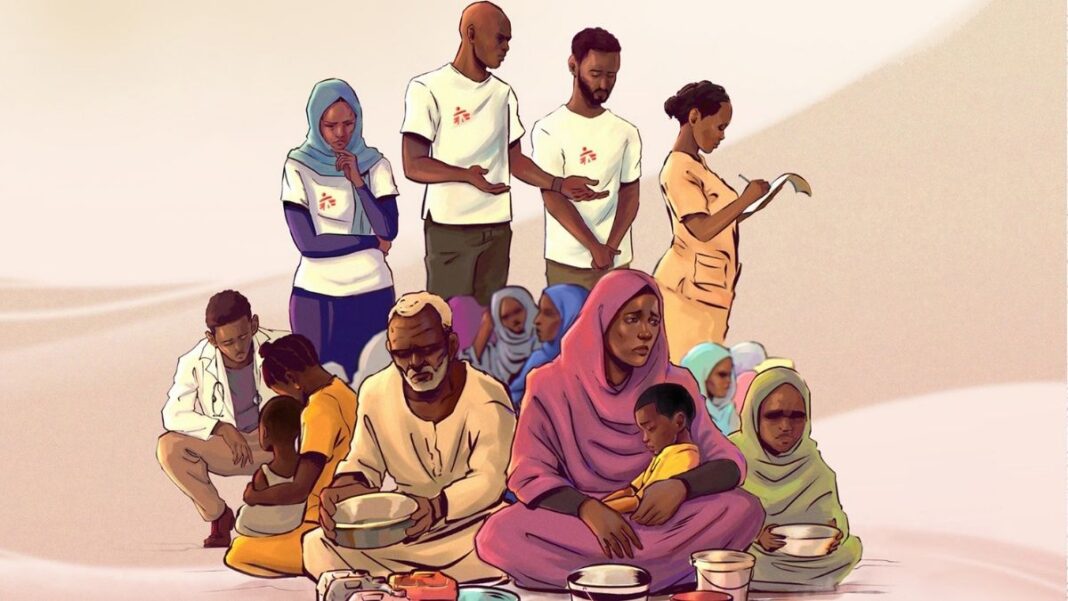
Médecins Sans Frontières/Doctors Without Borders (MSF) has collaborated with Khartoon Magazine, a network of Sudanese cartoonists — many of whom are themselves displaced or living as refugees — to produce illustrations that tell Sudan’s story through the voices of its own people and capture the reality of a war the world has largely forgotten.
“In a world that has largely looked away, we ask ourselves: who tells the story of Sudan? It is Sudanese who can express these realities as they have lived them, particularly now, with so little attention from international media. When we put this question to a Sudanese Médecins Sans Frontières/Doctors Without Borders (MSF) colleague, the answer came before we finished asking: “It is we, the Sudanese, who can tell the world our story,” said a statement by the MSF.
In this collaborative series, artists depict the realities of war — including hunger, epidemics, mental health needs, and barriers to healthcare — through familiar Sudanese sayings, proverbs, and expressions. These range from sayings such as “reassurance is half the cure” and “patience is the first step toward recovery,” to using familiar, everyday terms like Hakim (the wise one) or Baseer (the one who sees clearly) to refer to a doctor.
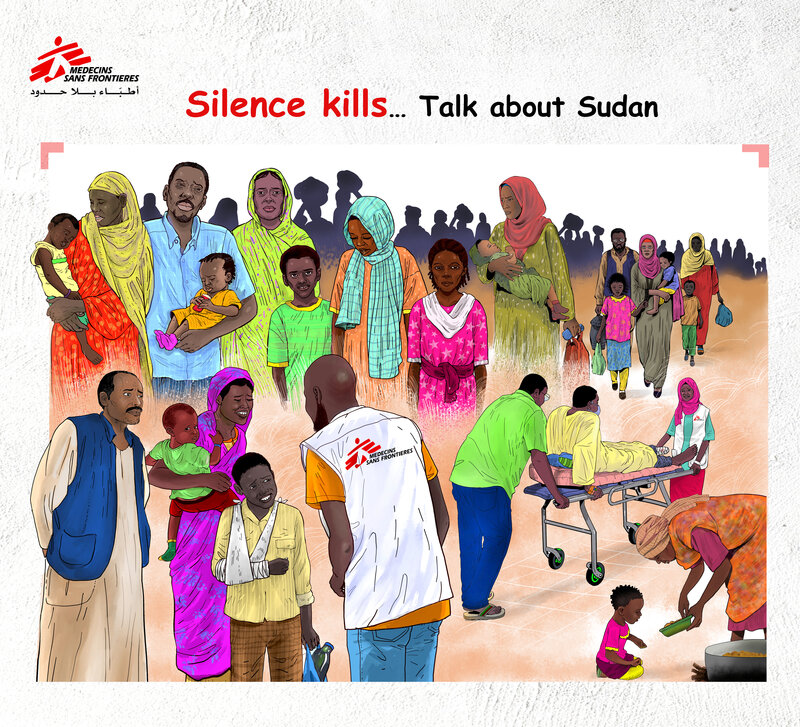
Sudan’s war has entered its fourth year, not in headlines, but in days, months, and lives.
Hundreds of thousands are estimated to have been killed, and millions have been displaced. Those who remain are caught between violence and collapse: hospitals barely functioning, infrastructure crumbling, and safety increasingly an illusion. No one is untouched by the war. Yet the global response remains far below what this crisis demands. The world’s attention has moved on. Sudan’s suffering has not. Talk about Sudan. Act for Sudan.
Illustration by Sudanese cartoonists from the Khartoon Magazine network.
“Sometimes a simple drawing says what large international conferences cannot,” said one of the artists.
Each cartoon focusses on a humanitarian issue, anchored by data collected from MSF projects in Sudan, where the organisation has been present for more than 40 years. When the war began in 2023, MSF expanded their activities to respond to growing needs, providing maternity care, treatment for malnutrition, sexual and reproductive healthcare, and mental health support.
“Art is a powerful way to express humanitarian realities because it transforms suffering and numbers into images and feelings that anyone can understand,” says Akram Abdo, one of the illustrators who contributed to the series. “As a Sudanese artist, I believe art can draw attention to issues such as cholera and malnutrition in a way that is simple and feels close to home.”
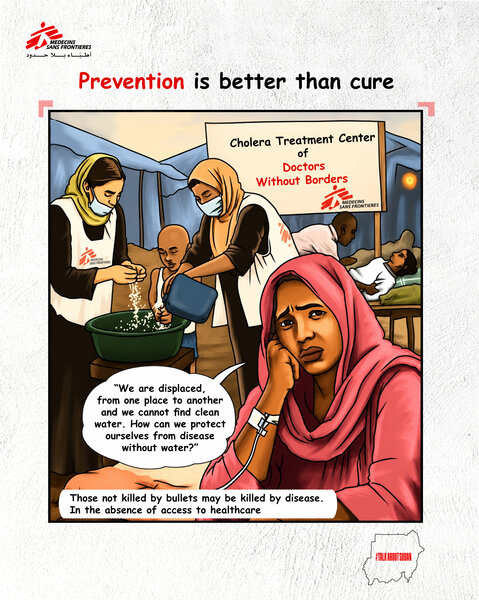
Three years of war in Sudan have dismantled vaccination programmes and collapsed disease surveillance, fuelling epidemics we know how to prevent. From MSF’s collective annual data, in 2025 alone, MSF treated more than 42,000 cases. Their teams are present and ready to expand the response when outbreaks occur. However, their ability to reach people is often restricted by insecurity, limited humanitarian access, administrative obstacles, and delays in moving essential supplies. MSF is calling on donors, diplomatic actors, and health authorities to increase flexible funding and press the warring parties to remove administrative barriers, unblock supply routes, and guarantee safe passage for humanitarian aid. Without immediate action, outbreaks will continue to spread, and more people will die from preventable diseases. Those who survive the bullets may still die from disease. MSF can reach them, but they must be granted a fast track to deliver the most needed care.
Illustration by Sudanese cartoonists from the Khartoon Magazine network.
“Together, these cartoonists portray Sudan’s humanitarian realities using art and language that speak directly to Sudanese people — those inside the country as well as in diaspora,” said MSF.
“Sudan’s war has entered its fourth year. That’s more than 1,200 days of conflict. And its story is not being told in news headlines; it’s told through the lived realities Sudanese people face. Despite the scale of the crisis in Sudan, its complexity, and its impact on people, this story has received little international attention and media coverage. One of our Sudanese colleagues put it plainly: This is a result of “deliberate international indifference to the war in Sudan,”‘ said MSF.
According to the UN Refugee Agency, nearly 12 mn people remain displaced — inside Sudan and in neighbouring countries — while OCHA reports that about 33.7 mn people in the country need humanitarian assistance. The World Health Organization (WHO) states that more than one-third (37%) of health facilities in Sudan remain non-functional, leaving a large segment of the population without access to essential healthcare.
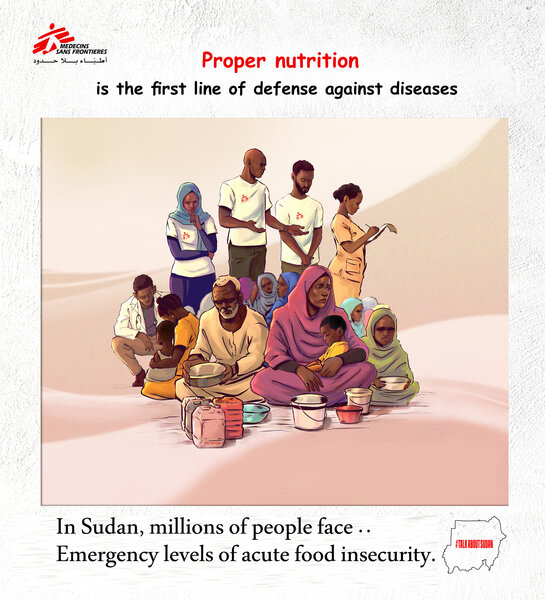
In Sudan, millions of people face emergency levels of food insecurity. In early 2026, according to the Integrated Food Security Phase Classification (IPC), more than five million people in Sudan faced Emergency levels of acute food insecurity. Food prices have soared far beyond what families can pay, and humanitarian funding is nowhere near enough to close the gap. Between January and July 2026, MSF recorded more than 13,000 admissions to inpatient and ambulatory therapeutic feeding programmes for acute malnutrition. A malnourished child can die from an illness that a healthy child would survive such as measles, diarrhoea, a chest infection. Meanwhile, the world keeps turning away, while families fight to secure a single meal. Talk about Sudan. Act for Sudan.
Illustration by Sudanese cartoonists from the Khartoon Magazine network.
“I think art helps people because it makes them feel that someone understands them, that someone is with them,” says Nader Jenni, an illustrator and writer for Khartoon Magazine. “Sometimes a simple drawing says what large international conferences cannot. On a human level, art can soften the sharpness of the tragedy — for someone, somewhere — and that is exactly what keeps me going.”
As the violence has intensified, many international actors have withdrawn from Sudan due to security concerns or funding cuts, further diminishing access to healthcare for communities already lacking adequate services. Despite the significant health challenges people face, cartoons can provide a sense of hope.
“For me, art is not a solution to every problem, but it opens a door by making the problem visible,” says Amani Al Zein, an illustrator and designer from Khartoon Magazine. “Turning to art is a shortcut for carrying humanitarian messages.”
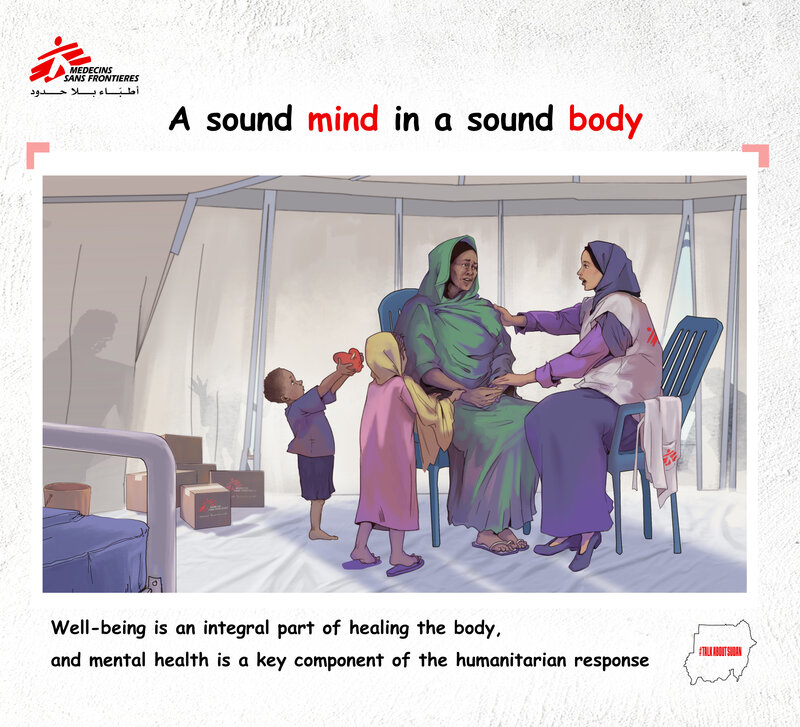
Well-being is an integral part of healing the body, and mental health is a key component of the humanitarian response. War leaves scars that you cannot see. Till the end of July 2026, MSF teams in Sudan provided about 70,000 mental health group consultations; a care for invisible wounds. As the war has entered its fourth year, that need keeps growing. Mental health care is not an extra. It is a human necessity.
Illustration by Sudanese cartoonists from the Khartoon Magazine network.
The lack of news coverage Sudan has received is a story in itself, reflecting what many describe as a crisis of compassion.
“Cartoons give both the artist and the viewer a chance to see some hope, even when the drawings are about disease, displacement, and war. I want my work to reach our people across Sudan, to plant hope and ease some of the suffering,” says Mustafa Kiobi, another illustrator who participated in the series.
In Sudan, cartoonists and artists hold a special place in public life. “Cartooning has long provided a way for people to express feelings and experiences that may be difficult to communicate with words. In this lens, illustration is not simply decoration, but commentary,” said MSF.
Artistic talent also exists within MSF’s own teams. Narin Fandoglu, an MSF operations advisor, visited Sudan twice in 2025 and witnessed life on the streets of Khartoum and in Darfur. While she was there, she drew sketches to process what she was seeing. “Sketching became my way to slow down, to process my emotions, and to keep going,” she explains.
What Fandoglu chooses to draw is spontaneous: a street market, a coffee stand in front of a partially destroyed house, a communal clay water pot that neighbours refill for passers-by, or Sudan’s ancient pyramids that many people outside the country do not know about.
Fandoglu also stresses the importance of Sudanese artists telling their own stories. “One effect of war is that artists and storytellers have lost the space to tell their own stories. When outsiders step in to speak for them, they often focus on narratives of ‘victimhood.’ That is why MSF’s collaboration with the cartoonists of Khartoon Magazine is so important: It gives them back the space that war has stolen,” she said.
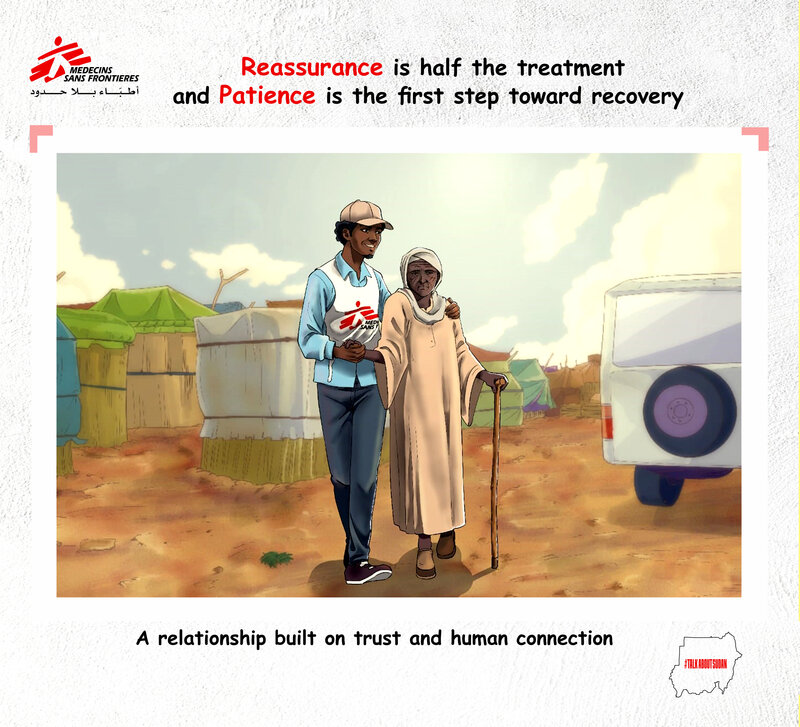
A relationship built on trust and human connection
In Sudan, people say that reassurance is half the cure, and patience is the first step to recovery.
It’s the same spirit that makes people call their doctor Hakim or Baseer — words from Sudanese colloquial Arabic for a wise one, a healer, someone who sees clearly.
That name carries an expectation: that care is built on trust and human connection, not just treatment. It’s also one of MSF’s core principles: to put patients first.
In 2026, up to the end of July, MSF teams in Sudan provided more than 400,000 outpatient consultations.
Illustration by Sudanese cartoonists from the Khartoon Magazine network.
What does this piece say to you? Share your thoughts in the comments.
MSF’s collaboration with Khartoon Magazine is yet another attempt to give Sudanese cartoonists space to portray their country, its suffering, its resilience, and its humanity.
“We cannot stop the war with drawings, but we can refuse to look away,” says Fandoglu.
MSF has provided emergency medical humanitarian assistance in Sudan for decades and significantly expanded its response following the outbreak of war in April 2023. Working across conflict-affected states including Darfur, Khartoum, Al Jazirah, White Nile and South Kordofan, MSF supports hospitals, clinics and communities with emergency trauma care, surgery, maternal and child healthcare, treatment for severe acute malnutrition, primary and reproductive healthcare, mental health support and responses to disease outbreaks. Its teams also provide care for survivors of sexual violence, medicines, medical equipment and technical support to local health facilities, reaching displaced and conflict-affected populations despite damaged infrastructure, insecurity, restrictions on humanitarian access and the collapse of much of Sudan’s health system. For more information about MSF, visit www.msf.org/sudan.
This feature was provided to The Sudanist by Médecins Sans Frontières (MSF) and published with acknowledgement of the source.