


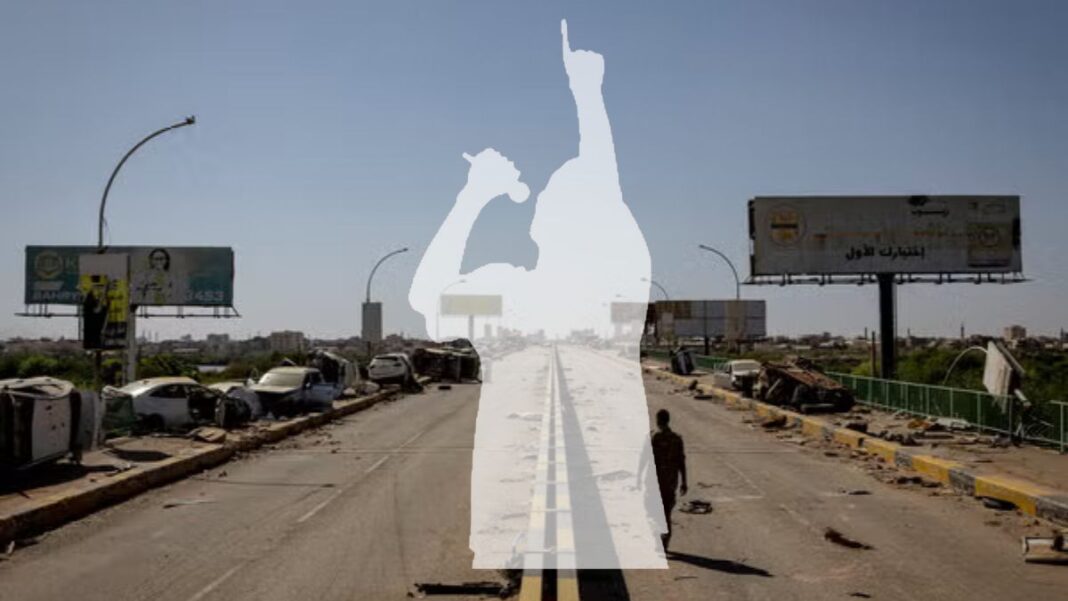
It is perhaps understandable that a serious hip-hop culture in Sudan awaited the spectacular violence of the warring parties despite its roots going back to at least the early 2000s, if not the late 1990s.
After all, and as Kendrick mused in “Euphoria”, one cannot really imitate the kind of violence that led to the organic emergence of hip-hop as a culture of resistance in the US.
Rapping in Sudan has similarly responded to the overwhelming physical and political violence of parties waging an all-out war at the moment. And despite a masculine zeal at the heart of this emerging hip-hop culture, the young men at its centre are on the verge of stewarding conscious political rap reminiscent of the likes of KRS-One, 2Pac and Nas.
While we can confidently charge the Rapid Support Forces (RSF) with inflicting the most harm on the bodies and psyche of young men and women in the country, the Sudanese Armed Forces (SAF) can easily be held responsible for doing the most harm to our social fabric.
A recent article, Khartoum After the Storm, by Magdi El-Gizouli published on equator in August 2026, proclaimed the utter confusion of elite politics on the conflict in Sudan. The article put to rest any notion of continuity between the December Revolution and the ongoing political machination against a SAF-led government. El Gizouli narrated the story of a group of revolutionary youth who decided in a projected Leninist wisdom to carry arms for SAF. Abandoning the peaceful civic politics of the December Revolution evidently posed little challenge in the face of a murderous unhinged militia and its international backers.
While hinting at a certain masculine ardour at the heart of this movement, the article glosses over pressing identity markers in relation to the war. The RSF is a racist avaricious militia conjured up by the former regime and transformed by SAF into the menace to Sudanese lives that it is today. Quelling the political rebellion in Darfur in 2003 was not just at the expense of civilian populations. It was also indelibly framed as racial, thereby planting the seeds for an even more confused and divisive narrative on belonging.
The RSF’s documented tendency to de-civilise and brutalise populations opened the space for a new narrative on Sudanese identity that is increasingly civilisational in tone. By de-civilising populations, I mean stripping civilians of the protections they have under international law norms and universal ethical considerations. The term was used by the UN Special Rapporteur for the Occupied Palestinian Territories in her first report on the Gaza Genocide titled “Anatomy of a Genocide”.
The narrative in question glorifies a civilised Sudanese core and denigrates an uncivilised other represented not just by RSF fighters, but also by the spectre of foreign-backed political elite. The invocation of the atrocities in Al Gezira and against the “free women” there, rather than evince genuine concern for the lives and rights of Sudanese people, creates a false dichotomy between populations in different parts of the country. The accompanying calls to purify Sudan of “foreign elements” and “foreign agents” are designed primarily to sow distrust between the Sudanese people.
In addition to the obvious racist tropes that seek to depict RSF fighters as culturally inferior, physically unclean and behaviourally uncouth, there is an underlying discourse of how the rest of Sudan is more civilised because of Islam and Islamic teachings.
In “Double Lio”, EZ9 is advocating for a military solution against the RSF while constantly repeating, “What is the RSF? Yaghsi!” Yaghsi is a word in the Sudanese dialect that expresses rapprochement and assigns blame and guilt for shameful disgusting behaviour.
However, the RSF’s behaviour towards civilians and their utter disregard for the laws of war and decency are not new. We have seen this happen to the “non-free women of Darfur” in 2003. At the time, the orders came from SAF and a central government that saw itself as a stand-in for the same values that are now being touted as ensuring civility and respect for rights and for women. Some of this narrative also seeks to somehow discredit international law norms on women rights, including CEDAW (Convention on the Elimination of All Forms of Discrimination Against Women).
I mention this to drive home the point that the narrative is in its essence contradictory to the ideals of the December Revolution; not just on identity and racial equality, but also specifically on women rights. When the December Revolution was described as thawrat banat, it was to acknowledge that 70% of those protesting and demonstrating on the streets were women.
However, this fear of the feminine is perhaps expected from former regime pundits. In the recent sit-down with the chair of the National Congress Party (NCP) that incidentally led to his arrest by SAF, he casually suggested that the inclusion of women in security-related workshops is antithetical to Sudanese values. The insinuation was that war should remain a predominantly masculine affair.
“Double Lio” was officially released in August 2026 but apparently existed and was ceased upon by SAF propagandists since 2024. By contrast, Morwan Shady released “Al Haddak Mno?” a few months into the war and decried not the RSF’s inherent lack of civility, but the rather obvious contradiction in their position and that of T’asis that they are fighting for democracy, and to bring human rights and dignity to the people of Sudan. Shady’s song makes inter-textual references to Quran and to Sufist tenets of faith as well as to communist coded cultural outputs such as Igd Aljalad’s infamous “Hajja Amna.” “Al-Haddak Mno?” also includes churches in the list of sacred spaces that were not spared the violence of the warring parties. Rather than the deterministic rap of EZ9, it is Shady’s rap that captures the true spirit of what it means to be Sudanese.
War in the past has always been somewhere else, somewhere in the far-away sprawling margin – of which we heard tales we only half-believed as if said margin did not exist here with us in the same timeline; leave alone the same country. And it is not a reflection of the endemic racism in the Sudanese society that people assumed was the reason no one rallied for Darfur in the early 2000s. I was in North Sudan in the mid-2010s researching the displacement of Sudanese “Arab” Riverine tribes while my friends and relatives in Khartoum calmly carried on in their upper middle class and middle-class bubbles entirely unbothered by the happenings in the North.
But Al Gezira is not the margin. It is here; a mere 3 hours and a half by car from Khartoum.
I was born in Wad Medani; a year after my father and a group of his friends founded the faculty of economics in the University of El Gezira. When we eventually moved to Khartoum, he commuted to Wad Medani to give lectures, examine PhDs, supervise students, or to do any number of things that academics often do on the job.
My cousins’ entire paternal line is from a village a few kilometres away from the city. When I spoke to my aunt a few months into the war, her usually tame racial narrative on Darfur and its people had fully transformed into an openly racist diatribe on the superiority of our values compared to theirs. Her position was that the solidarity which animates our relations is somehow absent from theirs.
I understand how the trauma of war can warp one’s conception of reality. When the RSF’s destructive sexual violence unveiled itself in Al Gezira, something must have broken somewhere in the Sudanese collective spirit.
I argue elsewhere that the National Islamic Front (NIF) which manned the previous regime, infiltrated SAF and created the RSF, has started a tradition of contesting the social order by using non-sanctioned violence against classes that are ordinarily protected by Sudanese societal norms. I theorise that the RSF did the same thing in Al Gezira when it targeted women and children. In effect, they were sending the message to Islamists that there is a new masculinity in town; one measured against access to economic and military power on a scale rather different from that which was open to the NIF/NCP. However, the violations by the NIF/NCP and the atrocities of the RSF exist along the same continuum.
This history also means that we are more united today by our experience of violence than we have ever been before. Surely, protecting the women of Al Gezira is the same as carrying arms to protect the villages of Darfur. In both instances, Sudanese people were confronted with the need to stand up to what writer Edward Thomas describes as a “neo-liberal militia” intent on brutalising them for profit. In both cases, however, these militias were enabled by the unscrupulous and violent kakistocracy in Khartoum which dressed and continues to dress itself in the garb of monolithic cultural framings of Arabism and Islam. Yet, it is not our identity that distinguishes us from the RSF. We are not better because we are prayerful, and they are not; or because we know God, but they are savage brutes. We are better because our sense of self is rooted in something ancient and more durable than the passing favour and/or whims of rulers.
In Rap Shar3’s “Hariga”, AwabTheRapper describes Sudan as both a blessing and a curse. He sees the country as a combination of good and bad traits that make it giving and treacherous and renders it malleable as well as unruly. He concludes the list of binary traits by mentioning his own tribe Danagla, originating from Dongola in northern Sudan, and the tribal group of Baggara; a cattle-herding Arab-speaking tribe residing in Darfur that include Al Rizeigat, to whom the RSF leader Mohamed Hamadan Dagalo (Hemedti) belongs.
Awab’s rapid use of the suffix “-iya” or “-a” and “-ara” over the building crescendo of the beat conveys the urgency of his message and draws an equivalence; false perhaps, between these binary categories. One could choose to read this verse as a pointed opprobrium of the cultural figure of Himedti. I read it as signifying the inevitable contradiction at the heart of one’s experience of “being Sudanese.”
“Hariga” starts with Ghayzaz AK, lamenting a land that welcomed someone who ended up destroying her and its people. This verse could well apply to almost all of us given our common history of immigrating into this land. And perhaps all of us are equally guilty of what has become of it given our refusal to engage in honest conversations about race, ethnicity and gender equality.
Shady is also Dongolawi and he often invokes Kush in his rap. He boasts of his urban roots in Al Kalakla, one of the epicentres of resistance during the December Revolution. Shady starts“Nashfa” with one of the crispiest bars I heard in Arabic: “Min Allah radhi, wu min al-ibad bitdaggir, Ahsan fikra jat fi rasi innu ahsan ma affakir.” It loosely translates to “I am content in God, but his people I avoid. The most excellent thought I had is I better not think.”
The Arabic language in general and the Sudanese dialect in particular offer a great deal of potential to a genre that thrives primarily on rhyme and rhythm. In an increasingly post-literate world, rap is an effective vehicle for poetry. Perhaps, this was the meaning behind EZ9’s edict that he is not interested in “buying a language” in “3adeela”. The song is a favourite of mine with its traditional beats and mystical rhythm. EZ9 also proclaims in the song that he is not interested in contests of masculinity because “he is/he has written the book on masculinity.”
EZ9 was one of the first Sudanese rappers who pulled me into the genre. He invariably starts his songs by proclaiming he is Gharrabi; a term that denotes belonging to western Sudan. His co-option of the word is rather significant given its chequered history. It has been used by Riverine Tribes to denigrate populations from Kordofan and Darfur. As such, the word is confrontational and shatters the taboo of talking about racism openly.
My fascination with rappers like EZ9 in this space is linked to a deeply held belief of mine that the conversation on peacebuilding in Sudan has neglected an essential ingredient for emancipation; self-recognition and self-love.
In Soulja’s “CA VA” for example, he defiantly proclaims that he “will open a strip club in Shendi” as ode to his own rebellious nature. Having come from a conservative background that included early childhood in the Kingdom of Saudi Arabia (KSA), the promise to become a pimp in the heartlands of the Jaalyeen; a conservative Sudanese tribe, is by far the most audacious self-promotion in the genre. As hyper-masculine as these overtures may seem, they are necessary to challenge our own complacency when it comes to problematic societal tenets; including the inviolability of social hierarchies.
In rehabilitating the term Gharrabi to denote pride in ethnic origin, EZ9 is using a classical device of rap that is also shared by Arabic poetry; the elevation of self and the denigration of a rival – be it imaginary or real. In doing so, he has started an important conversation on race and ethnic identity that we have failed to foreground for at least the last seventy years. The journey to self-love for the disenfranchised of us – and I include all Sudanese women in this group – must start by crushing the cultural narratives that inform our collective identities. As American writer and civil rights activist James Baldwin once said “I would like us to do something unprecedented. . . to create ourselves without finding it necessary to create an enemy.”
The narrative on RSF criminality that tags traditional conceptions on gender roles, sexual purity and racial superiority is particularly harmful to an emancipation project built on the ethos of the December Revolution. My fascination with Sudanese rap is about the opportunities it affords all of us to start talking about identity, sexism, and racism without the need to create enemies amongst ourselves.
The reaction to the 2003 ethnic cleansing in Darfur had largely demonised Arabism in Sudan as the root of all evil; a weed that had to be forcefully removed from the consciousness of Sudanese people lest they all turn into the worst examples of their rulers and start victimising their fellow non-Arabised non-Arab Sudanese. Arab superiority remains at the heart of the endemic racism in the Sudanese society because of a long unexamined history of slavery and the role that both Ottoman and British coloniality played in stratifying the society into rigid racial categories. What I am not sure of, though, is how do you excise Arabism – or for that matter, Islam – from the Sudanese consciousness?
Ironically, the promise of a hip hop renaissance in Sudan would have been impossible without this heritage.
Nada A is a lawyer, thinker, writer and, simply human.