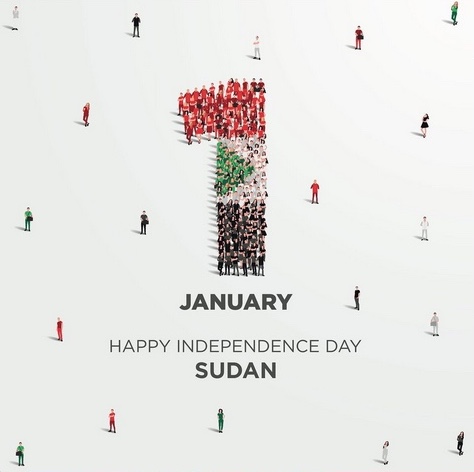
As the world celebrates the arrival of the New Year on New Year’s Day on 1 January, Sudan and the Sudanese people, are celebrating two occasions. They are welcoming more than just the New Year; they are also celebrating Sudan’s Independence Day.
However, many people ask whether 1 January is truly Sudan’s Independence Day. The answer depends on perspective. The Sudanese parliament, acting unilaterally and unanimously, declared Sudan’s independence on 19 December 1955. It was not until 1 January 1956 that the British and Egyptian governments formally recognised Sudan as an independent state. As a result, 1 January 1956 became the officially recognised date of Sudan’s Independence Day.
A Little Bit of a History Lesson
The colonisation of Sudan began in 1820 when Egypt, under Muhammad Ali Pasha, invaded and took control of the region. Sudan became part of the Egyptian Empire, and the Egyptians exploited its resources. In 1881, the Mahdist Revolution, led by religious and political leader Muhammad Ahmad, better known as Al Mahdi as he claimed he was, successfully ousted Egyptian and British forces, establishing a short-lived Mahdist state. However, in 1898, British and Egyptian forces defeated the Mahdists and reasserted control, establishing a joint British-Egyptian condominium that lasted until Sudan’s independence in 1956.
Sudan gained independence in 1956, but the colonial legacy left deep ethnic, regional and religious divisions that would lead to decades of internal conflict. The British had favoured certain regions over others, creating division between the north and the south. These tensions culminated in the First and Second Sudanese Civil Wars and eventually the secession of South Sudan in 2011. For many, the colonial period and the divide-and-rule policy created lasting challenges for Sudan, making it difficult for the country to achieve political stability and unity after independence.
For more information, see BBC’s Sudan country profile.
Sudan Today
War broke out in Sudan on 15 April 2023 between the Sudanese Armed Forces (SAF) and the paramilitary Rapid Support Forces (RSF). According to the United Nations, the conflict has created the world’s largest displacement crisis and one of the worst humanitarian crises globally, forcing an estimated 12 to 14 million people from their homes, and killing nearly 200,000 people.
See Sudan in 2025: The Year in Review
Why is the 1st of January the birthday for many Sudanese people?
1 January is not only the birthday of many Sudanese people; it is also commonly recorded as the date of birth for people from several other nationalities, including South Sudanese, Vietnamese, Somali, Afghan, and Pakistani communities. Statistically, around 1 in 365 people worldwide are likely to have 1 January listed as their birthday.
This phenomenon is the result of several factors. In earlier decades, many births were not formally registered, while others went unrecorded due to periods of conflict, displacement, and institutional upheaval. When individuals later applied for passports, national identification cards, visas, or refugee status, thousands adopted 1 January as their date of birth, or, in some cases, it was assigned to them by authorities.
Side note, Sudan celebrates two new years!
The world celebrates the New Year on 1 January each year based on the Gregorian calendar. However, there are around 40 calendars still in use today, each with its own system for marking time and the beginning of a new year. Among the most widely used are the Gregorian, Jewish, Islamic (Hijri), Hindu, Chinese, Julian, and Persian calendars, all of which observe New Year on different dates.
For Muslims, and in Sudan, a predominantly Muslim country, the New Year is observed according to the Hijri (Islamic) calendar, which is a lunar calendar based on astronomical observation of the moon. Hijri year 1447 AH began around 26 June 2025. The next Islamic New Year (1448 AH) is expected to occur around 17 June 2026, subject to moon sighting.