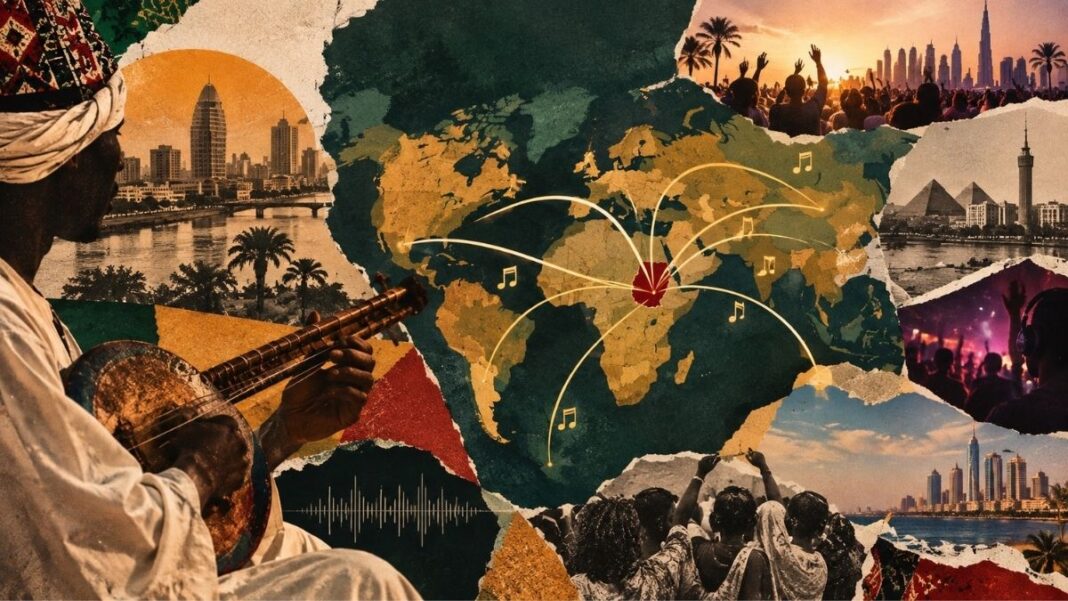
Picture yourself at a function where the audience is majority Sudanese, and the DJ is playing crowd favourites. Then, an Egyptian or Khaleeji song plays and the crowd’s energy surges with it, people singing along to the song without missing a single beat. Now ask yourself, if you were at a majority Arab event, and there was a DJ, how likely would it be that a Sudanese song is played? And if a Sudanese song was played, how likely would it be that the audience would know it, let alone sing along?
It would not be completely uncommon at present times, but it’s rare, and there was a time in Sudan’s music history when that simply would not happen. Non-Sudanese would rarely know Sudanese songs and their lyrics, and not even recognise the music if they heard it, let alone enjoy it. For decades, Sudanese music has been limited to the local scene, and when it did travel, it existed solely within the Sudanese diaspora communities or neighbouring countries.
Since it evolved, one of the most distinctive properties of Sudanese music, specifically traditional music, has been the use of the pentatonic scale in melodies, which is a scale that creates melodies using five of the seven notes in a standard octave. This scale is used by musicians from Sudan, a few African countries, and some Asian countries. On the other hand, traditional Arabic music scales are based on a musical system called the Arabic Maqam, which divides the traditional seven-note octave into 24 tones. In layman’s terms, this means that traditional Sudanese music is sonically different from Arabic music, making it difficult to listen to if the audience is not accustomed to it.
A question that may be posed now would be: why do more non-Arabs listen to Arabic music, and why is that not the case for Sudanese music?
The answer is simple: exposure. Egyptian and Khaleeji cultures have been more widespread for a longer period of time, whether it is through television, the movie industry, or even tourism. A culture, including its music, becomes more accessible the more audiences are exposed to it. Media travels, stars become recognisable, and the culture as a whole becomes within reach of a bigger audience.
For the longest time, Sudanese culture has been inaccessible by the global masses, which was initially, before the 1950s, a natural result of it being a North African country, and the region was not in the international spotlight in terms of entertainment, unlike the USA and UK. While the music scene did become more sonically diverse between the 1960s to 1980s, the rise of the dictatorial regime of former Sudanese President Omar Al Bashir brought with it significant censorship, which blocked Sudan’s path to the international spotlight. Cinema and television were not given the creative space required to grow, and music continued to be censored, made in a way that restricted its appeal to the people of Sudan. With the lack of entertainment culture being produced, or existing outside Sudan and Sudanese diaspora, global audiences became more distant from Sudanese music.
After the Sudanese revolution and the fall of Al Bashir and his regime, which in itself shed light on Sudan, the creative scene in Sudan massively grew and evolved further to make space for bigger, more global projects such as You Will Die At 20 (2019) and Goodbye Julia (2023) – both Sudanese movies that have won global awards and introduced the international audience to Sudan’s culture. Ever since, Sudan has witnessed a surge in the number of Sudanese influencers, creating a strong internet presence for Sudanese culture. This growth, in recognition for Sudan, opened the door for singers, musicians, and rappers to create music that is contemporary enough for the global audiences, but authentic enough in its preservation of Sudanese sound.
Of all the social media platforms, TikTok specifically has been the friendliest to Sudanese music, with 30 second clips from songs becoming viral across many countries, mainly the Arab population. Rappers, and even traditional singers, have been releasing hit after hit, most of which are picked up by TikTok users. This has been improving the visibility of Sudanese music across the world and allowing non-Sudanese listeners to familiarise themselves with the Sudanese sound.
This increase in visibility and exposure has led to Sudanese musicians performing on Arab stages, especially in Egypt, the KSA, and the UAE. Many DJs and radio hosts, such as the pioneering Saudi radio host, music producer, and leading champion of Arab hip-hop Big Hass, openly support and encourage the Sudanese music scene by playing Sudanese music on their stages and platforms. A recent remarkable accomplishment was rapper Connan being played on one of the Coachella stages, and his hit “Liga” crossing the Atlantic was a turning point not only for Connan, but the music scene as a whole.
While the recent progress has been significant, I still believe Sudanese music has a long way to go in terms of visibility, especially outside the MENA region. Rappers, musicians and even the industries outside the music scene are slowly paving the way to globalisation. Sudanese media needs to continue being more accessible to non-Sudanese, familiarising them with Sudanese dialect and culture. That way, in no time, the imprint of Sudanese music will be a lasting part of the world’s history, known and memorised by people all around the globe, Sudanese or not.
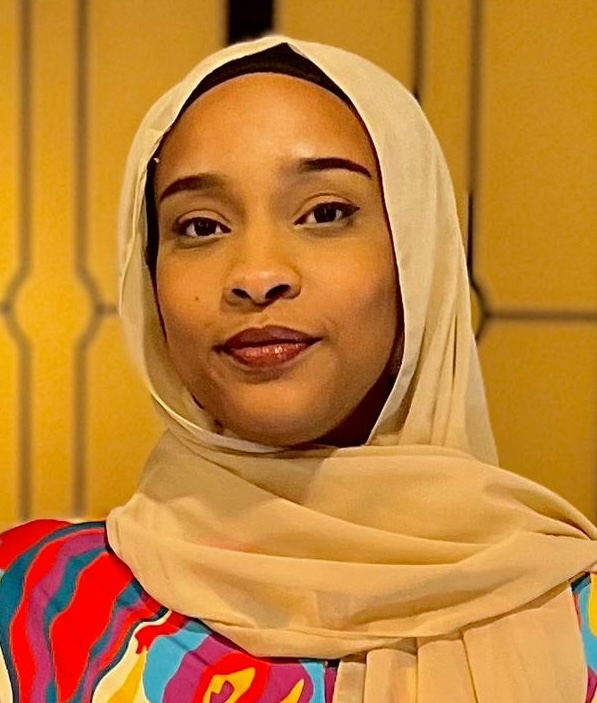
Samar Bengawi is a medical student by day, and a literature and music enthusiast by night. She was born and raised in the UAE and is now based in Georgia. She is never without a cup of coffee in hand, and is always “on the go,” chasing after one hobby or another. Passion in Sudanese politics runs in her blood and she considers herself a patriot who hopes to leave a memorable mark in the world.