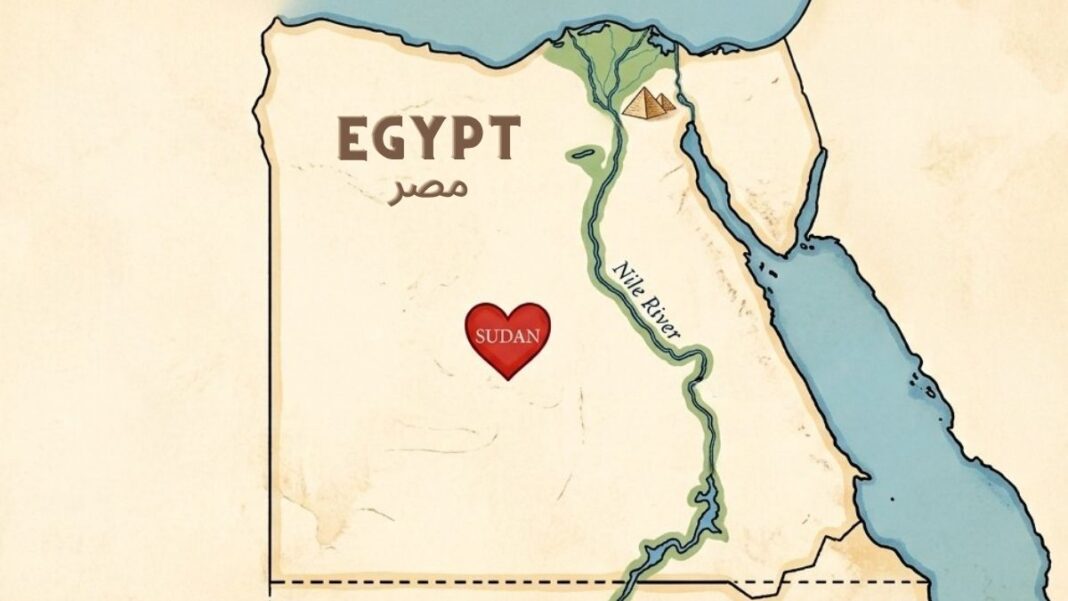
“Al Sudan hilwa bi nasa” (Sudan is beautiful because of its people) is a saying Sudanese are all familiar with, especially when visiting Sudan. It is a reminder that Sudan, with all its shortcomings, is still beautiful because of its people. The same can now be said about Egypt, because that is where our people, our families, friends and other loved ones are.
“Al Sudan bega hena” (Sudan is now here), said one of my cousins, who has lived in Egypt since before the war began in Sudan in 2023. By this, he meant that Egypt is now where Sudan is because it is where so many Sudanese are because of the war, further highlighting how Sudan is defined by its people.
More than a million displaced Sudanese have found refuge in Egypt. For some, it has become home; for others, it offers temporary stability until returning to Sudan becomes possible or they find stability elsewhere. Egypt was already home to around a million Sudanese before the war began, making it a longstanding centre for the Sudanese community. When it comes to the xenophobia and racism Sudanese have experienced in Egypt, there are also different experiences and perspectives. Some have felt welcomed and say they have never experienced discrimination, while others have experienced the opposite. Both realities can exist at the same time. People experience places and people differently.
With so many more Sudanese now living in Egypt, the country has also become a place of reunion. More Sudanese are visiting than ever before, often making multiple trips to see family, friends and other loved ones who have been separated by the war.
My family and I recently visited Egypt for the first time since the war began in Sudan in 2023. Visiting Egypt was truly like visiting Sudan; it was all about the people, about family. It was the first time we had seen our families who had been displaced by the war, and their first time seeing us as a family – as husband and wife, and even as parents. There were embraces, tears of sadness and tears of joy – for all that had been missed, all that had changed, and everything that had happened in the years since we last saw each other.
The last time I saw most of them was during my 2020 visit to Sudan. I had never been away from Sudan and my family for so long. Then, a new chapter of my life began in 2021, one most of my family, especially those closest to me, did not get to witness because of COVID-19.
Since 2020, so much has happened in and to Sudan and its people: COVID-19, the aftermath of the revolution, the coup and now the war, which has displaced 12 to 15 million people and killed more than 150,000.
In just six years, with all that has happened in Sudan and to the Sudanese people, it feels as though people have aged 10 years. Children are suddenly no longer children, while their parents have aged a lifetime, carrying the weight of the world on their shoulders. And then there are those who are no longer with us, gone before we could see them, say goodbye, or even say hello after such a long absence.
Since the war began in 2023, it feels as though people have been dying at a faster rate, particularly the elderly. It is as if the war and its consequences have rapidly taken an entire generation from us – our habobat and jidos – a generation that lived through and witnessed Sudan in what many remember as its golden age.
Yet, amid so much loss, it was beautiful to see so many of my family members persevere and somehow create a home away from home. Life goes on, even through struggle, and there is something deeply heartwarming about seeing that firsthand. People got married. They had children. They continued their education in Egypt and elsewhere. Some started careers, businesses and lives of their own. They kept going.
It was equally beautiful to see what being surrounded by family did for my children. They quickly came out of their shells, becoming more social, confident, warm and outgoing. They experienced something they rarely get back home in Qatar: simply being around family, especially younger relatives, playing and spending entire days together. For those of us who grew up with it, that kind of childhood is among the fondest memories we carry.
And yet, I could not shake the bitterness of knowing that these experiences had been taken from us.
We come from a country that has, for decades, made it difficult for its people to simply call it home. That is why we have such a rich library of songs and books about emigration, better known as ghurba in Sudan. Generation after generation has left Sudan in search of a better life elsewhere, often having to choose between staying close to home and family or pursuing safety, stability and opportunity somewhere else. Now, the war has turned that long-running pattern into mass displacement – a forced mass migration – and for many, leaving may mean never returning.
There is something deeply painful about being denied the simple privilege of choosing where to build a life. For many Sudanese, the question is not simply where they would like to live, but where they can survive, where they can find security, stability, opportunity and a future. Everybody dies, but not everybody gets the chance to live. And so the search for somewhere to call home continues, whether in Egypt, elsewhere in the Middle East and North Africa (MENA), or farther afield.
Although Sudan can be found in Egypt like nowhere else, it also lives on in large diaspora communities across the world, from the GCC to the US and the UK. It lives on wherever Sudanese people gather, build lives, thrive and create community.
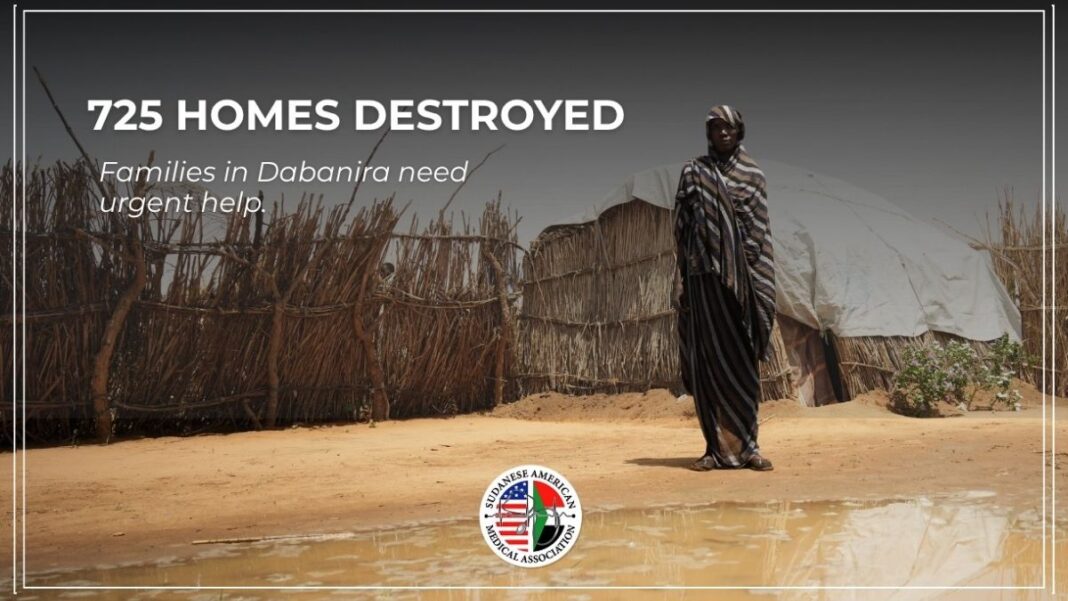
Egypt, however, has become home to one of the largest concentrations of Sudanese displaced by the war. More than 1.1 million refugees and asylum-seekers are registered with UNHCR in Egypt, the vast majority of them Sudanese. But this is not to take away from the fact that the majority of Sudanese people remain in Sudan, where millions have been displaced within the country. By the end of 2025, an estimated 9.1 million people remained internally displaced, while the UN estimates that nearly 34 million people in Sudan require urgent humanitarian assistance – almost two-thirds of the population – with over 20 million facing acute hunger.
Looking at Egyptians living their everyday lives, and thinking of people of other nationalities, made this realisation even more painful. There are people fortunate enough to have the choice – and even that choice is a privilege – to live safely and comfortably in their own country, surrounded by their families, communities and familiar surroundings. We as Sudanese have not had that certainty, and today we have it less than ever.
That does not mean Egypt is easy. Life there comes with its own challenges: rising costs, unemployment, overcrowding, chaotic roads and traffic, long distances and the everyday difficulties of getting by. But beneath all of that is something fundamental: it is still a place where people can choose to live.
Perhaps what affected me most was realising all the little yet significant parts of life we have been missing: being physically close to family, having my children know them, learn from them and build their own relationships with them. The family you create should know the people who shaped you – those who were part of your childhood and the different stages of your life. Instead, there is now a physical distance between them, and with it, a disconnect that did not exist before.
There is also the knowledge that this visit is temporary. One day, we will leave and return to the place and life we have become accustomed to. And that brings its own questions: Will my children remember this? Will they ask about these people when they are older? Will these memories stay with them? And now that we have reconnected with family, how do we make sure that connection does not slowly fade once we are apart again? And most importantly, when will we see each other again?
I was also saddened to learn that people do not gather as often as they once did. They might see one another every few months, largely because of distance, and understandably so. For many, getting anywhere can take at least an hour, while the cost of transportation is another burden. This is particularly difficult for Sudanese who cannot easily find employment in Egypt because of their visa or residency status.
Still, it was lovely to see Egyptians notice and appreciate our culture of visiting – a culture rooted in profound Islamic values of hospitality, generosity and respect for family and community. Many Uber drivers commented to us, “You visit each other more than anything else.” Some even seemed exhausted by the idea, asking, “Isn’t it exhausting?” And they are not wrong. It can be exhausting. But it is also something we love to do, whether out of obligation, affection or simply because this is how we have always maintained our bonds.
So much of Egypt reminded me of Sudan, which is perhaps why so many Sudanese have chosen to settle there since the war. It is still a reminder of home, only one border away. Some made their way to Egypt and other neighbouring countries in the MENA region, choosing to stay as close to home as possible, and most importantly, to their families. For many Sudanese, family and the ties that bind us together come above all else.
Perhaps it is also the familiarity of some of its imperfections: worn-out cars, a lack of traffic rules, poverty-stricken areas, humble homes, a simple way of life and the chaos. It is a chaos we knew in Sudan, only in a different setting.
Then there are the major landmarks that, in their own way, remind us of Sudan. Egypt has its three great pyramids, while Sudan has its own small but numerous pyramids – in fact, more pyramids than any other country in the world. And then there is the Nile, flowing north from its headwaters through Sudan and into Egypt, an essential lifeline for both countries. Simply walking along the Nile in Egypt brought me a strange sense of comfort and nostalgia. It took me back to the times we walked along the Nile in Sudan, and to driving over Al Mugran, where the Blue Nile and White Nile meet. When will I see it again?
Then there are the parts of Egypt that make you wonder what Sudan could have been: its urbanism, modernity and developed infrastructure. Seeing such stark contrasts – poverty alongside wealth, underdevelopment alongside modern infrastructure – makes you wonder why some of that potential could not have been realised in Sudan. You see it in the Pyramids of Giza, and in the way Egypt has preserved, developed and invested in them as a world-renowned attraction. You see it along the Nile, too, where the river has been transformed from a landmark into a destination for locals and tourists, with the new two-level Mamsha Ahl Misr (The Walkway of Egypt’s People), a 54-km promenade along the Nile Corniche lined with local and international restaurants, cafés, retail shops and entertainment areas.
But in Sudan, even the little that existed has now been destroyed. What remains are memories – of places that once were, and of what they could have become.
And ultimately, you wonder: will we ever see Sudan reach its potential? Will we ever have a Sudan where its people can afford the simplest privilege of all – to choose to stay or the bigger question is now, will they return?

Ola Diab is the new founder and editor of 500 Words Magazine, and the deputy editor of Marhaba Information Guide, Qatar’s premier information guide. Based in Qatar, the Sudanese journalist graduated from Northwestern University in Qatar (NU-Q) in 2012 with a Bachelor of Science in Journalism and has since built a successful career in the print and digital media industry in Qatar. Find her on X (formerly Twitter) @therealoladiab or on LinkedIn.