


Recently, I went to a Sudanese salon in Qatar to get my henna done. I usually prefer to stay away from these spaces. Soon after walking in, I was reminded exactly why.
When I was shown into the henna room, I walked directly into a conversation between three women talking about Sudan. The moment I sat down, I was forced to listen; there was simply nothing else to do. The three women came from different regions, represented different generations, and held vastly different experiences of life both in Sudan and as part of the diaspora in Qatar. One was young, likely in her 20s or early 30s, married with kids. Another was older, seemingly in her late 30s or early 40s. The third woman was the eldest, likely in her 50s or early 60s. Two other women in the room remained quiet throughout the exchange, and so did I.
I had stepped into the middle of a conversation about exploring the country. The eldest woman was urging the youngest to travel beyond Khartoum, telling her she should explore more of Sudan because of its beauty and the opportunity it offers to truly understand her identity. The young woman shot back, stating flatly that she was no longer interested in Sudan and was not considering ever returning. She explained that she had travelled from Qatar to Sudan just before the war broke out, only to find herself trapped in a living hell with her children and parents. It took them nine gruelling months to finally escape.
“Why should I go back?” she added. “I am living in a country where I am comfortable, everything is accessible, and we are well-respected and loved.”
I have to admit, I rolled my eyes at that last statement — the reality of being an expat is far from that gilded truth. But that is a conversation for another time. At the moment, I gave her grace; she had fled an active war zone, and everyone’s lived experience shapes their own version of the truth.
The second woman agreed that Sudan is beautiful. She was from Dongola, and mentioned that she visited her hometown every time she travelled back, emphasising that it was beautiful in a way Khartoum never was. “Sudan is not Khartoum,” she stated. Yet, despite that sentiment, she had completely adapted to life in Doha, dressing like the locals and speaking the Qatari dialect with flawless fluency, which poured into her Sudanese dialect.
The conversation then shifted to the current state of the war and the news that people are beginning to return. The eldest woman, full of patriotic fervour, declared that she would soon go back because Sudan is, after all, home. They began debating the advantages and disadvantages of returning, eventually turning their focus to the Rapid Support Forces (RSF) and sharing their theories on what had happened to the paramilitary group.
Listening to them, they seemed completely out of touch with the reality on the ground. They spoke about the RSF as if the group were weakening, disbanding, or no longer existing — as if they didn’t still pose an existential threat to the nation. They had completely bought into the narrative that Sudan is suddenly becoming “safe” again.
I found it deeply ironic. How could they claim “Sudan is not Khartoum,” yet base their entire view of safety on the fact that only Khartoum and its neighbouring states are experiencing a fragile return to normalcy? Just because active danger has receded from Khartoum and Al Gezira, it does not mean the rest of the country is safe. It does not mean the RSF is no longer a threat.
It was chilling to hear them dismiss the danger while international alarm grows over Al Obeid, amid warnings from the UN and foreign governments about an expanding conflict and worsening humanitarian conditions. The RSF’s encirclement of Al Obeid is the most consequential operational development in this war since the fall of Al Fasher in October 2025.
It was a stark reminder that even a war of this magnitude hasn’t changed our collective mindset. We wanted to believe the destruction would change us for the better, that it would unify us, and force us to realise that all of Sudan matters equally. Instead, while the safe states breathe a sigh of relief, the Darfur and Kordofan regions are left to burn.
The wider Kordofan region remains the epicentre, with intensified fighting around Dilling, Kadugli, and Babanusa as factions contest strategic areas. Recent drone strikes on bridges and transport corridors across Darfur and Kordofan have disrupted humanitarian routes, leaving entire communities isolated. The security situation also remains highly volatile in White Nile and Blue Nile states, with continued clashes in the Kurmuk, Geissan, and Bau localities. Meanwhile, the human cost mounts. As long as the RSF exists, it will remain an imminent threat of instability to Sudan and its people.
Then, they said something that left me truly flabbergasted.
“Ya helail Al Bashir and the days of Al Bashir,” the eldest muttered. The others chimed in with agreement. They said something along the lines of how they might not have had everything back then, but it was still better than where they are today.
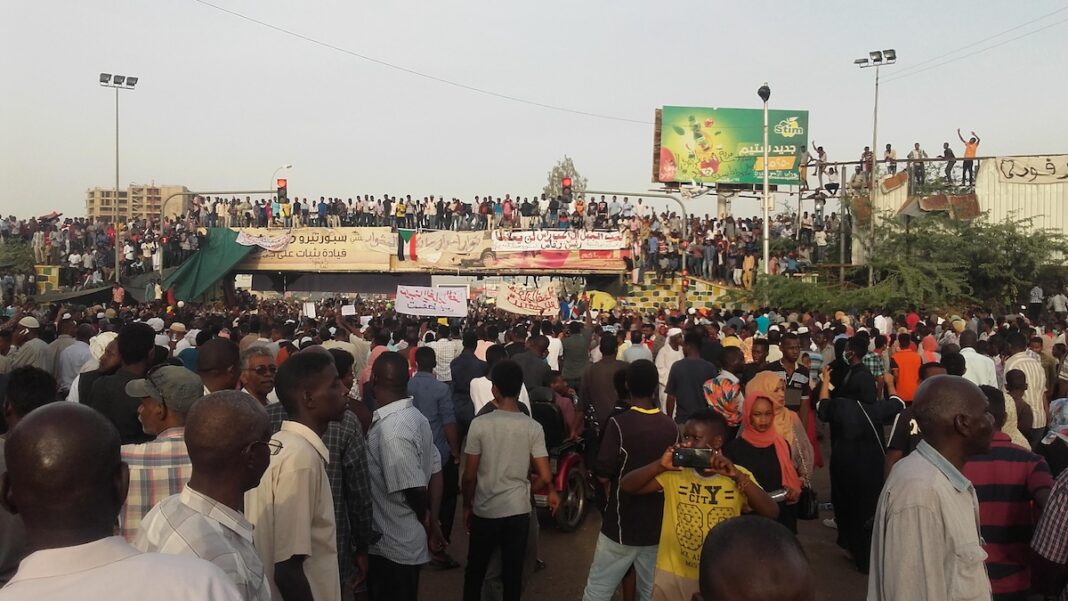
Adding fuel to the fire, they continued to say: “It’s all because of the revolution and the protesters. They are the reason we are here today.” They even began to curse the protestors.
The young woman went so far as to say she deeply regretted protesting and chanting “Freedom, peace, and justice.”
“They made me believe in their nonsense,” she said. “I never imagined this is what it would result in.”
My eyes and mouth opened wide in sheer disbelief. My heart raced; my mind was completely blown. I sat there thinking: How can they believe this? How dare they disgrace the revolution and the memory of the people who died for it? I remember opening my mouth to speak, but all that came out was a sharp gasp. I was utterly dumbfounded.
Later, the shock subsided into a grim realisation. One of my writers, who was displaced by the war and is currently in Kassala, had previously shared that many people within Sudan now discredit the 2018–19 December Revolution, blaming it for the outbreak of the war. It has unfortunately become a common, popular opinion. She had even written about this shift in 2025 for the seventh anniversary of the uprising. But until that moment in the salon, I had never been personally exposed to that way of thinking. No one in my immediate circle or environment had ever expressed it.
For my generation, the dictatorship of former President Omar Al Bashir was all we had ever known for the first 30 years of our lives. Following his ouster in April 2019, Abdel Fattah Al Burhan became the de facto ruler, and Mohamed Hamdan Dagalo (Hemedti) became the de facto deputy leader — both of them direct products of Al Bashir’s regime. Under Al Bashir, the Sudanese people endured decades of authoritarianism, conflict, political instability, hyperinflation, systemic poverty, and unemployment. That miserable reality is exactly what birthed the revolution; an overwhelming majority of the population could no longer even afford a loaf of bread.
Anyone who truly experienced the days following the revolution describes it as the most beautiful, exciting Sudan they had ever witnessed. The new Sudan, as people called it, under a newly established military-civilian Transitional Sovereignty Council (TSC) headed by Al Burhan and Hemedti with former Prime Minister Abdalla Hamdok, saw wide-reaching, historic reforms. The new administration permitted non-Muslims to consume alcohol, outlawed public flogging, and allowed women to travel with their children without needing a permit from a male guardian. They repealed the death penalty for apostasy, permitted mixed-gender spaces without fear of state punishment, and criminalised female genital mutilation (FGM). Globally, the US formally removed Sudan from its State Sponsors of Terrorism blacklist, ending 27 years of international isolation.
All of these basic freedoms had been strictly criminalised during the reign of Al Bashir. Most importantly, it was under Al Bashir’s direct supervision that Hemedti and the RSF were created in the first place. Hemedti had served as Al Bashir’s loyal enforcer long before he turned on him. Al Bashir relied heavily on Hemedti to crush regional rebellions, particularly during the brutal 2003 conflict in Darfur. Al Bashir famously nicknamed Hemedti “My Protector,” giving him the unchecked authority and financial backing to transform the Janjaweed militia into the heavily funded parallel army we now know as the RSF. As a result, Hemedti amassed staggering wealth by seizing control of Darfur’s gold mines. The tragedy playing out in real-time today was engineered decades ago.
When massive popular protests finally threatened Al Bashir’s regime in 2019, Hemedti and Al Burhan opportunistically turned their backs on their master. They joined forces to arrest the long-time president, establishing the Transitional Military Council (TMC) with Al Burhan at the helm and Hemedti as his deputy.
By June 2019, under immense public pressure, the military council and the civilian Forces for Freedom and Change (FFC) agreed to establish the TSC –a joint 11-member military-civilian sovereign council meant to govern the country on a rotational basis for 39 months, leading up to democratic elections. The military was to lead for the first 21 months, followed by a civilian chair for the final 18 months.
While the signing of that power-sharing agreement was celebrated by many as a victory for the people, others saw it as a dangerous betrayal, terrified of leaving power in the hands of the generals.
Those fears proved prophetic. In October 2021, right before the civilian members were scheduled to take over the leadership of the council, Al Burhan led a military coup. That fatal power grab, combined with the subsequent, inevitable friction between Al Burhan and Hemedti, is what ultimately sparked the devastating war that has fractured the country and triggered a catastrophic hunger crisis.
The road to our current ruin did not begin with the protesters; it began with Al Bashir opening the gates for Hemedti. It was cemented when Al Burhan tore up the transitional agreement to stage a coup.
Unfortunately, Sudan has long been cursed with corrupt leaders who care for nothing but power and personal wealth, leaving their citizens to suffer, struggle, and die. The December Revolution was a moment of profound courage — the Sudanese people taking a stand, demanding change, and using the collective power of their voices to enforce it.
I remember when the uprising first began, my father said, “This is only the start. Before things get better, things will get a lot worse.” And here we are.
Although none of us expected the destruction to reach this terrifying scale, the warning signs were always there. I can only hope that the absolute worst of the storm has now passed, and that when this war finally ends, the better days we marched for will finally come.
Related links

Ola Diab is the new founder and editor of 500 Words Magazine, and the deputy editor of Marhaba Information Guide, Qatar’s premier information guide. Based in Qatar, the Sudanese journalist graduated from Northwestern University in Qatar (NU-Q) in 2012 with a Bachelor of Science in Journalism and has since built a successful career in the print and digital media industry in Qatar. Find her on X (formerly Twitter) @therealoladiab or on LinkedIn.