


On a normal September morning in 2025, I was on my way to make a transaction for my tuition fees. It was my first experience outside of the US dollar (USD) account windows, and the first time I had to deal with a South Sudanese Pound (SSP) account and the counters for it. The queue was long, and people were complaining about the waiting period as well as the small amount of money they were receiving due to inflation and the lack of liquidity in the local currency.
It is a suffering and somehow normal to be endured in any human experience. However, what is abnormal is normalising the systemic failure and putting it equal to an unskippable destiny written by God. For decades, and since the pre-independence period of South Sudan, the narrative about us has been one of perpetual crisis – a repetitive cycle of conflict, displacement, and famine to the outsiders and more increasingly to many within the country, which leads to this phenomenon of accepting the system failure and calling it God’s will.
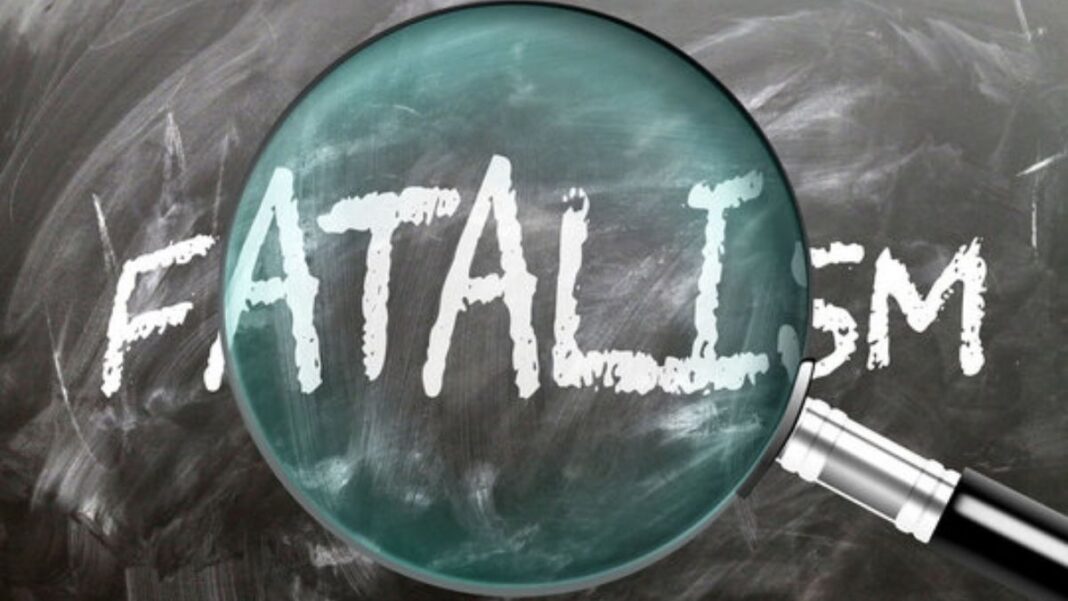
However, to get a deeper understanding of the stasis of South Sudanese progress, we must look beyond the physical battlefields and into the psychological landscape of the citizens. The only obstacle to achieving lasting peace is not merely the absence of weapons, but the centralised pervasive ideology of fatalismm, which is the idea that the future is entirely fixed, making it impossible to do anything other than what has already been predetermined. TTo realise progress and move forward, South Sudanese must undergo a reformation of mindset, shifting from a state of resignation to what the Brazilian educator Paulo Freire termed conscientização (critical consciousness). According to his seminal book, Pedagogy of the Oppressed (1968), developing this critical consciousness transforms individuals from historical objects who are managed into active subjects who know and act upon history.
In the context of South Sudanese, fatalism went beyond being a cultural trait or a lack of collective ambition; to what Freire described, “the fruit of an historical and sociological situation.” Based on this fact, when a population is submerged in a reality of constant trauma, the ability to objectively analyse one’s surroundings is often rationalised as the will of God or an unalterable fact of nature. I was shocked that day in the back when I heard the person next to me saying, “It is written to us to always be behind and not evolve as a nation.” My inner thoughts were surprisingly asking, “Who said so?!”
This magical perception according to my understanding serves as a survival mechanism in harsh realities, yet it is ultimately a trap. Eventually, it created a culture of silence, another social problem that we have advocated for a solution to clearly correcting the mindset where the oppressed South Sudanese citizens believe they are powerless against the invisible forces of history.
To break this cycle, the South Sudanese people and any other nation must begin to identify their limiting situations and understand the social and political barriers, such as
corruption, tribalism, and the weaponisation of identity. That’s to say, for a long time, South Sudanese have been acted upon by the international community, government decrees, and the rebel movement without asking who benefits from the current situation or thinking about conflicts as natural disasters rather than human decisions.
To become subjects and actors, people must win back the right to say their own words: freedom of speech. Yet, this is the first step and the essence of dialogue to ensure that liberation cannot be gifted or prepared in a foreign land, rather than be processed where people themselves name the world. Identifying those needs and demanding accountability is no longer about passively receiving history; it is making it.
From leadership, it requires a radical shift and authentic change against false charity where paternalistic aid or political crumbs maintain the status quo while appearing to help. However, these changes should push forward with true generosity, involving fighting to destroy the causes of poverty and injustice. It demands that they should die to their elite status and be reborn in communion with the people.
South Sudan’s untested feasibility is a nation where identity is a source of richness rather than a trigger for war. Reaching a stable future requires more than just the absence of war; it requires the presence of a conscious citizenship. By shattering the culture of silence and embracing the power of critical awareness, our people can finally cease being the victims of their history and become its primary authors. The limit-situation is before us; the transformation is in our hands.

Butros Nicola Bazia, born in Khartoum, Sudan in 2001, is a South Sudanese freelance writer, storyteller, and cultural commentator based in Juba, South Sudan. Nicola serves as columnist at 500 Words Magazine and contributed to multilingual regional and international platforms including The New Humanitarian, Mundo Negro, El Pais, Contemporary&, The Van-Magazine, and among others. His work explores the intersections of arts and socio-cultural dynamics, with a focus on South Sudanese narratives in the global conversations.