


Arabic is one of the world’s major languages, with more than 400 million speakers, making it the fifth most spoken language globally. It is an official or co-official language in 22 countries across the Middle East and North Africa (MENA). Arabic exists in two main forms: Classical and Modern Standard Arabic (MSA), which are used in formal contexts, and a wide range of regional spoken dialects used in everyday communication.
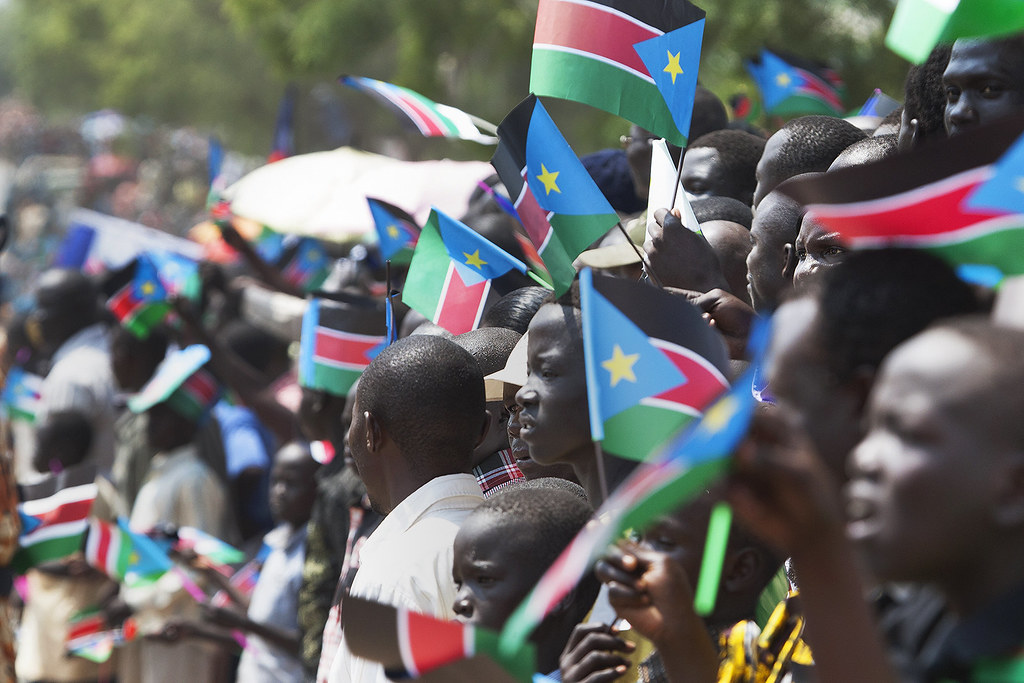
Little do people know a form of Arabic is spoken in South Sudan, an African country that once part of Sudan, until it seceded in July 2011, making it the world’s youngest country.
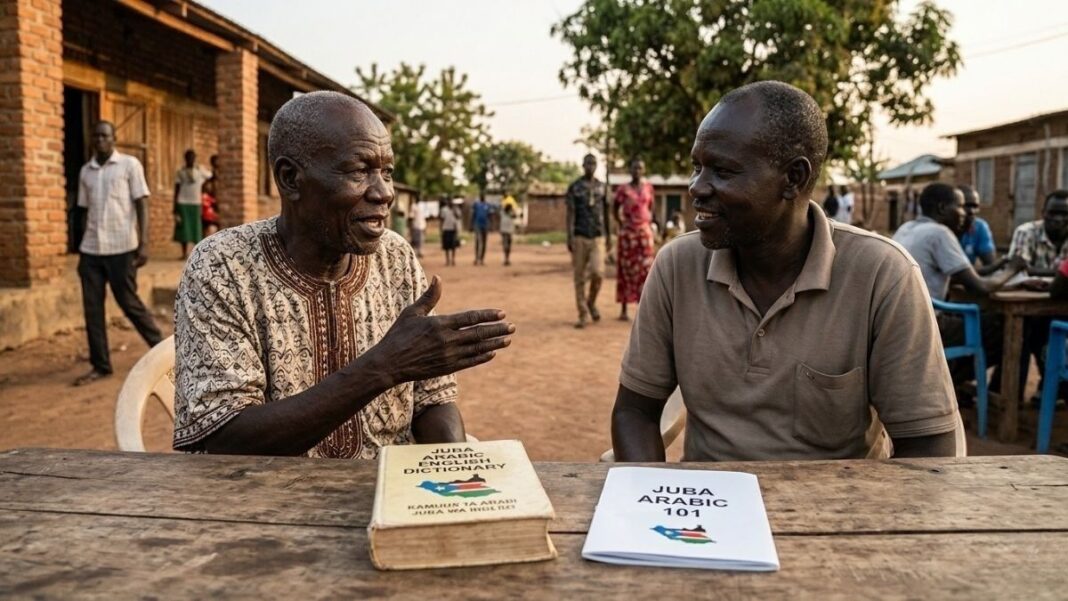
Although English is the official language in South Sudan, Juba Arabic (Arabi Juba), an Arabic-based pidgin-creole, serves as the primary lingua franca of South Sudan. It blends standard Arabic vocabulary with the grammatical structures of local South Sudanese languages, featuring a simplified grammar, a five-vowel system (a, e, i, o, u), and open syllable structures. While predominantly Arabic-based, it incorporates words from local languages, particularly in Equatoria. It has a highly simplified structure compared to formal Arabic, often using subject-verb-object word order.
Developed from the mid-19th-century trade pidgin in the southern Sudan, it was often used as a simplified lingua franca for communication by non-native speakers, specifically between the Turkish-Egyptian army, traders, and local non-Arabic-speaking populations. It heavily borrowed from Sudanese Arabic.
What started as a basic pidgin stabilised and evolved, become the primary lingua franca and a native first language (creole) for a large portion of the urban population, particularly in the South Sudanese capital of Juba.
South Sudan is a highly multilingual nation with over 60 indigenous languages, including Dinka, Nuer, Bari, Zande, and Shilluk, with English designated as the official language. While English is used for government and education, Juba Arabic serves as a widespread lingua franca. It is the most widely spoken language in South Sudan and is used for daily commerce, media, and communication across different ethnic groups.
Common Phrases (Arabi Juba)
- How are you? Ita keef? or Kef alhal?
- What is your name? Isim bitak munu?
- I am fine Ana kwayis (masculine) / Ana kwayisa (feminine)
- Thank you Shukran or Shan
- Where are you going? Inta mashi wen?
- Come here Taal hina
- How much money? Be kam gurush?
- I don’t know Ana ma arif
The Juba Arabic Alphabet
Juba Arabic does not use the standard Arabic script. Instead, it is written using an adaptation of the Latin (English) alphabet, consisting of 29 letters and combinations. This includes the standard English letters, along with five additional digraphs (letter combinations) to represent sounds specific to the region.
A, B, S, D, E, F, G, H, I, J, K, L, M, MB, N, ND, NG, NJ, NY, NZ, O, P, R, SH, T, U, W, Y, Z, CH
Q, V, X do not exist in Juba Arabic
The alphabets can be written in capital letters (Huruf Kubar) and small letters (Huruf Sukerin).
Note: Juba Arabic replaces or drops several complex standard Arabic consonants like ‘ayn (ع), and replaces emphatic consonants (like ص and ض) with softer, plain sounds.
/Arabi Juba
Key Differences from Standard Arabic
- No Arabic alphabets: Uses an adaptation of the Latin (English) alphabet
- Uses combination letters: MB, ND, NG, NJ, NY, NZ,SH, CH
- Lack of dual number: Uses the plural instead of a special dual form.
- Possession: Often uses the marker ta or bita (e.g., kitab bita ana – my book).
- Verb conjugation: Lacks complex conjugations; verb forms are generally stable.
Juba Arabic Numbers
Juba Arabic uses the standard Latin alphabet (A-Z) and borrows its numbers primarily from Arabic. Unlike standard Arabic, it features no gender agreement for numbers. For tens, numbers are formed by adding “wa” (and) between tens and single digits (e.g., \(21\) is ishriin wa wahid).
| Number | Juba Arabic Word | Pronunciation |
|---|---|---|
| 0 | Sifir | (see-feer) |
| 1 | Wahid | (wa-hid) |
| 2 | Itnin | (it-neen) |
| 3 | Talata | (ta-la-ta) |
| 4 | Arba | (ar-ba) |
| 5 | Kamsa | (kam-sa) |
| 6 | Sita | (see-ta) |
| 7 | Saba | (sa-ba) |
| 8 | Tamaniya | (ta-ma-ni-ya) |
| 9 | Tisa | (tee-sa) |
| 10 | Ashara | (a-sha-ra) |
Juba Arabic Sources
There are several online resources available for those interested in learning and understanding Juba Arabic.
Launched in 2022, the YouTube channel Arabi Juba is one of the few dedicated platforms offering free lessons in the language, with structured video content for beginners and learners at different levels. The channel can be accessed at youtube.com/@ArabiJuba.
In addition, further vocabulary practice and contextual learning are available through the Quizlet Juba Arabic Study Guide, which provides flashcards and exercises to support memorisation and real-world usage of common terms. The Juba Arabic Verbs and Phrases Guide is a practical guide which is written by a native speaker of the language, Rombok Logworong.
There are also books such as the Juba Arabic English Dictionary/Kamuus ta Arabi Juba wa Ingliizi published by a Ian Smith and a Morris T Ama in 2005, and the Juba Arabic for Beginners by a Richard T Watson in 2015.
Source: apics-online.info