


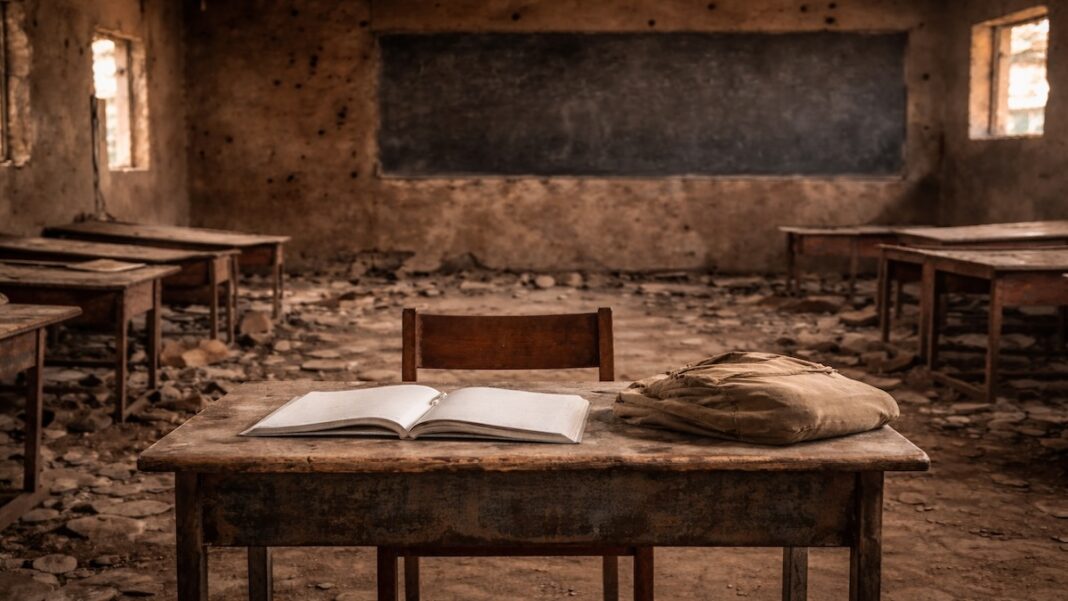
It was supposed to be a day of triumph. An English teacher walks with purpose, her mind filled with words of encouragement for students taking their IGCSE exams. She smiles. In her head, she can almost hear their nervous whispers and concerns from endless sessions of practice, preparing them for the future that is calling to them. She is eager to reach them and reassure them that their hard work will definitely pay off. That they were, indeed, on their way to bright futures ahead.
But the sky had other plans. A low, bone-shaking roar tears through the morning air — the sound of a chaotic mix of heavy machine-gun fire and artillery claiming the atmosphere. In that single, deafening heartbeat, the exams ended before they began. The pens were dropped. The future vanished. It was the first breath of a war that would swallow Sudan for three long years.
A Classroom in the Crosshairs
Somewhere still, in a quiet deserted neighbourhood, a chalkboard still bears the date 15 April 2023 — the day the music of childhood stopped and the thunder of artillery began. For three agonising years, this classroom, like thousands of others across Sudan, fell into a haunted silence as the country descended into a catastrophic civil war. How do you measure the value of a thousand days stolen from a child’s future? Is a dream deferred for years a dream discarded forever? Today, as 2026 unfolds, the silence is finally being broken by the rhythmic sound of sweeping brooms and the hesitant, hopeful chatter of children’s voices. But as Sudan enters its self-declared ‘Year of Education,’ the path back to the desk is paved with the jagged glass of extreme scarcity and a widening, heartbreaking divide between those who can afford to hope and those left in the shadows.
Following the stabilisation of key sectors in Khartoum and Omdurman, the government has launched an ambitious recovery plan. Over one million students are expected to re-enrol this year, returning to a landscape where almost 280 schools have been reduced to rubble or repurposed as makeshift shelters. While the government aims for a million re-enrolments, the scale of the loss is staggering. As of January 2026, UNICEF reports that over 8 million children (nearly half of Sudan’s school-age population) remain out of school. Having endured over 1,000 days of conflict, an entire generation is now at risk of permanent educational collapse. To meet this challenge, the Ministry of Education has consolidated students into ‘hubs,’ grouping entire districts into the few buildings left standing. The stakes are highest for the seniors; on 13 April 2026, the first national secondary exams in three years are set to begin — a logistical feat that authorities are calling a ‘strategic indicator of recovery.’ It is worth noting that of the 54 academic secondary schools in the Khartoum locality, only about 25 are currently confirmed as operational.
The IGCSE and the ‘Academic Refugee’
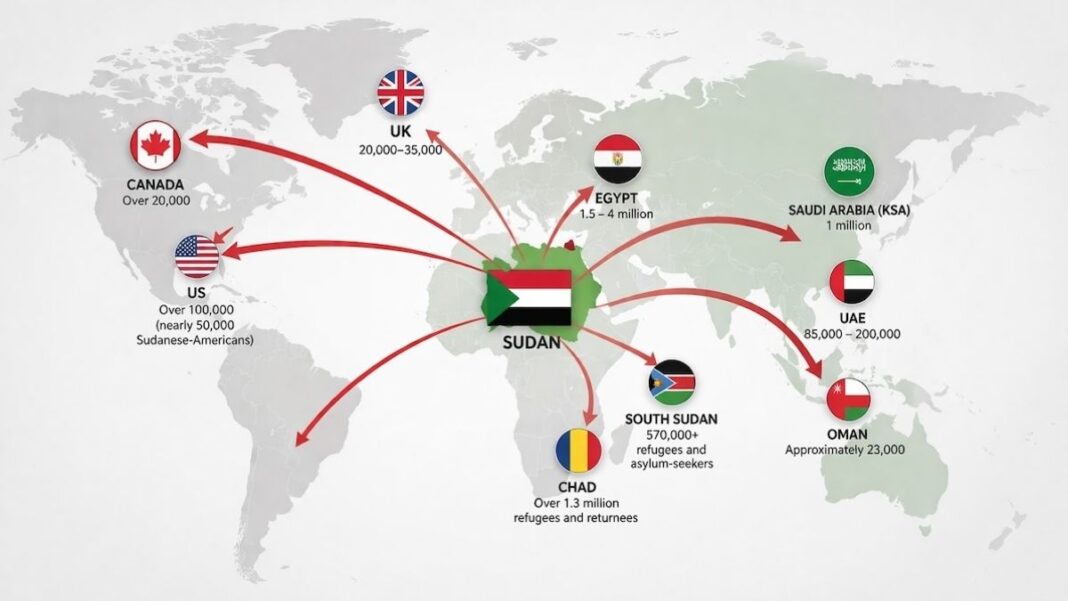
While the national system crawls toward a restart, the international curriculum remains in a state of suspended animation. For students pursuing IGCSE and A-Level qualifications, the gates of the British Council in Khartoum remain locked. Citing safety standards and the inability to secure physical exam papers in a war zone, international boards have moved testing to regional hubs. This has created a class of ‘academic refugees’ — students forced to travel to Cairo, Egypt or Riyadh, Saudi Arabia just to sit for a paper. This displacement comes with a backbreaking price tag. In Cairo, where Sudanese students were recently restricted from low-cost public schools, families now face a fragmented private market. Registration and tuition at community centres and private Sudanese schools now range from 12,000 to 15,000 Egyptian pounds for secondary stages — a steep barrier for refugees who have lost their livelihoods.
For the average Sudanese family, the cost of the trip, the visa, and the foreign currency fees has made the international dream a privilege of the few.
The cost of a single textbook is beyond anyone’s capacity, let alone a whole academic year with all that it entails. Even for those in the local system, the financial burden is staggering. With only 30% of textbooks currently available, a single Arabic or Science book has become a prized commodity, often fetching three times its value on the private market. Parents, many of whom have gone years without steady income, are now asked to provide ‘contribution fees’ just to keep school doors open and teachers fed. In a country where inflation has turned a simple school uniform into a luxury, the digital ‘Learning Passport’ has become a vital lifeline, offering free, zero-rated access to the curriculum via mobile phones.
A Race Against the Clock
Sudan’s educational revival is a race against time and a test of national will. Reopening the schools is more than just an academic necessity; it is a battle to reclaim a generation from the psychological vacuum of war. As 13 April approaches, the world will be watching to see if a tattered chalkboard in a classroom can finally be wiped clean for a new lesson to begin.The Ministry of Education has confirmed that the national secondary exams will proceed across 2,500 centres inside Sudan and 35 centres abroad. For those who cannot make 13 April start date, alternative examinations for refugee students (specifically those in neighbouring regions like western Chad) have been scheduled for 11 to 21 May, 2026, to ensure the ‘Academic Refugee’ isn’t left behind entirely.

Nasreen Mukhtar is a writer and educator who believes that words are never just ’empty’ — they are the most powerful tools for transformation we possess. With 23 years of experience in educational leadership and a deep specialisation in ESL (English as a second language), she blends technical structure with a passionate commitment to the ‘soul’ of every message. Her mission is to bridge the gap between clarity and emotion, using her passion for storytelling to spark meaningful change and foster authentic self-expression. She doesn’t just write to inform; she writes to reach others on a deeper level.