
The December Revolution Almost Saved Us, But The Power Struggles Destroyed Us

In every nation’s history, there are focal points that shape the future and change lives, but few have had as much impact on Sudan’s future and its people as the December Revolution, also known as the 2018–19 Revolution.
The story of modern Sudan cannot be told without going back to the winter of 2018, when Sudan stood on the edge of something new. Thousands of people across Sudan took to the streets with hope, a strong sense of change, and a resounding belief that the country had reached a turning point. Even now, it is easy to remember those days — the chants, the posters, and the collective sense of responsibility and duty.
What followed was not only a political movement; it was an act of freedom, a deep breath Sudan was waiting for. For the next few months, Sudan felt like it was moving towards the change many only dreamed of but never dared to claim.
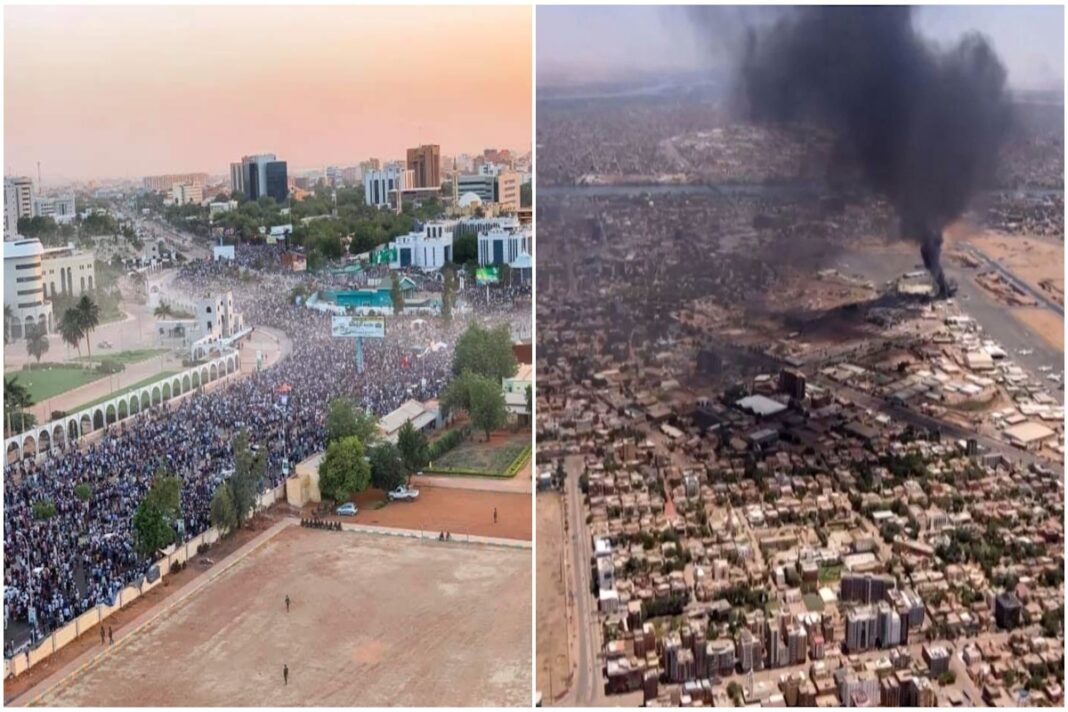
Since 15 April 2023, Sudan has been engulfed in a devastating war, after tensions between the Sudanese Armed Forces (SAF) and the paramilitary Rapid Support Forces (RSF) erupted into open fighting. Nearly 14 million people have been displaced, over 11 million within Sudan and more than 3 million forced to flee across borders, while tens of thousands of civilians have been killed or injured, according to the United Nations (UN) “Spotlight on Sudan.”
Large parts of Darfur, Kordofan, and the capital are now destroyed, as famine, displacement, and the collapse of basic services continue to define daily life. Beyond the physical destruction, the war has deepened social fractures, pushing the prospect of stability further out of reach.
As December progresses, one cannot help but reflect on the December revolution. Through months of peaceful protests, the people of Sudan successfully overthrew former Sudanese President Omar Al Bashir on 11 April 2019, after nearly 30 years of dictatorship and economic decline. After the revolution, hope sparked among the Sudanese people, but that hope began to fade away, now leaving nothing but distant echoes as we commemorate the seventh anniversary of the December revolution. Since April 2019, Sudan has not witnessed stability.
The Revolution in Retrospect

On 19 December 2018, decades of oppression and economic decline under the regime of Al Bashir finally pushed Sudanese people to the streets. The rising prices of food and basic necessities were the spark that initiated the fire of the revolution in El Damazin on 13 December 2018, but what really set off the movement was when the people in the city of Atbara, in River Nile State, took to the streets, setting fire to the headquarters of the National Congress Party (NCP). Civilians in Khartoum and other cities, such as Wad Madani in El Gezira State, followed in their footsteps shortly after, taking to the streets and protesting against the consistent decline in living conditions.
The December revolution served as the first wave of hope among Sudanese people in almost three decades. People came together on the streets, scheduling protests, sit-ins, and strikes, their voices and demands united, and it quickly became clear that a civilian government would be Sudan’s only path to stability. Despite the violent responses from the RSF and the National Intelligence and Security Service (NISS), two of the prominent paramilitary forces, the protests remained peaceful, and the voices of Sudanese people grew louder, chanting against military rule and the killings of peaceful protestors.

For months, the protests continued until the massive protest on 6 April 2019, which led to the popular sit-in, I’tisam Al Qeyada, in front of the headquarters of the SAF, known as Al Qeyada, and the ousting of Al Bashir on 11 April 2019, and lasted until 3 June 2019, when the sit-in was violently dispersed by the RSF, resulting in the killing of over 120 civilians.
Examining the Turning Points
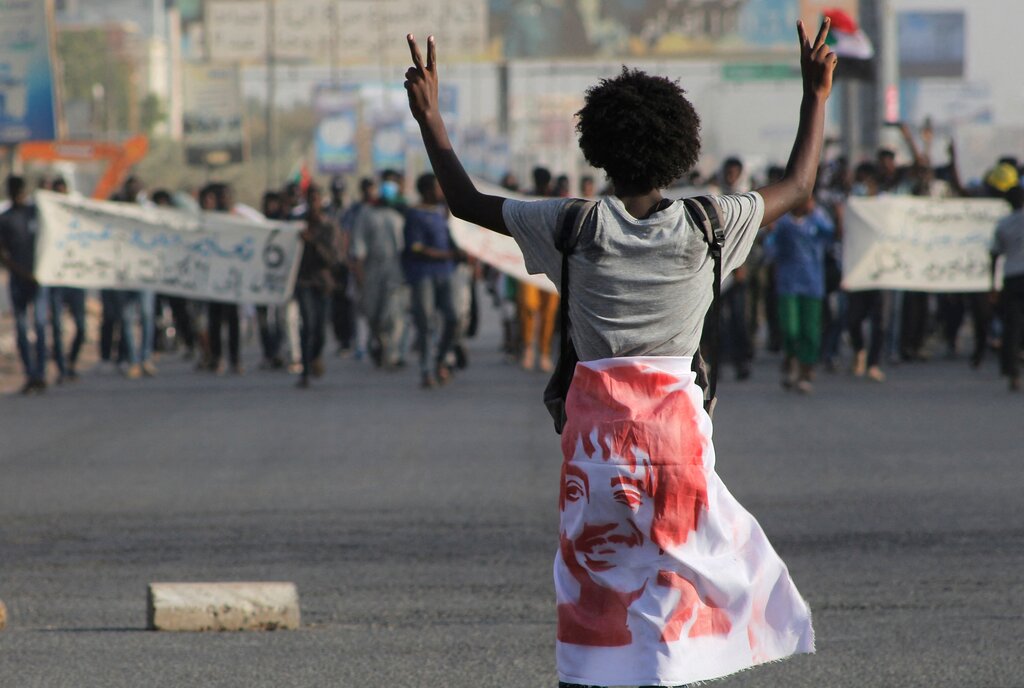
Protest in Khartoum in April 2022. Photo credit: AFP via Getty Images
The December Revolution began with a historic promise. After three decades of dictatorship and a country weary of war, corruption, and economic collapse, Sudanese people finally felt they were standing on the edge of real change. The fall of Al Bashir brought a wave of relief and a deep belief that the door to democracy had finally opened. In reality, Sudan had stepped into a narrow tunnel it has yet to escape. The regime had collapsed, but the institutions that upheld it remained. The SAF and the RSF continued to hold real power, shaping the transition from the very beginning.
The period that followed was very unstable. A power-sharing agreement tried to bring civilian and military leaders together, but the balance was never equal nor genuinely protected. There was a severe lack of reform in multiple sectors; the absence of unified civilian leadership and a weakened economy created cracks early on. Then came the disaster of the Khartoum massacre, which took place on 3 June 2019, revealing how little control civilians had over the institutions meant to carry the transition forward. By 2021, those cracks split open. Then came the coup that dismantled what remained of the partnership. After the coup, Al Burhan and Hemedti began to clash over power. This clash was the triggering chain of events that set the country on a path of total destruction.
It was the war of April 2023 that finally exposed the full contradiction at the heart of Sudan’s leadership. Two rival forces, the SAF, led by Al Burhan, and the RSF, led by Hemedti, clashed in a struggle that had been building for years. The Juba Peace Agreement had failed to resolve parallel military structures, and foreign influence only became harder to navigate due to conflicting ambitions. When the fighting erupted, whatever hope people held still faded, as Sudan descended into a conflict, tearing apart the fabric of the state.
The December Revolution left a deep mark on Sudanese society, though its institutional footing never fully solidified. It awakened generations, reshaped political imagination, and proved that Sudanese people were capable of unity and collective vision. But without real authority, without strong and coherent civilian leadership, and without the ability for true reform, the transition could not protect itself. What should have been an opportunity for a new beginning turned into a fragile moment that collapsed under its own weight, leaving the country facing one of the darkest chapters in its modern history.
The Echo of December in Today’s Sudan
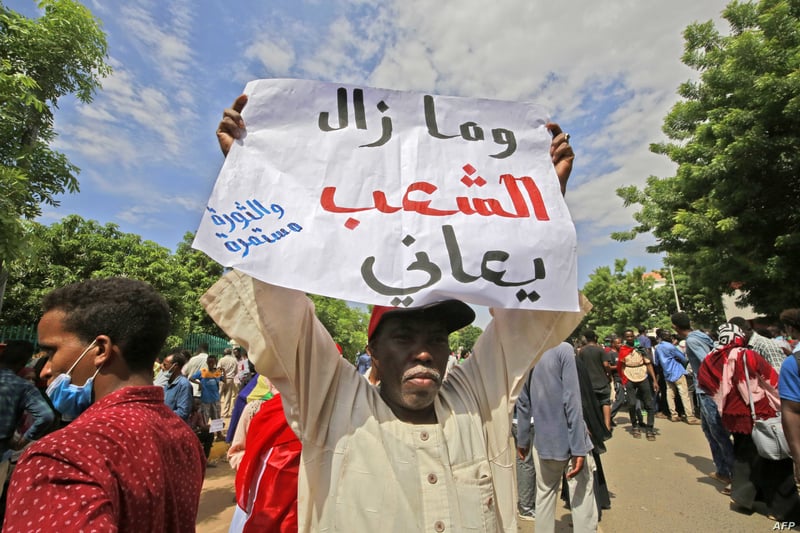
Photo credit: AFP
Life in Sudan in the years leading up to the current war was a constant test of tolerance. People found themselves caught between choosing what was best for their own survival and what was best for the country. For many who chose to remain in Sudan post-war, even as the revolution’s promise had vanished, that choice came from the belief that change was still possible, and rebuilding, however painful, was not beyond reach.
For those who stayed, leaving often felt like an act of betrayal to the very ideals the Revolution had stood for. As the country faces a tragedy that threatens its fabric, the sense of duty has fallen on the younger generation, who see themselves as responsible for carrying whatever hope is left. Yet, through the eyes of older Sudanese generations, the Revolution is remembered not for its potential, but for the disaster that followed. To them, it stands as one of the most painful chapters in Sudan’s modern history.
Looking back at what unfolded after 2019, the heartbreak is all around. People who lived through every moment, those who chose not to leave, who watched the hopes of the Revolution slowly disappear, carry a deep sense of loss. What was once a proud, unifying moment has been overshadowed by grief, turning it, in the eyes of many, from a symbol of hope and unity into a wound that future generations will struggle to make sense of.
The Revolution Through the Eyes of the Diaspora
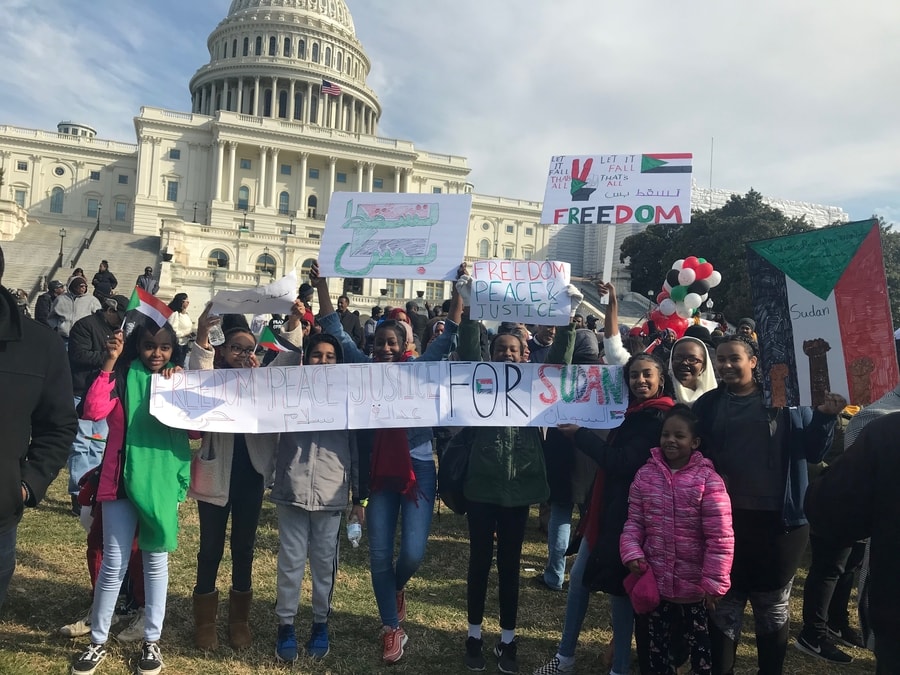
Protests in Washington DC, the US in 2019
For Sudanese in the Sudanese diaspora, being far from home and experiencing the events of their country from afar makes them more nostalgic, especially those who have lived outside Sudan for most of their lives. Because of this longing for a home country they have never lived in, or have only visited a few times, the December Revolution touched their hearts the most. For many, hope was sparked, and returning to a better Sudan started becoming a realistic dream.
At every obstacle Sudan has faced since the Revolution, the diaspora’s spark kept hope afire for Sudanese people. The diaspora’s resilience and hope only seemed to grow with each setback, with Sudanese in major cities worldwide, such as London, Washington, DC, and Sydney, organising protests and rallies in support and advocacy for Sudan. These protests almost always coincided with major events occurring in Sudan — from the 2018–19 protests to the military coup orchestrated by Al Burhan in October 2021, to the ongoing war and humanitarian crisis that began in April 2023.
For Sudanese people living abroad, the memories of the December Revolution now have a bittersweet taste. While hope still exists for many, it is tainted with grief over lives lost, pain from seeing the dream derail, and anger at the political betrayal that occurred after the Revolution. Though the setbacks were countless, the Revolution reminds them that what once seemed impossible was achieved, and Sudan was free from Al Bashir’s dictatorship. If that was achieved, despite all barriers, what would stop Sudan from continuing on the path of freedom to a newly rebuilt Sudan?
In modern times, many people still look back on the Revolution as a major milestone for Sudan. For many, especially those born and raised in Sudan, a new purpose was discovered, and a stronger connection to their roots was established. To this day, people in the diaspora remain nostalgic about the December Revolution, especially now in light of current events, particularly the ongoing war that has filled many with grief over the deaths of over 150,000 people. With many grieving what has happened since 2023 and the events currently unfolding in Al Fasher, the need to hold on to hope is greater now than ever. To them, the Revolution meant hope and an end to life away from their homes and families.
Even with many still remaining optimistic, others feel a growing sense of resignation, with some going as far as saying the Revolution is the reason Sudan has faced crisis after crisis since 2021. Recently, social media posts that reference the December Revolution have been met with countless negative responses, mostly from people who live outside Sudan. Many would share comments along the lines of “Is this the civil rule you wanted?” and “We should have never protested.”
A majority of people, both inside and outside Sudan, also have a viewpoint that can only be described as middle of the spectrum, describing the December Revolution as a movement that was bound to happen, but that many external political forces derailed after it began to succeed. These include the Forces of Freedom and Change (FFC) and many prominent political parties in Sudan, including the National Umma Party (NUP), the Sudanese Congress Party (SCP), and even the NCP, with which Al Bashir was affiliated.
A Glance into the Future
The December Revolution has touched and moved many souls, both inside and outside Sudan, making people feel hope, joy, anger, disappointment, and grief all at once. Many lives, especially inside Sudan, are permanently shaped by the course of the Revolution and every event that occurred after it. Holding on to the little hope left is becoming a painful struggle, with many surrendering and accepting their country’s fate, and some remaining resilient and hopeful.
Since 2018, death tolls rose to 250 during the December Revolution, including the Khartoum Massacre, and over 150,000 people have died since the start of the war in April 2023. These lives cannot be lost in vain, and to honour them, a civilian government must be instated, which was the motive behind the December Revolution. For Sudan to cross the bridge to democracy, a ceasefire between the RSF and SAF must take effect, but that is only the first step.
While the Sudanese people are adamant on bringing about a hopeful and positive change, many aspects of the longstanding status quo need to be reversed for that change to happen. A smooth transition into civilian rule should occur, the involvement of the SAF in politics needs to be revised, and reforms of all political offices should take place.
For any movement to succeed, it must be met with obstacles in its path. Today, the obstacles awaiting Sudan on its path to democracy seem profound. From decades of marginalisation and systemic inequality, to ethnic cleansing and mass displacement, to an infrastructure that needs complete rebuilding, the challenges are overwhelming. Yet these obstacles must be overcome little by little, and the struggle for democracy must persist.
Despite conflicting perspectives on the December Revolution today, the people of Sudan are unified in one point of view: everyone wants to see Sudan become a place where a future is possible – a future for families to grow together, careers to flourish, and patriots to stand proudly and say, “Raise your head high; you are from Sudan.”
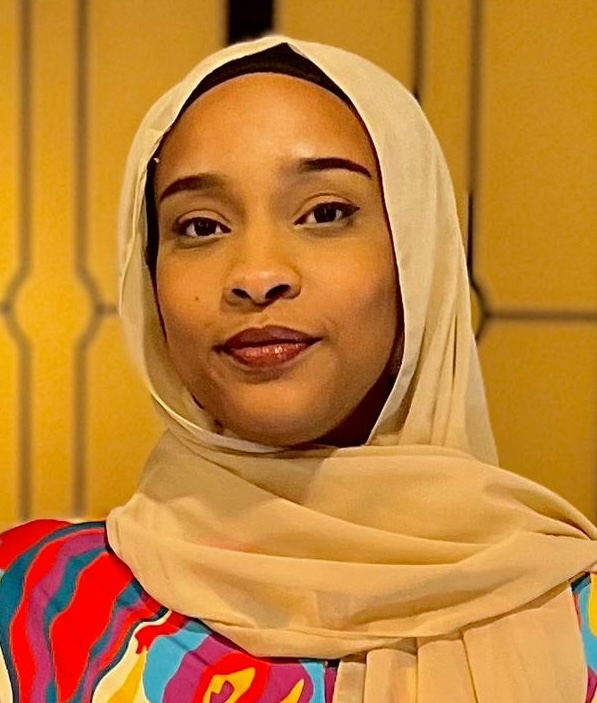
Samar Bengawi is a medical student by day, and a literature and music enthusiast by night. She was born and raised in the UAE and is now based in Georgia. She is never without a cup of coffee in hand, and is always “on the go,” chasing after one hobby or another. Passion in Sudanese politics runs in her blood and she considers herself a patriot who hopes to leave a memorable mark in the world.

Tuqa A Hafeez is an architect based in Sudan, currently exploring the world of writing. She is a passionate thinker, creative person, and a film, music and book enthusiast with a huge appetite for knowledge.
Related posts