

Across the Muslim world, the Quran is much more than just a religious book, but a living guide. Each community recites it in a way that reflects its history, language and spirit. In Sudan, that sound is unmistakable. Deep, resonant and communal, Sudanese Quran recitation has a rhythm that feels at once both ancient and alive. It is a tradition rooted in centuries of devotion, shaped by classrooms, Sufi gatherings and voices that echo well beyond Sudan itself.
How Islam Reached Sudan
Islam came to Sudan not by conquest but gradually through trade and treaties. A pivotal moment of Islamic history in Sudan was the Baqt Treaty of 652 CE, in which an agreement was reached between the Muslim rulers of Egypt and the Christian Nubian kingdom of Makuria. This lasting peace opened the door to merchants, scholars and settlers, allowing Islam to take root without war.
From the 12th century onwards, Sufi orders such as Al Qadiriyya, Al Tijaniyya and later Al Khatmiyya carried the message deeper into Sudan. Sufi orders, known in Arabic as turuq (paths), are spiritual brotherhoods within Islam that focus on drawing closer to God through remembrance (dhikr), prayer and service. Each traces back to a founder: the Qadiriyya to the Iranian Abd Al Qadir Al Jilani in Baghdad, Al Tijaniyya to the Algerian Ahmad Al Tijani in North Africa, and Al Khatmiyya to the Sudanese Sayyid Muhammad Uthman Al Mirghani in the 19th century. Of these, Al Khatmiyya became the most prominent in Sudan, shaping both spiritual life and social fabric.
In Sudan, these orders were central to religious life. Their teachers travelled widely, spreading faith through Quranic recitation and rhythmic chanting that strengthened devotion and built community. In Sufi circles, the Qur’an was chanted as part of the dhikr, its verses mingling with songs of longing for the divine.
The Sufi orders placed great emphasis on memorisation and recitation of the Quran, especially in dhikr gatherings where verses were woven into chants lasting well into the night. This gave Sudanese recitation its spiritual and melodic quality. By the fourteenth century, as the Christian kingdoms of Nubia declined, Islam and Arabic had become dominant, and khalwas (Quran schools) spread across the land. The Duri narration, traced back to Iraqi Quran reciter and Arab linguist Abu Amr AlBasri, became the standard. From the beginning, the story of Islam in Sudan was bound up with the sound of recitation: it was how the faith was taught, practised and remembered.
Quranic Recitations Around the World
The Quran has always been recited in slightly different, but equally authentic ways, known as qira’at. These variations affect pronunciation, rhythm and tone without changing the meaning. Around the world, most Muslims are familiar with the Hafs style, which became dominant in the Middle East and Asia. In contrast, Sudan preserved the Duri ʿan Abi Amr style, which entered the region through early scholars and khalwa traditions as far back as the sixteenth century.
The Duri style is known for its clear, steady rhythm and careful pronunciation. It follows the tradition of Al Basri, whose approach emphasises balance and precision. In Sudan, this gives the recitation a slightly slower pace than styles such as Hafs or Warsh, with gentle elongations and thoughtful pauses that allow each verse to be absorbed giving it a sound that feels calm, dignified and focused on meaning.
The Evolution of a Style

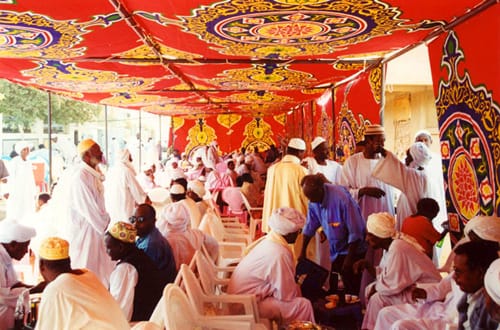
Sudanese recitation did not develop from the Duri narration alone but over the centuries also absorbed local influences that gave it its distinctive musical sensibility. Sudanese Arabic shaped articulation and phrasing, in the khalwa, children reciting in unison developed a chorus-like cadence, and in Sufi dhikr, repetition and melody created an atmosphere of devotion that seeped into everyday recitation. Together, these elements merged into a sound recognised for its communal energy and reflective calm, with a depth of tone that feels both solemn and moving. Once heard, it tends to stay with you. Outside the mosque, the same sensibility appears in madih, Sudan’s tradition of praise poetry. Madih in Sudan is a tradition of sung praise for the Prophet Muhammad. It is performed at community gatherings and celebrations, most notably mawlid (an annual festival commemorating the birth of the prophet) with a lead vocalist and a responding chorus, often supported by handclaps from the audience. The poems are devotional and plain in style, and the rhythm echoes the cadence of Quranic recitation taught in the khalwa.
The Khalwa: A School and Home
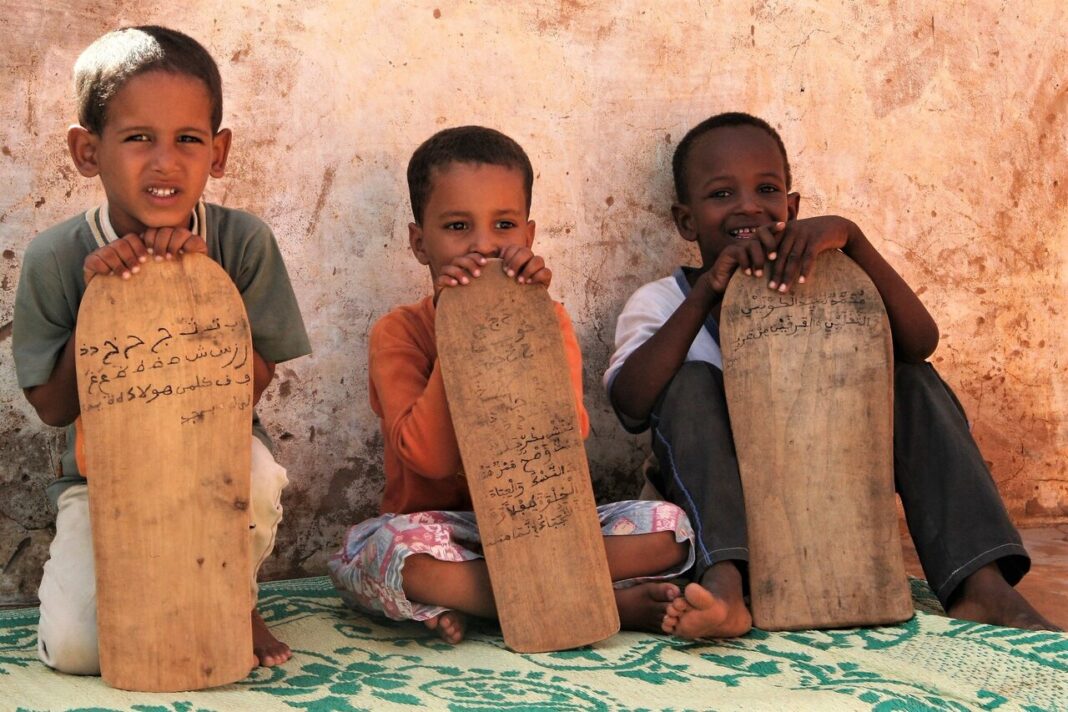
At the centre of this tradition stands the khalwa, traditional Quran schools. Even today, in villages and towns, children gather in courtyards, reciting together under the guidance of a teacher. Each holds a looh, a wooden tablet on which verses are written in ink. Once memorised, the ink is washed away and new verses are written in its place, creating a rhythm of writing, erasing and remembering that has continued for centuries. Life in the khalwa is simple and perhaps even austere. Students rise early, divide their time between chores, and study and live communally. This discipline, together with constant recitation, leaves a mark not only on their memory but also on their character. What makes the experience distinctive is its collective spirit. In many places Quranic recitation is treated as an individual performance, but in Sudan it is something done together. The sound of children chanting in unison, their voices rising and falling with the verses, is part of the national memory. By the time they leave, the Quran has shaped their voices as surely as it has shaped their lives.
Voices that Carried Sudan to the World

Sheikh Noreen Mohammed Siddiq
If there is one figure who brought the Sudanese style to global attention, it is the late Sheikh Noreen Mohammed Siddiq. Born in Umm Dam in North Kordofan, he memorised the Quran in a khalwa before becoming one of the country’s most beloved reciters. His voice was deep, controlled and unforgettable. His recitation was cherished for the way it softened hearts and reminded listeners of the presence of God, inspiring moments of reflection. For many, his voice carried a spiritual warmth that drew them closer to faith and renewed their devotion.
Recordings of Sheikh Noreen spread widely, first through local radio and later across social media. For many outside the country, he was their first introduction to the unique, bluesy recitation style that is popular in Sudan. He showed the world that Sudan’s Quran recitation tradition was profoundly beautiful. His sudden death in a car accident in 2020 was mourned widely across the Muslim world. For Sudanese people, it was as if a national voice had gone silent, but through his students and recordings, his presence still remains.
Other Sudanese reciters, such as Sheikh Alzain Mohamed Ahmad and Sheikh Salih Ahmad Salih, continue to carry this legacy forward. Their voices, often heard on television and radio as well as across online platforms, have helped bring the Sudanese style to new audiences around the world.
Holding on in a Changing World
In today’s digital age, recordings from Cairo, Egypt, and Mecca and Medina in Saudi Arabia dominate global platforms. Yet, Sudan has held on to its way of reciting, and in recent years it has become more visible than ever. The Duri tradition remains strong, and Sudanese voices now reach global audiences, appearing even on popular Quran apps alongside other famous reciters. For many Sudanese Muslims, keeping to their style is more than preference, but it is heritage. It is the sound of their parents and grandparents, the rhythm of their villages, the voice of teachers long gone but never forgotten. Sheikh Noreen’s recitations still play on radios, in homes and online. They remind listeners that beauty does not fade with time, and that even as the world changes, Sudan’s Quran recitation continues to stand out, steady and soulful.
The Living Sound of Faith
To hear the Quran recited in Sudan is to hear more than scripture. It is to hear centuries of faith, culture and memory woven into sound. It is the rhythm of children in khalwas, the chants of Sufi nights, the voice of their local imam carrying over loudspeakers in Ramadan prayers, and the collective devotion of a people who made the Quran their anchor throughout their lives. The beauty of Sudanese Quran recitation lies in its ability to move both the mind and the heart, and in preserving it, Sudan preserves a piece of the world’s shared Islamic heritage.
Khansa Al Bashier is a 25-year-old medical school graduate exploring her passion for writing and storytelling, with a deep interest in Sudanese culture, history, and politics.

Khansa Al Bashier is a medical school graduate exploring her passion for writing and storytelling, with a deep interest in Sudanese culture, history, and politics.