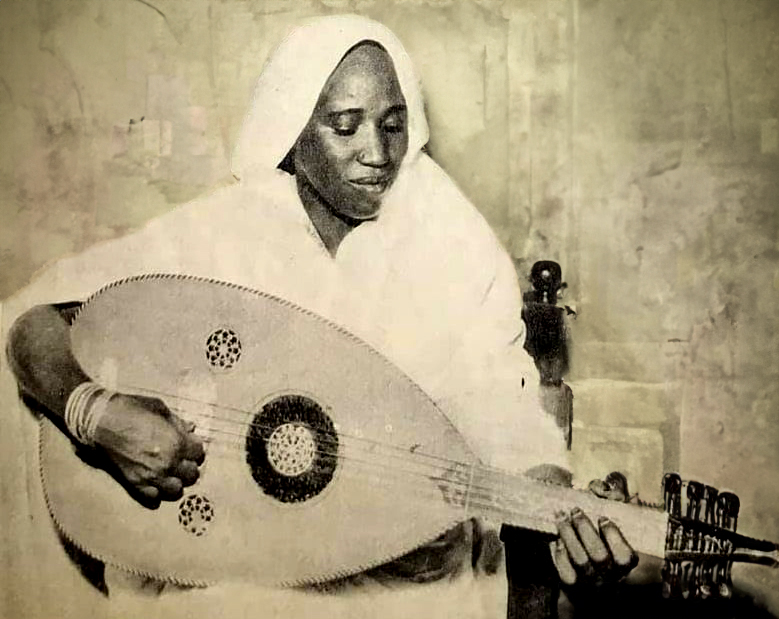

Asha Al Falatiya playing the oud. Image source: SSLH Museum
Over the past decade, the Sudanese music scene has bloomed with the rising popularity of countless female musicians such as Eman Al Shareef, Huda Arabi and Nancy Agag. With all these iconic women breaking barriers and paving their path in the music industry, it is important to recognise that almost 100 years ago, it was unheard of for a woman to appeal to the masses with a professional career in music.
In a music scene that just began to flourish in the 1930s-40s, Sudan heard the voices of many young men singing about love, longing and patriotism. Known as Umm Kalthoum of Sudan and breaking society’s barriers, Asha Al Falatiya cemented her place in history by becoming the first female voice on Sudanese radio, opening doors for many that came after her.
Early Life
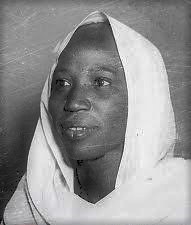
Born in Kassala in 1905 as Asha Musa Ahmed Idris, Asha, the Sudanese variation of the name Aisha, is revered across many generations for being one of the first pioneers of Sudanese music. Her stage name “Al Falatiya” pays homage to her ethnicity. Originally of Hausa and Fulani origin, both Nigerian ethnic groups, she was raised in the city of Omdurman, where she underwent religious education in her father’s khalwa, a small, traditional school where students are taught a religious curriculum, mainly consisting of Quran memorisation and recitation. It is believed that Asha married at an early age and had a son, though the marriage eventually ended in divorce. Some sources suggest she was married twice but divorced only once.
In her teenage years, Asha attended neighbourhood weddings uninvited to listen to the songs sung at these occasions, later memorising and practicing them in private, and some sources even state that Asha began her professional career by singing at small weddings herself. Her style was imitative of vocalists who were popular at the time such as the late Ahmed Al Mustafa, Hassan Atiya and Mohammed Ahmed Sarur, who are recognised as well known icons of the haqeeba era of Sudanese music, a classic genre that dominated the 1920s to 1940s.
The First Notes of Her Musical Journey
In the 1930s, the doors of opportunity opened for Asha when she began recording music professionally with a recording studio in Cairo, making her popular also in Egypt where her music played in Sudanese coffee shops . Her name soon after gained recognition as she worked closely with iconic musicians such as late composer Ismail Abdel Ma’een, also known as the uncredited father of modern Sudanese music, to produce her first records. She was also mentored by the late poet Basheer Abdel Rahman, who wrote the famous song Bint Al Neel (Daughter of the Nile).
During the 1930s, professional male musicians and singers were just beginning to gain popularity amidst a conservative Muslim society, and women singing at that time, especially professionally, violated all known social norms. The career Asha was slowly nurturing at the time was unprecedented in Sudanese history, her social courage molding her legacy in Sudan’s music scene.
Asha’s Voice During Wartime
During World War II, Sudanese soldiers joined the fight as part of the armies of the British colonies. Music played a significant role in the motivation of war troops, and Sudanese musicians gave numerous morale-boosting performances, instilling a sense of hope within the forces at the front lines.
Asha was invited by the Anglo-Egyptian offices to join majority-male groups of singers and musicians for tours to Asmara, Eritrea and across North Africa to entertain troops of the Sudan Defence Force near combat zones. She was also known for performing for wounded soldiers in Khartoum, singing songs such as Yijo A’ydeen (They Will Return).
Making History on Omdurman Radio
In the 1940s, Asha pioneered change in Sudan’s music scene by becoming the first woman to sing on national radio, dressed in a white Sudanese toub traditionally worn by women in official or professional settings. She was accompanied by her sister, musician Jadiya Musa on the oud, along with an orchestra. Her debut performance on Omdurman Radio featured the song Ana Bahibak Ya Muhazab (I Love You, Courteous One). The style of the song was rhythm-dependent with a tum-tum beat, also known as the two-beat rhythm, resembling a heartbeat, while the lyrics were crafted by iconic poet Ali Mahmoud Al Tingari.
Omdurman Radio was established in the early 1940s, and it was the first Sudanese radio station to broadcast music by Sudanese musicians. Early musicians such as Ibrahim Al Kashif, considered the father of Sudanese music, used this platform to perform songs, which often revolved around nationalism and were used as means of coded resistance against the Anglo-Egyptian colonial rule. After the independence, Omdurman Radio flourished and more musicians performed live on the radio station, guiding Sudan’s music scene into its golden age in the 1960s.
Asha’s performance on Omdurman Radio skyrocketed her music career, making her a mainstream singer. She continued to record songs on Omdurman Radio, many of which are considered classics today. Asha worked with countless iconic poets including Al Tingari, Abdelrahman Al Rayyah, and Abdelmoneim Abdelhai to produce songs that revolved around a wide variety of themes from love and separation such as Law Ba’eed Anni (If You’re Far From Me) to patriotism and love for Sudan.
While performing on radio, Asha also sang a series of duets with Ahmed Abdelraziq, a notable performer during their era. Their duets, specifically Al Raida Al Raida (Love, Love), resonated with the public for their playful and affectionate lyrics that almost resembled a dialogue between two loved ones, with one voice answering the other. This structure of songs and duet performances was innovative during that period of Sudanese music history.
Criticism and Controversy
As Asha’s career exploded after her debut on Omdurman Radio, she faced profound criticism from Sudan’s conservative society. At the time, women performing in public spaces was considered scandalous, and while the progressive parts of society celebrated Asha’s music, she still suffered shame for her defiance of social norms. From society’s standpoint, Asha was too progressive, and what was considered far more dishonourable was her close professional relationships with male poets, musicians and composers in the industry.
Despite the criticism, Asha continued on her musical journey without responding to critics, singing for her country and using her music to make a powerful mark in history, all richly depicted in her famous quote, “I suffered, I toiled, and I dedicated my entire life to my homeland.”
The Legacy of Asha Al Falatiya

Asha Al Falatiya on stage. Image source: Al Sudan Weekly Page
During the course of Asha’s career, which continued blossoming until her passing in 24 February 1974 at the age of 69, she recorded over 100 songs in total, all rich with her unique emotive delivery of poetic lyrics. Her fame soared as she continued to record at Omdurman Radio, and she became a widely respected musician with hits such as Min Dar Al Idha’a (From The Radio Station) and Semsem Al Gadaref (Sesame of Al Gadaref) aging well and becoming timeless classics.
Asha’s resilience in pursuing music professionally played a significant role in normalising the presence of women on stage. Her voice and defiance of social norms became an inspiration for women in Sudan, resonating with early women’s rights activists at the time. The legacy she forged remains untouched to the present day, where many people still listen to her music, and the mark she left in the music scene remains evident, with many musicians covering her songs, especially hits such as Semsem Al Gadaref. Her style and legacy lives on through the female icons of today’s music such as Ensaf Medani, Mayada Gamaraldeen, Nada Al Galaa and many more.
Asha Al Falatiya is a name that is permanently inscribed in the pages of Sudan’s music history, a name that continues to command reverence to this day. Her unwavering boldness and refusal to conform to societal norms culminated in a legacy that opened doors for many female musicians after her, reshaping the music landscape of Sudan forever.
Samar Bengawi is a medical student by day, and a literature and music enthusiast by night. She was born and raised in the UAE and is now based in Georgia. She is never without a cup of coffee in hand, and is always “on the go,” chasing after one hobby or another. Passion in Sudanese politics runs in her blood and she considers herself a patriot who hopes to leave a memorable mark in the world.