


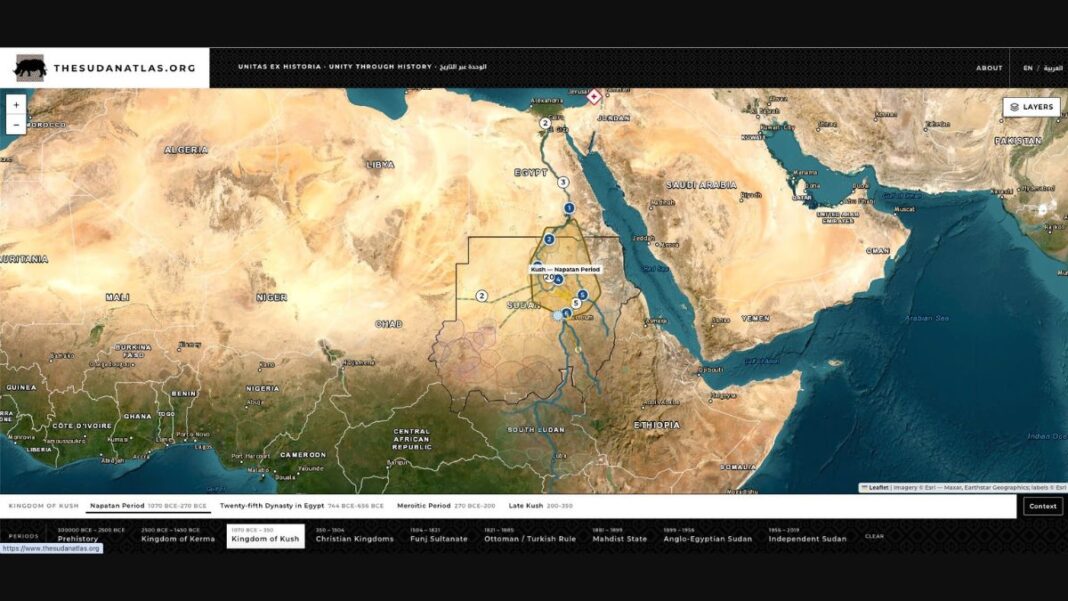

TheSudanAtlas (thesudanatlas.org), a new interactive digital platform dedicated to documenting and exploring Sudan’s history, geography, and cultural heritage, has officially launched.
TheSudanAtlas,org is an independent project launched by Hassan Mohamed, a 17-year-old Sudanese high school student based in Saudi Arabia. It aims to make Sudanese history more accessible, particularly to Sudanese audiences, through an interactive map that brings people together through historical places, events, characters, and stories.
“Unitas ex Historia (Unity Through History). TheSudanAtlas.org was created in response to the racism, tribalism, and fragmentation that too often shape our identity. Whether it is the casual tribalism/racism at dinner tables, weddings, or day-to-day conversations, it’s our duty as Sudanese people to strongly challenge and condemn these beliefs,” said Mohamed.
TheSudanAtlas.org does not seek to erase many of Sudan’s identities, but it exists to educate us about our interconnected history, despite our intense cultural differences, by showing how our peoples, kingdoms, cultures, religions, and communities met and influenced one another over time. To unite our Sudan is to strengthen our understanding of one another, accept our differences, and act as one.”
The timeline filters entries to a chosen period and highlights the political and cultural context of that time. The map is populated by “events” that depict historical figures, cities, battles, and other event types, each with dedicated icons and colours. Once you click on any of these events, you will find information on the event with subsections including: historical significance, related kingdom, historical period, prominent figures, and further reading, in order to encourage readers to “connect the dots” and feel a sense of adventure and exploration.
You can find the full list of event types, alongside geographical features and kingdom types in the Layers button. You can also move some of these events around to make the map feel like your own workspace.
Kingdoms and states are drawn as polygons based on available historical evidence, including flags or material culture where appropriate. Clicking on these states will display images and a description. Subsections also include: government type, capital city, religion, languages, economy, and a timeline.
“TheSudanAtlas.org is not just a collection of historical facts. It provides visitors with an opportunity to discover different aspects of Sudanese history, share their findings with their own local communities, challenge misconceptions, and encourage meaningful conversations about the country’s past,” said Mohamed.
TheSudanAtlas.org is an ongoing project with several planned areas of development. In the near future, this will involve expanding its historical coverage, particularly for the 20th and 21st centuries, introducing additional entries, and several other Quality of Life updates.
“Understanding Sudan’s history offers valuable insight into the societies, individuals, and events that have shaped our own collective identity. Understanding our past is key to understanding who we are. This is particularly important for Sudanese communities living abroad, many of whom may have had limited opportunities to engage with their heritage,” said Mohamed.
Beyond these additions, the project aims to explore new ways of making historical learning more engaging and educational. An important long-term objective is to encourage critical thinking by helping visitors examine historical narratives, question assumptions, and understand the connections between different events and societies.
Further into the future, TheSudanAtlas.org hopes to develop opportunities for greater public engagement and discussion surrounding Sudanese history. Potential initiatives could include a newsletter, a dedicated platform for historical discussion, or other community-oriented projects.
For more information, visit thesudanatlas.org or @thesudanatlas on social media.