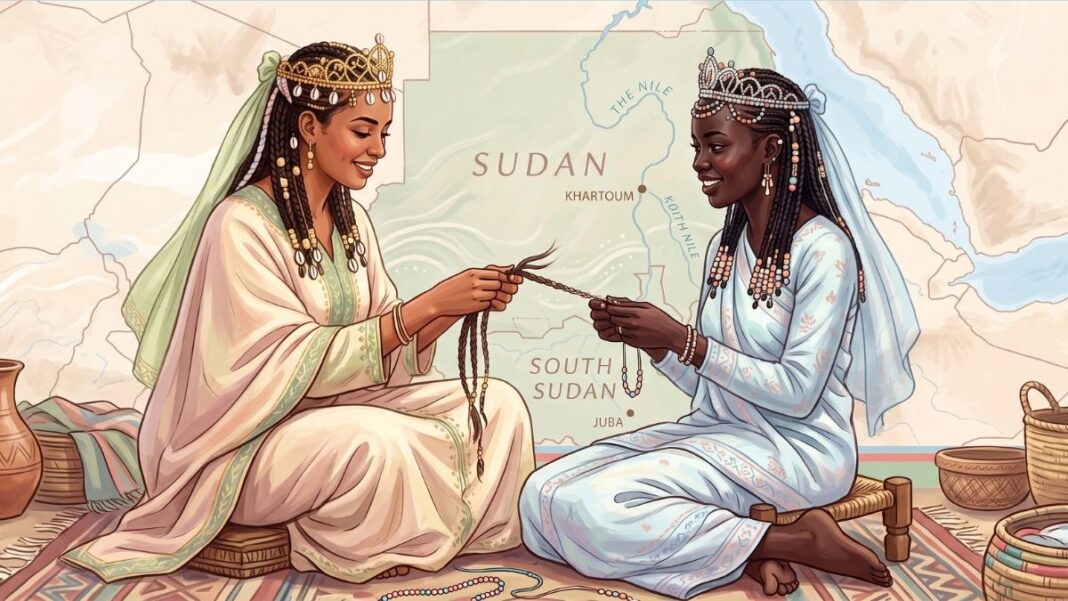
There is a certain nostalgia that arises when saying or contemplating the words “Afro” or “braids”, as they are among the defining characteristics of us as African women. It is the signature African hairstyle that is adopted by millions of women around the globe regardless of their ethnic background. Braids or braided hair have always been a statement to celebrate femininity and divine energy. In Sudan and South Sudan, the ancient hair braiding tapestry is a symbol of social status, cultural identity, and communal bonding.
On the occasion of World Afro Day, celebrated globally on 15 September each year to embrace natural Afro hair, promote self-acceptance, and end hair discrimination, The Sudanist takes you on a journey to tackle a timeline of the braid’s heritage in Sudan and South Sudan.
The Beginning of the Hair Braiding Art
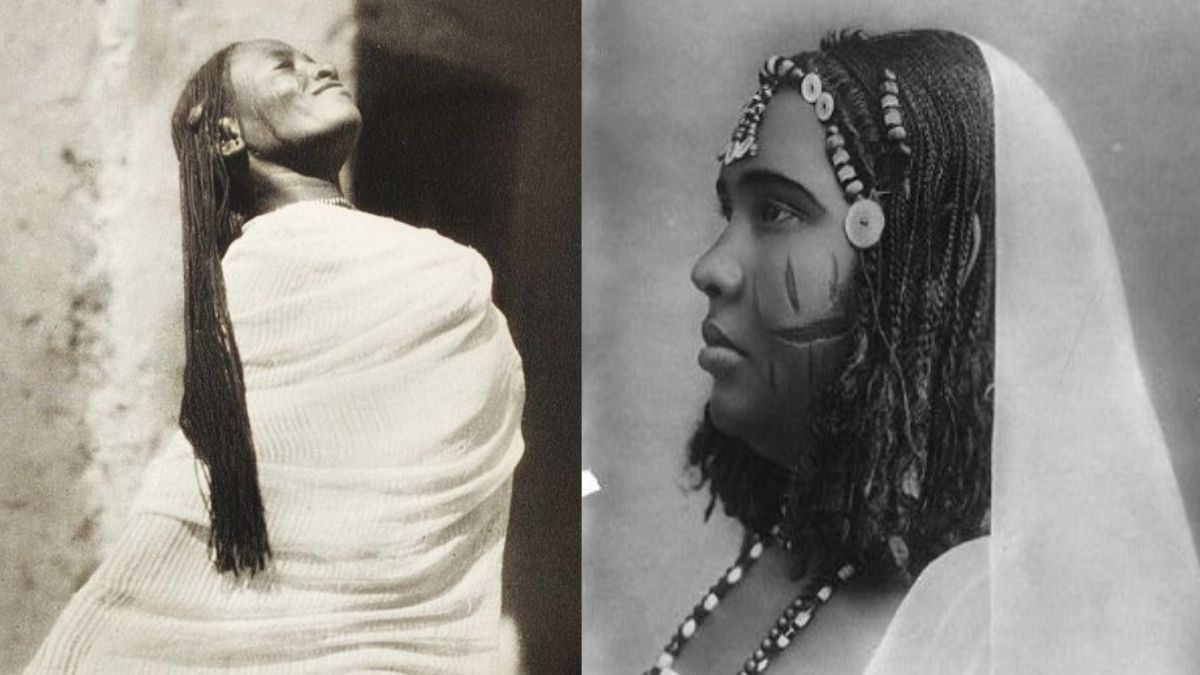
The first depiction of hair braids was in a rock painting discovered by a French ethnologist and his team in the early 1950s. The painting was basically a woman with cornrows in the Sahara desert. It dated back to 3,500 BCE (about 5,000 years ago). Essentially, hair braiding in Africa was used as a way to communicate and resemble wealth, social status and age. Simply, the more time consuming the hair braiding style was, the wealthier the person seemed. On the contrary, when Africans were enslaved they used cornrows as secret road maps as well as a survival method of hair grooming. In addition, cornrows were used to hide seeds that women can plant in their new homes after escaping the warzone.
Hair and Enthnicity
According to The World Atlas, there are 19 major ethnic groups and over 597 ethnic subgroups speaking more than 100 languages and dialects. Consequently, the different styles of hair braids will be a distinctive fusion of both indigenous Africans as well as Arab Africans due to the major migrations and different wars that took place throughout history. The South Sudanese braiding is known for its Pastoralic nature with bold geometric partings and heavy adornment in beads and nature stones, while the north Sudanese braiding is defined by its microscopic plaiting and adornments in gold and silver coins and shells as a result to the Arab African trade exchange between Sudan and the Arabian Peninsula.
The Distinctive Sudanese Mushat
Hair braiding in Sudan was not just a hair style, it was ceremonial. In Sudan, the word for braiding is called mushat. It comes from the Arabic word mashat as in ‘combed the hair’. Also, the Arabic word for the hair comb in Arabic is musht or misht. The Sudanese hair braiding or mushat, is a technique of tightly woven, incredibly fine plaits that map the scalp in geometric patterns. The hair braider, known as mashata, was a respected “cultural broker” who moved across social classes. She was summoned for weddings, births, and milestones, acting as the community’s rhythm-keeper while women exchanged news and advice.
Occasions for Hair Braiding
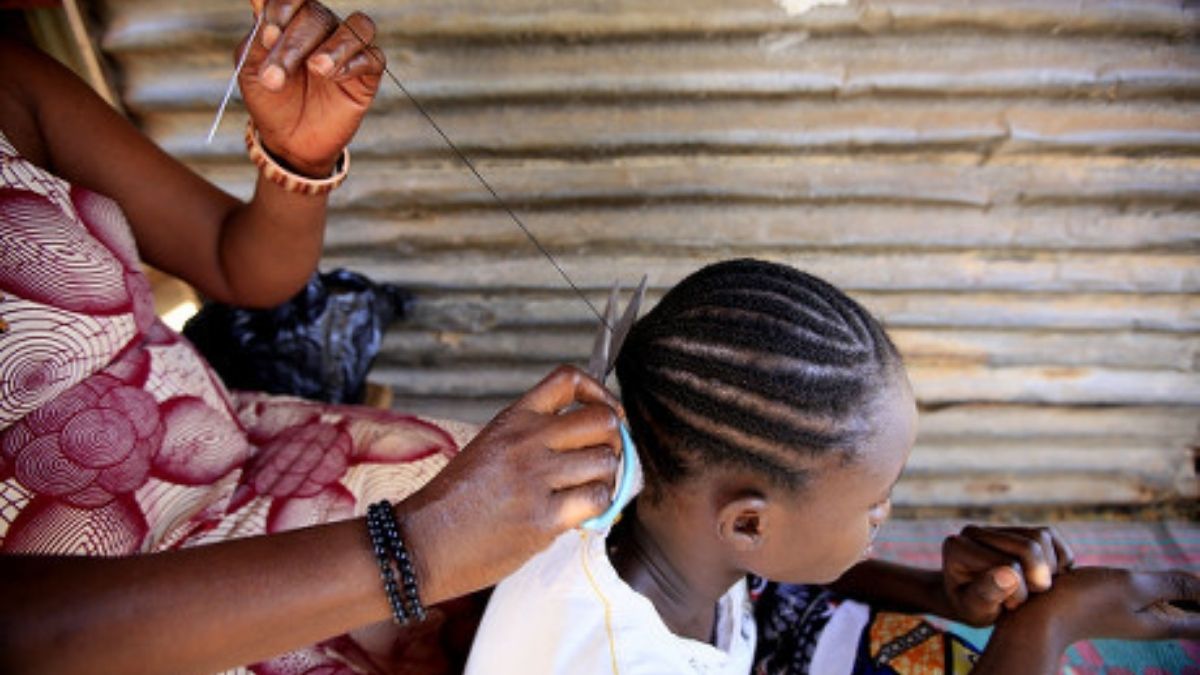
Historically, the hair braiding mushat ceremony was celebrated for several occasions such as wedding, birth, or even the holistic transition of women from being girls to adult sophisticated ladies. Weaving fine mushat could take anywhere from a full day to three days. The process brought women together in an intimate domestic setting. To prepare for matrimony, a bride would sit for days surrounded by female friends who kept her entertained with singing and conversation. Young girls and women would often adorn their braids with silver, gold coins, beads, or cowrie shells to indicate wealth or marital status. As certain ancestral styles shifted, it became common practice to weave black silk threads into the hair to seamlessly extend the length of the plaits.
The Evolution Through the Century
Throughout the past century, there were distinctive milestones and eras in which the hair braiding art juxtaposed the culture of North Sudan versus that of South Sudan. The timeline below depicts the ways the two hair arrangements’ styles were either completely different or interwoven.
100 Years of Heritage: A Timeline of Hair and Braids
Era 1: The Historical Foundation (1920s)
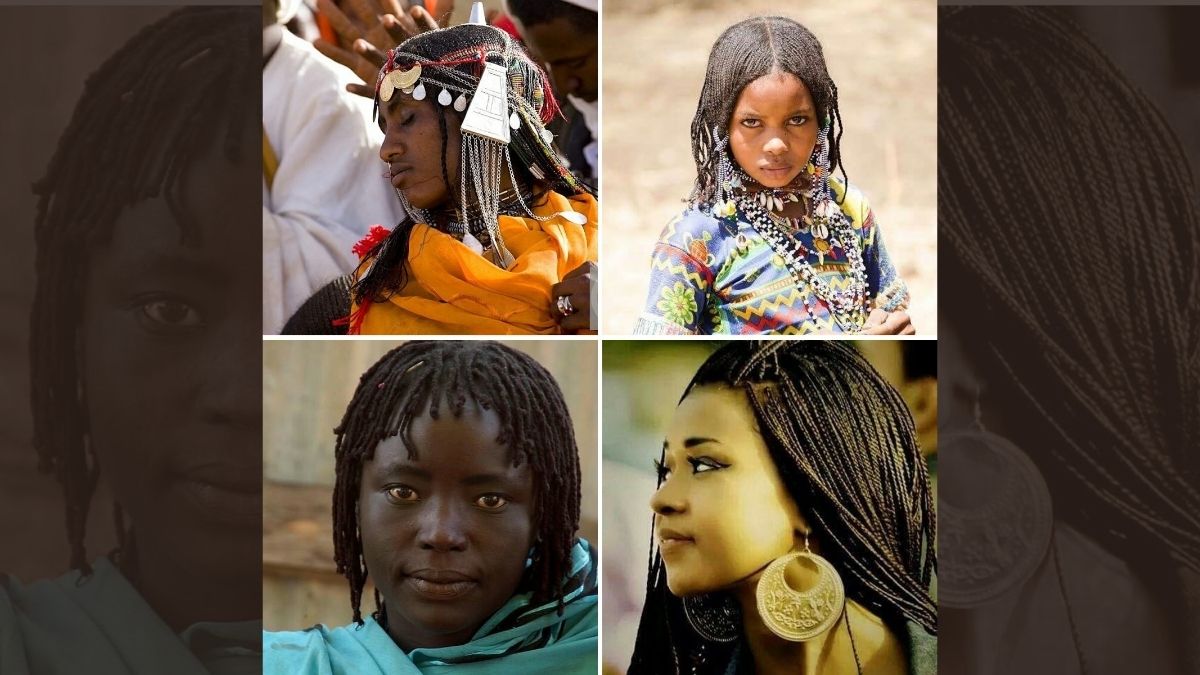
The early 20th century in northern and riverine Sudan was defined by the strict cultural institution of the mushat. This style featured dozens of microscopic, tight plaits mapped in complex geometric patterns close to the scalp. Weaving these required immense skill and days of communal labour. As a sign of social status and preparation for marriage, a young woman’s braids would be heavily adorned with precious materials. Historical accounts mention silver coins, gold disks, and cowrie shells indicating wealth. In South Sudan, however, the culture dominantly relied on different structural techniques like free-hanging twists, geometric shaving, and the use of ochre and animal fat, rather than the scalp-hugging plaits of the Northern Sudanese mushat.
Era 2: Innovation and Regional Division (1950s)
Following World War II, increased trade and communication led to subtle shifts. While the foundational geometric mushat remained popular in the north, new materials were integrated.
A key innovation in the 1950s was the widespread adoption of weaving black silk threads into the natural hair. This allowed women to exponentially increase the length of their braids while maintaining the signature fine, tight appearance, blending tradition with extended elegance. In South Sudan, distinct styles tied to pastoralism began to solidify separately from the northern plaiting traditions.
Era 3: Pastoral Rites and Beaded Identity (1970s)
In the 1970s, there was less emphasis on the traditional mushat hair braiding in North Sudan. Women often requested softer, personalised adaptations, such as leaving loose sections of hair on either side of a centre parting to frame the face rather than plaiting every strand.The hair maintenance involved rubbing the washed plaits with a fragrant blend of sandalwood, sesame oil, and local herbs. The mushat was intentionally designed to complement the toub, the traditional draped garment Sudan wear. Women would sometimes fold their toubes deliberately to allow glimpses of their elaborate plaits beneath.
On the other hand, practices in South Sudan (among groups such as the Nuer and Dinka) were distinct. Hair was rarely braided into tight patterns. Instead, style was broadcast through cutting and extensive accessorising. Men and women used cattle ash to bleach their hair to reddish hues, and complex beadwork integrated directly into the hair signalled social status and age grade. The style below features bold red, white, and blue beads, which are still used in contemporary cultural markers in South Sudan.
Era 4: Fusion and Global Influence (1990s)
By the 1990s, urbanisation and global media introduced new influences. Young women, specifically in North Sudan, began fusing traditional complexity with Western-style braiding. This era saw the rise of ‘fusion styles’: combining neat, geometric cornrows (derived from the mushat logic) on the scalp with medium-sized hanging ‘box braids’ using synthetic extensions. These hybrid styles were accessorised with traditional elements like cowrie shells and gold clips, blending ancestral heritage with modern fashion trends. Historically, however, South Sudanese hair styling during this decade was defined by the harsh realities of the Second Sudanese Civil War (1983–2005) rather than the fashion and urbanisation trends seen in the north. Mass displacement forced a shift to making the hair styles low-maintenance in simple twisting and cornrows the norm for hygiene and survival purposes. For South Sudanese communities that managed to resettle globally during the 1990s, traditional structural styling and beadwork were fiercely preserved and adapted using modern materials as a vital method of cultural resistance and identity retention.
Era 5: Modern Dynamic Heritage (2020s)
Today, braiding is a dynamic expression of cultural pride and individual artistry. In the north, styles are highly inventive, mixing coloured synthetic extensions and intricate scalp patterns (such as zigzags and spirals) that are far more sculptural than the historical mushat. Conversely, contemporary South Sudanese styling centres on the powerful resurgence of pastoralist aesthetics. Youth and diaspora artists are bringing traditional fine twists, sharp geometric shaving, and vibrant red, white, and blue structural beadwork into modern fashion spaces. Across both traditions, the look is completed with bold accessories, from polished beads to vibrant fabrics, celebrating 100 years of visual language.
Sara is an author, journalist, and a previous communication specialist with a passion for storytelling that bridges complex social issues and deeply human experiences. She holds a degree in Journalism accompanied by a certificate in Middle Eastern Studies. Her journalistic work spans a diverse array of critical global topics, ranging from in-depth reporting on gender controversies in Sudan to exploring solutions in sustainable fashion. Sara is the debut author of the children’s book There Will Be a Day. Driven by a personal mission to provide comfort and gentle guidance, she wrote the book to help young readers navigate the difficult journey of grief and loss.