


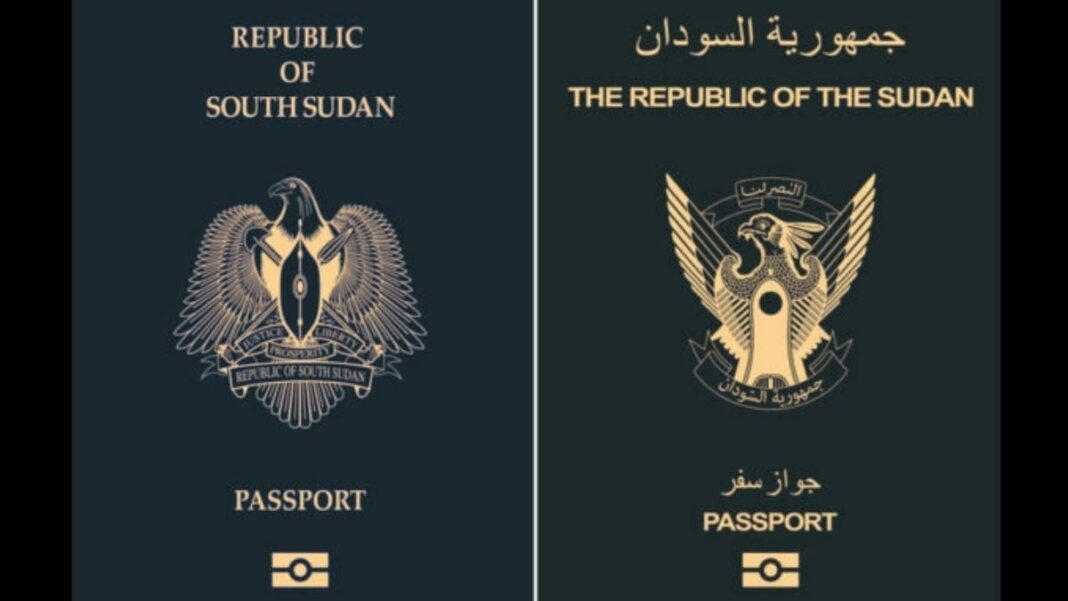
South Sudan and Sudan ranked 93rd on the Henley Passport Index 2026, with visa-free access to 41 destinations.
Both countries dropped one place from their joint 92nd ranking earlier this year, which was their highest position in recent years, despite ongoing political and economic challenges.
Ranking passports based on the number of destinations their citizens can visit without a prior visa, the Henley Passport Index released its 20th anniversary edition on 21 July 2026, revealing that the average passport now provides visa-free access to 108 destinations worldwide, up from just 58 when the index was first launched in 2006, demonstrating how dramatically global mobility has expanded over the past two decades.
The passport rankings for both nations have fluctuated over time. South Sudan has generally ranked higher than Sudan, reaching its lowest position at 104th in 2015 and 2021, and its highest at 86th in 2008 and 2009. Sudan, meanwhile, recorded its lowest ranking in 2021 at 107th place, and its highest in 2006 at 79th place. Since 2015, however, it has not managed to rise above the 90s.
Although both countries rank relatively low, they are not among the lowest-ranked passports globally. These include Afghanistan (104), Syria (103), Iraq (102), Pakistan (101), Yemen (100), Somalia (99), Nepal (98), North Korea (97), Bangladesh (97), Palestine (96), Iran (96), Eritrea (95), Sri Lanka (94), and Libya (94).
The world’s most powerful passport is Singapore, which has held the top position almost consistently in recent years. It is followed by Japan, South Korea, and the UAE (all ranked 2nd), with visa-free access to 188 destinations. Sweden ranks 3rd, with visa-free access to 187 destinations, while Belgium, Denmark, Finland, France, Germany, Ireland, Italy, Luxembourg, the Netherlands, Norway, and Spain are all tied in 4th place, with visa-free access to 186 destinations.
The Henley Passport Index is published by Henley & Partners is the global leader in residence and citizenship planning. It is considered the original and authoritative ranking of the world’s passports, based on the number of destinations their holders can access without a prior visa. It uses exclusive data from the International Air Transport Association (IATA), the world’s largest and most accurate travel information database, enhanced by Henley & Partners’ research team.
A score of 1 is awarded if no visa is required, including cases where a visa on arrival, visitor’s permit, or electronic travel authorisation (ETA) can be obtained. A score of 0 is given where a visa is required in advance, including e-visas or pre-departure government approvals. A passport’s total score equals the number of destinations for which visa-free or equivalent access is granted. To see the Henley Passport Index 2026, visit henleyglobal.com/passport-index/ranking.
According to a statement by Henley & Partners, “The findings stand in stark contrast to the latest Global Peace Index, which also marks its 20th edition and paints its bleakest picture yet. According to the Institute for Economics & Peace, the world is experiencing the highest number of state-based conflicts since the Second World War, with global peacefulness declining for the 12th consecutive year. Today, 119 of the 163 countries measured are less peaceful than they were in 2008, while 103 countries have been involved in an external conflict during the past five years — almost double the number recorded when the index began.”
The Global Passport Power Rank, which also measures passport strength based on mobility scores. In the 2026 rankings, Sudan is placed 85th and South Sudan 86th. The UAE holds the top position, followed by Singapore, while Afghanistan ranks as the world’s least powerful passport. To see the full Global Passport Power Rank 2026 index, visit passportindex.org/byRank