
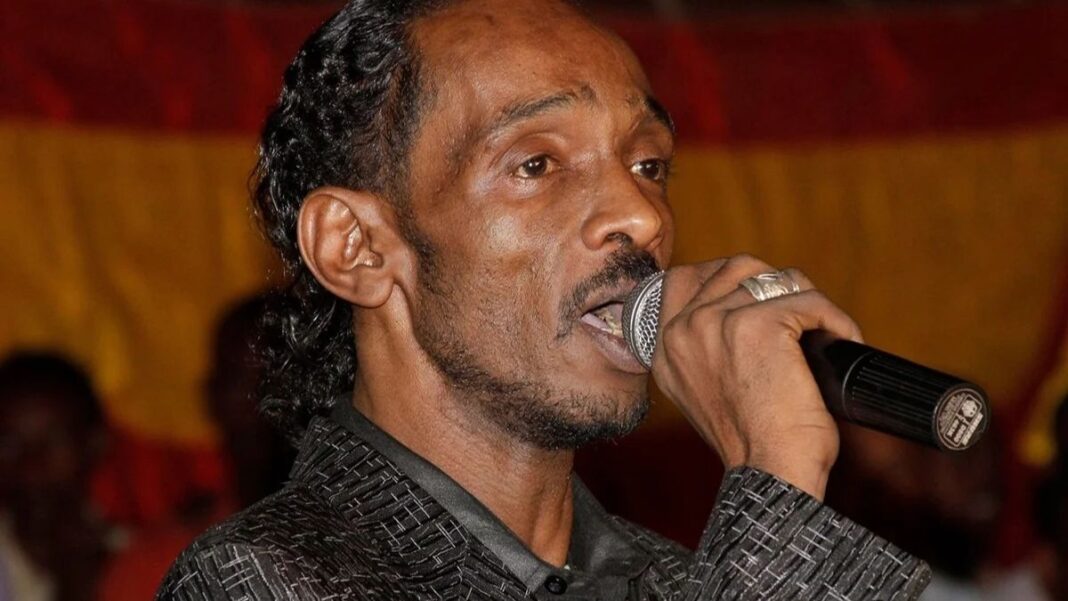
Early this year, 1 January marked 13 years since the passing of the late and great singer and songwriter Mahmoud Abdulaziz popularly known as “Al Hoot” or “The Whale”, whose legacy still lives on today.
After the era of consolidation, known as Tamkeen, which followed 1989 and the rise of the National Islamic Front (NIF), Sudan’s artistic scene began to change significantly.
Through the 1990s and 2000s, the regime under the leadership of former President Omar Al Bashir, supported by mastermind Islamist ideologue Hassan Al Turabi (1932–2016), imposed a form of islamisation on the country, specifically the music and arts scene. This shift reshaped the cultural landscape according to a narrow ideological vision. As a result, creative freedom declined, and many artists were forced to leave or withdraw from the scene. Over time, the presence of authentic artists, those who once reflected the diversity of Sudanese art, diminished, replaced by superficial figures who contributed to genuine creativity, leaving the arena hollow and deprived of innovation.
Consequently, many creatives emigrated, while others chose to stay in Sudan and resist this imposed reality, despite the suppression, ambiguity, and such a complex context. Abdulaziz managed to challenge what was presented as the regime’s “civilisational project,” exposing its contradictions and deceptions. Unfortunately, his journey ended early when he died on 1 January 2013 at the age of 45 in while seeking Amman, Jordan, following complications related to a medical procedure, with reports indicating a peptic ulcer.
Supported by a wide youth base frustrated with a system that had crushed their aspirations and modest dreams, young people found in Abdulaziz a voice that resonated with them. Born on 16 October 1967, he emerged as one of the most significant musical figures capable of transcending restrictions and creating a distinct artistic movement. Abdulaziz became an exceptional presence in the collective consciousness of Sudanese youth, capturing the emotions of an entire generation experiencing frustration and alienation due to political and social transformations. Through his strong presence and unique style, he built a broad fan base, especially among young people who saw in his music a space to express their suppressed hopes and identities.
The regime eventually took notice of this rebellious young artist who opposed its agenda, much like many principled Sudanese youth. Attempts were made to co-opt him, to bring him into their fold, but these efforts ultimately failed. While many artists of that era faced pressures of co-optation or containment, Abdulaziz remained committed to his independent artistic path. He presented art grounded in genuine emotion and direct connection with his audience, far removed from political calculations or the dictates of authority. This is what made him, in the eyes of his admirers, a symbol of the free artist, one who chose to stand with the people rather than align with centres of power. Abdulaziz’s message was rooted in art, love, and truth, not in pleasing authority or serving projects that suffocated creativity.
Therefore, Abdulaziz lived as a noble and creative figure, offering his art to the youth, the dreamers, the rebels, the pure-hearted, and those disillusioned by the so-called civilisational project and Al Inqaz government (the ruling government in Sudan from 1989 to 2019, also known as the “Salvation” regime). In this sense, Abdulaziz was not merely a successful singer; he became a symbol of an entire generation of young people searching for a voice that could represent them in a turbulent time. His name remains a defining marker of that era in the history of modern Sudanese music.
Abdulaziz remains relevant not as nostalgia, but because the conditions that shaped his voice have returned in even harsher forms. Sudan’s current reality, marked by war, political fragmentation, and institutional breakdown, has intensified the same sense of dislocation and loss that once made his work resonate so deeply. In such moments, the absence of a sincere, unifying cultural voice becomes more visible, not less.
While today’s artists are still responding to the crisis, but they do so within a fractured and unstable cultural space that limits sustained influence or symbolic continuity. As a result, no contemporary figure has been able to occupy the same generational role or emotional authority that Abdulaziz once embodied.
The real question, then, is not whether his equivalent exists today, but whether Sudan’s present condition even allows for such a figure to emerge. Yet the need remains: an artist capable of articulating lived experience with honesty and resisting co-optation. In that sense, Abdulaziz endures less as a memory than as a benchmark for what cultural authenticity looks like under pressure.