


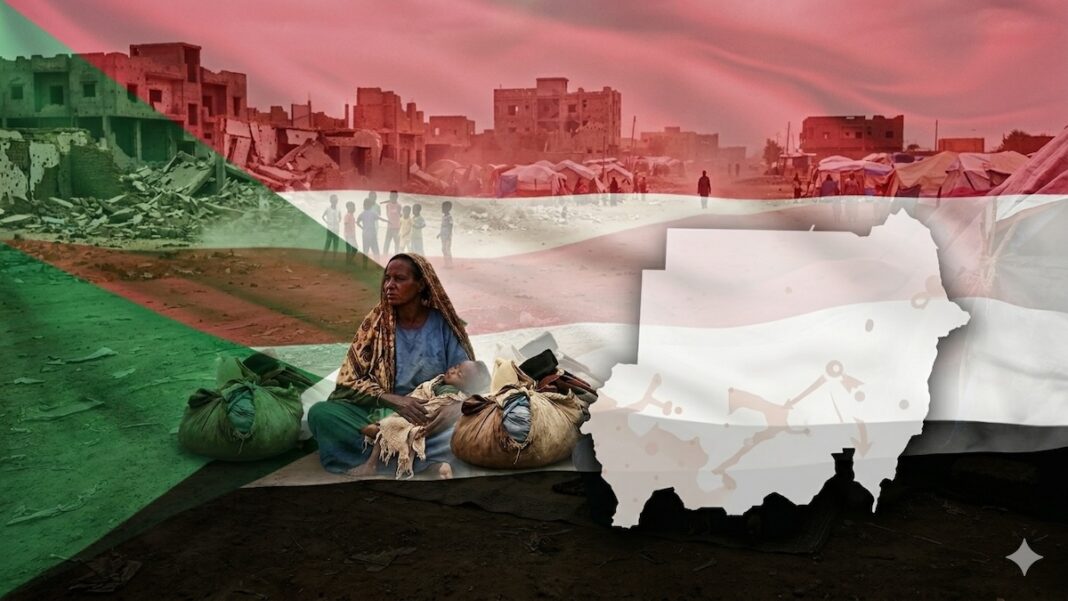
On 15 April 2026, Sudan marks three years of war.
On 15 April 2023, war broke out in Sudan between the Sudanese Armed Forces, led by General Abdel Fattah Al Burhan, the de facto leader of Sudan, and the paramilitary Rapid Support Forces (RSF), led by Mohamed Hamdan Dagalo (Hemedti).
The conflict has displaced between 12 and 14 million people resulting in what is widely considered the world’s largest displacement crisis and one of its worst humanitarian crises. The war has resulted in a devastating death toll estimated between 150,000 and over 400,000, encompassing deaths from direct violence as well as starvation and disease.
Where Sudan Stands Today – in 2026?
- World’s largest displacement crisis.
- World’s largest child displacement crisis – over 5 million children have been displaced within or outside Sudan.
- One of the world’s worst humanitarian crises.
- One of the world’s worst education crises, with over 8 to 17 million school-aged children out of school.
Famine in Sudan
The Integrated Food Security Phase Classification (IPC) has confirmed famine and severe food insecurity in Sudan across multiple regions since 2024, with over 21 million people facing acute hunger. Several areas have been classified as:
- Catastrophe (IPC Phase 5)
- Emergency (IPC Phase 4)
- Crisis (IPC Phase 3)
Most affected areas include:
- South Kordofan (IPC Phase 5/4): Dilling, Kadugli, and surrounding areas of the western Nuba Mountains
- North Darfur (IPC Phase 5/4): Al Fasher and northwestern localities including Um Baru, Kernoi, and At-Tine
- North Kordofan (IPC Phase 3): Al Obeid and surrounding rural areas
The Good News
In late 2024, the SAF recaptured several major cities and states, including Khartoum and Al Gezira, from the RSF. This has restored a degree of safety in some areas and encouraged many Sudanese to return home, both internally and from abroad.
As of early 2026, more than 3 million displaced Sudanese have returned to their home areas, with thousands more continuing to return despite ongoing conflict.
Khartoum International Airport has also partially reopened, and Sudan Airways has resumed operations, offering both domestic and international flights.
Ongoing Concerns and Struggles
- Hunger remains widespread with over 21 million in acute hunger, from Khartoum to Al Gezira to Darfur.
- Water and electricity services are only slowly returning.
- Internet and telecommunications remain unstable.
- Healthcare services are severely limited across the country.
- Damaged education infrastructure has led to three years of disruption, with an estimated 8 to 17 million school-aged children out of school. Since April 2023, nearly 500 days of learning have been lost, with 54% of schools either in conflict zones or used as shelters.
- Access to basic goods (groceries, household necessities) remains inconsistent.
- Disease (cholera, dengue fever, malaria, etc).
- Burglary, theft and robbery.
- Recovering lost, damaged or stolen property.
- Uncovered and active military mines, along with unexploded ordnance (UXO).
- Thousands of bodies continue to be recovered from streets, homes, and makeshift graves across Sudan, particularly in Khartoum and Darfur – over 15,000 bodies have been exhumed in recent months.
- Rape and sexual violence – over 4,000 reported cases of sexual violence affecting men and women, and children (boys and girls) as young as one year old.
How to Help?
Three years later and Sudan is still in urgent need of humanitarian aid.
Donate, donate, donate.