“Did you hear about the rose that grew from a crack in the concrete?” is a popular line from the late, iconic rapper Tupac Shakur’s poem and song, The Rose That Grew from Concrete.
Sudan plunged into a devastating war in April 2023 after a vicious struggle for power broke out between its army, the Sudanese armed forces (SAF), and a paramilitary group, the Rapid Support Forces (RSF). The war started in Khartoum, the capital, and eventually spread to other parts of Sudan such as Al Gezira State, and parts of Darfur and Kordofan in western Sudan.
As a result, Sudan is facing the world’s largest internal displacement crisis, with at least 11.5 million people forcibly displaced by conflict since April 2023. Approximately 7.2 million people are internally displaced (IDPs), while over 4 million have fled to neighbouring countries like Egypt, Chad, and South Sudan.
Families continue to navigate uncertainty, disrupted livelihoods, and weakened systems of support inside and outside Sudan. As a humanitarian aid worker, I’ve seen the struggles as well as the resilience of displaced Sudanese across country first-hand.
During my time as a humanitarian aid worker in Port Sudan, which once served as Sudan’s de facto temporary capital and seat of government until Khartoum’s recent return, and the main port city in Red Sea State, I had resumed my work there after being displaced from Khartoum. I organised many observational visits to sheltering sites in the city that accommodate internally displaced people from all over Sudan, during one of these visits, I met one of the bravest women I have ever met, a teacher and artist named Suaad AbeidAllah sitting under a sheltered corner hiding away from the heated Sudan. As if we had already known each other, I felt an urge to approach and greet her. She quickly welcomed me into her small corner, and little did I know that from this woman I would carry with me a sense of hope during the devastating times my beloved country is going through.
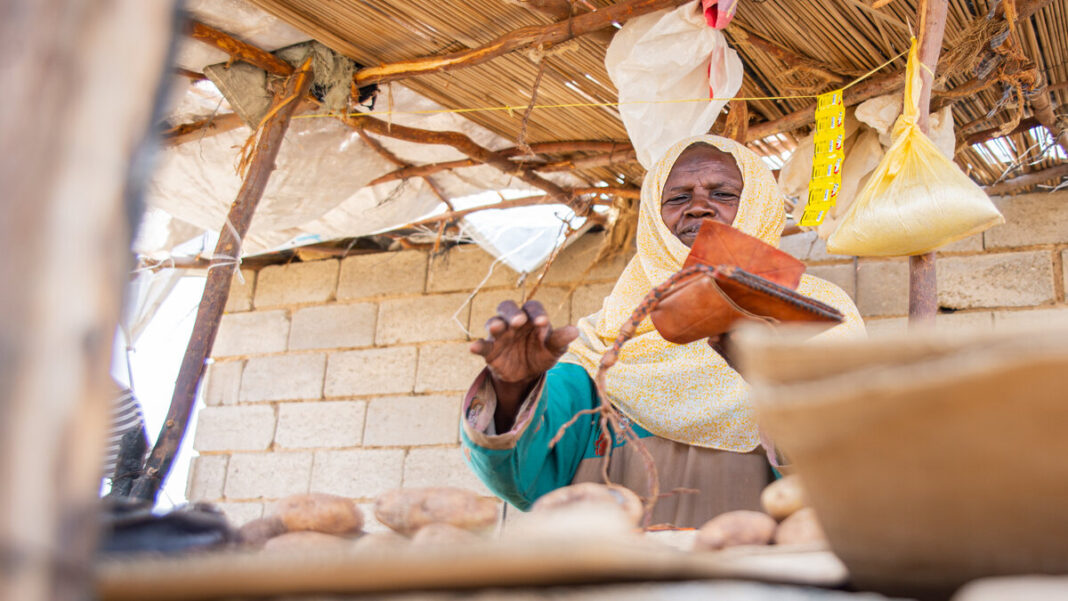
I found Suaad in the Al Eskan neighbourhood, one of the largest displacement centres in the Red Sea State, seated in a modest corner of her home, surrounded by vegetables and locally crafted bags she had stitched herself. Her hands moved steadily, with the confidence of someone who had taught for over forty years and exhibited artwork abroad, but also with the urgency of someone who must now provide for her family in displacement.
Suaad offered me a cup of minted tea and three dates, and introduced me to herself and her family. Before the war reached Khartoum, her life centred around teaching and art. She had been a teacher for 40 years, and beyond her teaching career, she participated in art exhibitions and travelled abroad to present her unique crafting talent.
Two months into the conflict, Suaad and her five children were forced to flee, first to Wad Alhadad in Al Gezira State, where she sold zalabya or luqimat, popular fried doughnut balls, for a living. When fighting spread there, they endured a 17-hour walk to Wad Yassin in Al Gezira, before finally moving again through Sennar, Al Gedarif, and finally arriving at Port Sudan.
There, with relentless determination, Suaad borrowed supplies to cook and sell zalabya for two months, slowly rebuilding her capital. Seeing an opportunity, she then arranged a small corner to sell vegetables, starting with just one kilogram each of potatoes and tomatoes. Through her perseverance, her capital grew, allowing her to expand her humble business.
I have seen this pattern repeatedly in my work in the humanitarian field, displacement in Sudan is rarely one journey; it is a series of disturbances, each one stripping families of savings, social networks, and stability.
In such environments, I often observe systemic gaps that go beyond immediate needs, the centres are overcrowded, families face the danger of getting kicked out from schools which now serve as shelters, children struggle to access continuous education, healthcare is fragile and families must improvise to fill these voids. Yet within these gaps, women like Suaad are not passive recipients of aid. They take initiative, whether through selling food, crafting, or organising community support. What drew me the most to her was her commitment to continue and deliver.
Across Sudan, in Al Gedaref State, Sinkat locality and other displacement sites, I have seen women carving spaces as educators, entrepreneurs, and cultural bearers. Suaad’s experience is part of a broader mosaic of displaced women whose creativity and labour preserve culture and create bonds of cohesion in fractured communities. Her daughter now serves in the neighbourhood’s IDP registration committee, linking new arrivals to humanitarian actors and helping her mother manage the small business.
Suaad’s story carries lessons for us all. Humanitarian actors can do more to support creative livelihoods by investing in small markets and providing access to materials and finance for women. Policymakers can protect displaced entrepreneurs through fair vendor regulations and secure tenancy, while communities themselves can amplify the role of women as leaders and mediators. Supporting education and healthcare in these sites must be seen not only as emergency measures but as investments in the future of families who may live in displacement for years.
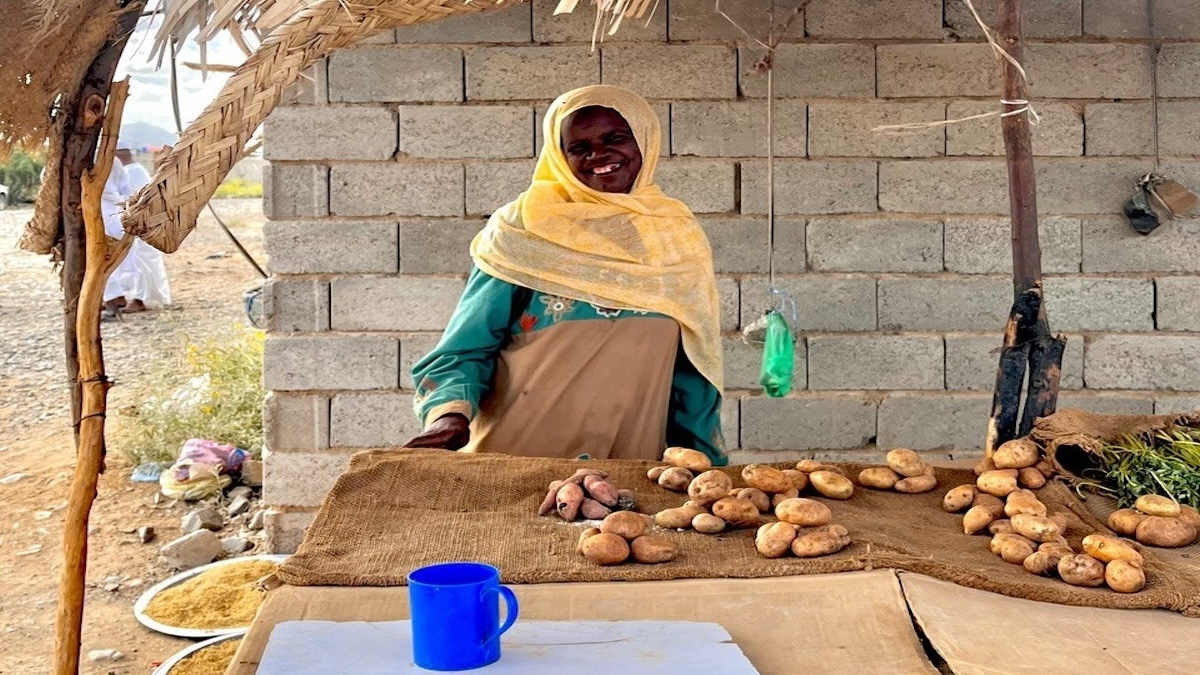
“I don’t know what tomorrow holds,” Suaad told me with a gentle smile. “At first, you live a very normal life, you wake up in the comfort of your own home, do the things you love, and go about your day. Then, suddenly, everything collapses. The places where you once felt safe become dangerous. You pack with a heavy heart, leave behind the things that meant everything, and step into the unknown. I hope that love and security endure in Sudan, that there is purity of intention, and that the country progresses,” she concluded.
According to a UN Women report, “The impact of Sudan’s war on women, two years on” from 15 April 2025, women make up 53% of those displaced inside Sudan, reports of gender-based violence have surged by 288% in 2024. with 80% of hospitals non-functional, maternal deaths are rising and safe spaces have vanished. Yet, women of Sudan are stitching, selling, organising, teaching, and raising their children. Supporting them is strategic. Investing in women’s leadership, safety and livelihoods is how post-war recovery begins, from the ground up, hand by hand, story by story.
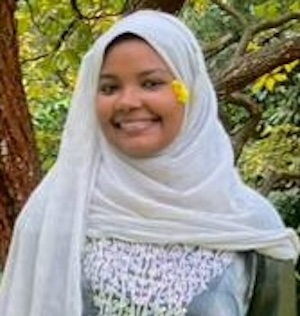
Rania Elhassan is a 24-year-old Sudanese woman, working in humanitarian aid and advocacy, with an academic background in political science and sociology from University of Khartoum. In her free time, she enjoys spending her time reading novels and writing pieces.


Very interesting topics.ihope to ready more
I hope to silver some topics
We can speak