



In 2020, Sudanese-Russian filmmaker and researcher Suzannah Mirghani released the short film Al-Sit to a glowing international reception. Writing for 500WM in 2023, Sudanese film enthusiast Tuqa Hafeez described it as a “masterpiece.” In my list of 10 memorable Sudanese films, I ranked it 10th, praising its script and performances while noting it was “too brief to fully deliver on many of its themes.”
Luckily, Mirghani’s intention was always to make the story of Al-Sit into a full-length film. Now, five years later, Cotton Queen (2025) is Sudan’s first female-directed and written narrative feature, reworking Al-Sit’s story about a teenage girl facing arranged marriage into a full-fledged coming-of-age drama.
Some will be wary of another Sudanese film where a young protagonist asserts their autonomy in an environment of dogmatism and misogyny. However, Cotton Queen is no exercise in Eurocentric self-flagellation. Not only does the film critique Westernisation, it also presents a loving portrait of rural Sudanese womanhood. All in all, it is the most multifaceted cinematic depiction of agrarian Sudan to date, offering a rewardingly complex meditation on generational struggle, colonialism, and patriarchy.
The Filmmaker

Behind-the-scenes photo of the cast and crew of Cotton Queen. Source: Suzannah Mirghani
Mirghani was born in Sudan and lived there until she was a teenager, where she encountered the characteristic cotton fields of Al Gezira State, site of one of the country’s primary industries during the period of English colonisation of Sudan (1899-1955). In a 2025 interview with the London-based publication The Upcoming, Mirghani described the cotton fields as “magical,” discussing how her early memories of Sudan have been reshaped — perhaps unreliably — since her moving to Qatar, where she now works and resides.
In Qatar, Mirghani undertook media and museum studies at the local branch of University College London (UCL). After time spent researching cinema, she officially entered the world of filmmaking in 2011 with Hamour, a short film about a family of Indian boat repairmen in Qatar dealing with the decline in their socioeconomic status. This film was followed by Hind’s Dream (2014), a well-received, mystical short film about an Arab woman’s strange dream, and then Caravan (2016), another short exploring the inner lives of people stuck in a traffic jam in Doha.
In 2020, however, Mirghani’s focus shifted from explorations of the country she lived in, to the country she remembered, with the short film Al-Sit being produced as a proof-of-concept for a future feature film dealing with the life of a girl facing arranged marriage in Al Gezira. Winning 23 awards at international film festivals, Al-Sit was quickly appreciated as a feminist work confronting arranged and child marriage in the country. It was followed by Virtual Voice (2021), an experimental, satirical short film exploring the personal impact of social distancing during the COVID-19 pandemic through the figure of a Bratz doll, Mirghani’s digital avatar.
Virtual Voice was followed a year later by a documentary on acclaimed Sudanese artist Kamala Ibrahim Ishag, titled States of Oneness (2022), a continuing sign of Mirghani’s keen interest in examining the reality of Sudanese women through a feminist lens.
Production and Distribution

Suzannah Mirghani (centre) in front of a still from Cotton Queen, flanked by two organisers at the Venice Film Festival. Source: Suzannah Mirghani
All of Mirghani’s filmmaking experiences — from the magical realism of Hind’s Dream, to the rumination on modernity in Virtual Voice, to the Sudanese feminism of Al-Sit and States of Oneness — culminate in her debut feature, Cotton Queen.
Cotton Queen was produced under the tutelage of the Qumra mentorship programme, coordinated by the Doha Film Institute (DFI), a non-profit founded by Sheikha Al Mayassa bin Hamad Al Thani, sister of the current prince of Qatar. Like its predecessor Al-Sit, Cotton Queen is distributed by MAD Distribution Films, an independent Pan-Arab film company that holds the rights to many other Sudanese films, such as Madaniya (2024).
The film stars actors Mihad Murtada, recruited via auditions at Sudan Film Factory, as well as celebrated Sudanese stage actors Rabha Mohamed Mahmoud and Haram Bisheer in its principal roles. Most of the actors reprise their roles in “Al-Sit,” although a few have been replaced, notably the Sudanese businessman, played in Cotton Queen by Hassan Kassala, one of the lead actors in the Sudanese soap opera ‘Asham (2018).
Despite the crew’s desire to film in Mirghani’s home state, the circumstances of the third Sudanese civil war that began on 15 April 2023 required production to move to Egypt, forcing the team to recreate the scenery of rural Sudan in an Egyptian setting.
Regardless of these challenges, Cotton Queen debuted at the Venice Film Festival on 3 September 2025, and has, so far, been warmly-received by global critics. But what does the film hold for Sudanese audiences?
The Review
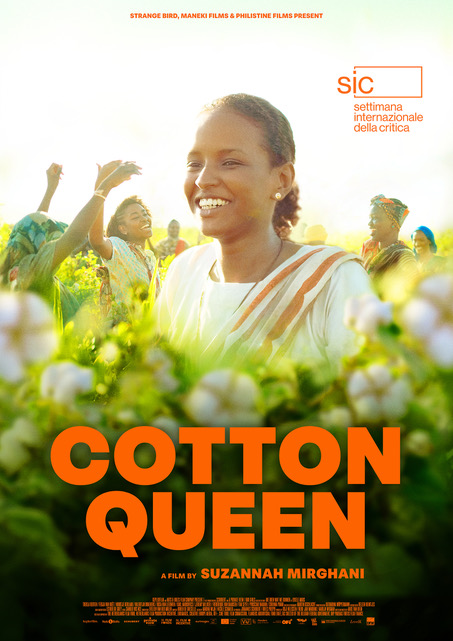
Cotton Queen is, at its core, a coming-of-age story. The film revolves around Nafisa, a teenage girl dealing with her mother and grandmother’s new expectations for her as she transitions to womanhood. The emotional heart of the movie is the struggle between these three generations of Sudanese women, who attempt to achieve their own, conflicting visions for Nafisa’s future.
Cotton Queen creatively intertwines this family drama with an exploration of the British colonial legacy in Al Gezira. The arrival of Nader, a Sudanese businessman raised outside the country, who aims to replace local cotton with imported, sterile seeds, threatens the self-sufficient farming methods that defined Nafisa’s childhood. This change is welcomed by Nafisa’s mother (who hopes to profit from it) and rejected by her grandmother (who defended the farms against colonialism) crafting a story where Nafisa attempts not only to assert her autonomy vis-a-vis her elders, but also resist a neo-colonial intrusion on local agriculture.
These two narrative threads tie together to examine rural Sudan’s experience of modernisation from an angle new to Sudanese film. Previous works set in rural Sudan, such as The Sheikh’s Blessing (1998) and You Will Die at Twenty (2019), presented Western-style modernisation as progress. By contrast, Cotton Queen offers a critical perspective, highlighting the loss of economic independence and severance of relationships with nature. The usual tendency to portray villagers as unthinking adherents to custom is subverted, as Cotton Queen presents rural Sudanese with sophisticated internal worlds. Each have their own ways of interacting with tradition, following, manipulating, or resisting based on their beliefs and personal incentives.
This is especially true of the female characters, whose decision-making, motivations, and relationships with one another receive the most focus. While Cotton Queen deals with patriarchy, the emphasis is not on the ways Sudanese men coerce women into participating, but rather, how women experience and negotiate these customs. Key to this approach is the role of Al-Sit, Nafisa’s grandmother, played by Rabeha Mahmoud, who dons the title of “Cotton Queen” and wields immense social influence, dictating the lives of male and female villagers alike. It is she who mediates the institutions of cotton farming, marriage, and female circumcision, an incisive commentary on the role elderly women play in enforcing patriarchy. It is also through her that Cotton Queen explores the fixation on female sexual purity, for which the cotton is often used as an allegory.
With this utterly unique character in Sudanese cinema, the film is able to explore the tragedy of misogyny with stunning breadth and depth, while presenting some of Sudanese cinema’s best written female characters by far. Discussing the film with my sister, she emphasised the film’s profound relatability, and abundance of nuances that recall the most frustrating and devastating elements of women’s oppression in Sudan.
Bolstering these screenwriting strengths are the film’s formal aspects. The cinematography is beautiful, emphasising communal intimacy and utilising local scenery to further the film’s themes. The music, largely a selection of aghani banat (girls’ songs) re-popularised by Sudanese diaspora artist Alsarah, is joyous listening and used with careful attention to the lyrics. The film’s performances are subtle and emotionally effective, despite a few stilted moments. Care has also been taken to depict elderly characters speaking in the dialect of Al Gezira, bringing the rural setting to life.
Sudanese singer Alsarah and her sister Nahid’s performance of the girls’ song “Habibi Safar Minni” (“my beloved left me”) is included in the film.
Cotton Queen’s use of magical realism is also noteworthy, not only for delivering visually striking moments, but also for its sympathetic assessment of rural Sudanese mysticism where the supernatural is real. In contrast to Bougainvillea (2024), which limits magical realism to the world of dreams, and You Will Die at Twenty (2019), which offers a negative outlook on mysticism, Cotton Queen portrays the mystical as an integral and positive aspect of rural Sudanese life, especially that of women.
On these aspects alone, Cotton Queen is a worthwhile watch and rewatch. The hope is that it will be made widely available to local and global Sudanese audiences, to allow for the multitude of discussions the film is built to inspire.
At the same time, there are a few shortcomings. While the film’s historical emphasis is the groundwork of its political messaging, its recounting of the economic history of Al Gezira flattens post-independence developments into the history of colonialism, overlooking internal factors for the decline in regional agriculture. The film also includes some mystical traditions that, while narratively useful, don’t appear rooted in local practices. The film also features a few unresolved questions that may bother some viewers, particularly in regard to Al-Sit’s exact role in the anticolonial struggle. I personally felt the ambiguity strengthened the film, however, leaving viewers to draw their own conclusions, while offering interesting commentary on how historical memory is manipulated.
While Al-Sit was a notable, but fundamentally simple film about a girl’s experience of patriarchy, Cotton Queen represents something far greater: an in-depth exploration of generational tensions, capitalism, and the ways women are reimagining their role and rights in society.
Most importantly, the film does all this while being an enjoyable watch. Nafisa is a charming and sympathetic protagonist, and her friends and family introduce compelling narrative tensions while delivering a plethora of relatable and humorous moments. The film is highly focused, with each aspect dedicated to the reinforcement of the central narrative and themes.
Overall, Cotton Queen represents one of the most exciting developments in Sudanese cinema since Goodbye Julia (2023), and hopefully paves the way for more complex, historically — and economically — informed explorations of Sudanese life in future cinema.

500WM Columnist Hatim Eujayl is a Sudanese-American writer involved in various projects to promote Sudanese culture. His most famous works include the Sounds of Sudan YouTube channel, the Geri Fai Omir Kickstarter, and the Sawarda Nubian font. More of his writing can be found on his Substack, ‘My Sudani-American LiFE,’ where he discusses Sudanese literature and cinema. He can be reached on Instagram @massintod or by email at [email protected].