
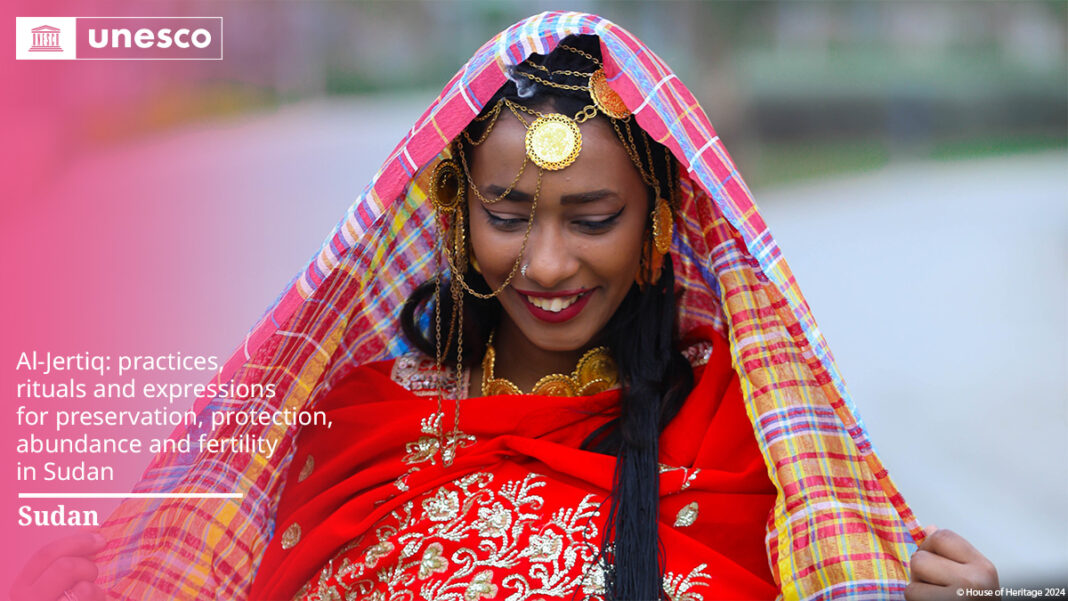

The traditional Sudanese wedding ceremony Al Jertiq was inscribed by UNESCO on the Representative List of the Intangible Cultural Heritage of Humanity on 11 December 2025 — a significant recognition for Sudan and its cultural identity.
🔴 BREAKING
— UNESCO 🏛️ #Education #Sciences #Culture 🇺🇳 (@UNESCO) December 11, 2025
New inscription on the #IntangibleHeritage List: Al-Jertiq: practices, rituals and expressions for preservation, protection, abundance and fertility in Sudan, #Sudan🇸🇩.
Congratulations!https://t.co/xoL14QknFp #LivingHeritage pic.twitter.com/JNMfx1ZFDl
The UNESCO Representative List of Intangible Cultural Heritage of Humanity (ICH) recognises living cultural expressions like oral traditions, performing arts, social rituals, nature-related knowledge, and traditional crafts, promoting cultural diversity and sustainable livelihoods, with recent inscriptions including India’s Deepavali and Czechia’s amateur theatre. This list, managed by UNESCO’s Intergovernmental Committee, showcases practices such as France’s Gastronomic Meal, Japan’s Washoku, and Argentina/Uruguay’s Tango, highlighting skills, meanings, and community value.
As described by UNESCO, Al Jertiq is a practice, ritual and expression “for preservation, protection, abundance and fertility in Sudan.” The ritual, with roots in Pharaonic times, involves symbolic acts, marking major life events such as weddings, pregnancy, circumcision and even mourning.
Al Jertiq is a special Sudanese wedding ceremony in which the bride and groom participate in a series of traditional rituals while dressed in customary Sudanese attire. The bride wears a red toub, along with garmasees, a silk, plaid-like fabric featuring red, yellow/gold, and blue stripes, commonly used as a veil during the ceremony. The groom wears a white jalabiya or a two-piece Sudanese outfit known as Alal Allah, adorned with a red ribbon and a gold crescent around his head.
Seated together on a traditional Sudanese bed called an angareb, facing the direction of the Kaaba, the couple is surrounded by close relatives who place al harira and other jertiq items on them. The bride and groom then take part in ritual practices such as sipping and/or spitting milk, exchanging dates, sprinkling khumra (Sudanese perfume), throwing sweets to the guests, and more.
The act of tying a crescent of gold on the forehead is called Jertiq, which can take place in various occasions from weddings to circumcision to funerals. As described by UNESCO, “Al Jertiq involves a variety of ornate tools that hold symbolic meaning and are tailoured to specific occasions. Each tool has a distinct purpose, such as protecting practitioners from the evil eye, bringing good fortune or promoting fertility.”
Al Jertiq is spelled in several ways, including versions that use an “i” instead of an “e” and a “g” in place of the “q.”
For more information, visit unesco.org.
Related posts: