
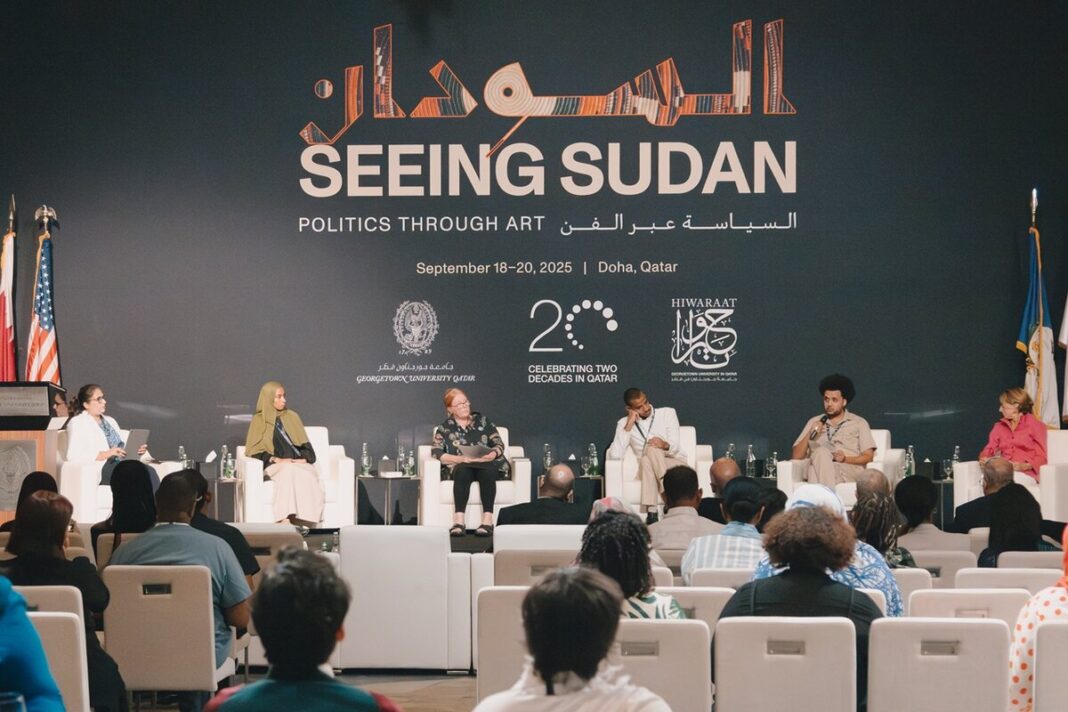
As war rages on in Sudan, Georgetown University in Qatar (GU-Q) concluded a landmark Sudanese intellectual and cultural gathering on “Seeing Sudan: Politics Through Art” to shed light on the country’s urgent humanitarian crisis.
The three-day conference on Sudan took place from 18 to 20 September 2025 in Doha, Qatar, bringing together acclaimed scholars and creatives to bring attention to a war that has left 12 to 14 millions displaced and more than 150,000 dead, and offered a roadmap to post-war recovery that ensures the preservation of the country’s rich legacy of being a centre of knowledge and culture.
The conference included highly-esteemed Sudanese figures such as Sudanese-British journalist Zeinab Badawi, Sudanese artist Rashid Diab, and Sudanese-British journalist and author Nesrine Malik, Sudanese-British journalist Yousra Elbagir, and Sudanese-Russian filmmaker and researcher Suzannah Mirgani (also organiser of Seeing Sudan).

Acclaimed journalist and GU-Q Practitioner-in-Residence Nesrine Malik captured the essence of the gathering, saying: “The challenge has been to think not only about what is the war in Sudan, but what is Sudan itself. With the erasure of cultural memories, physical artifacts, and history, the only way to hold on to it has been through storytelling, narrative, music, literature, and art.”
Conference participants highlighted how creativity and resistance are intertwined, collectively imagining a future based on reinvesting in education and cultural production, welcoming home displaced citizens, advancing scientific and industrial capacity, and drawing together politicians, civil society organisations, and grassroots movements to rebuild the country together.
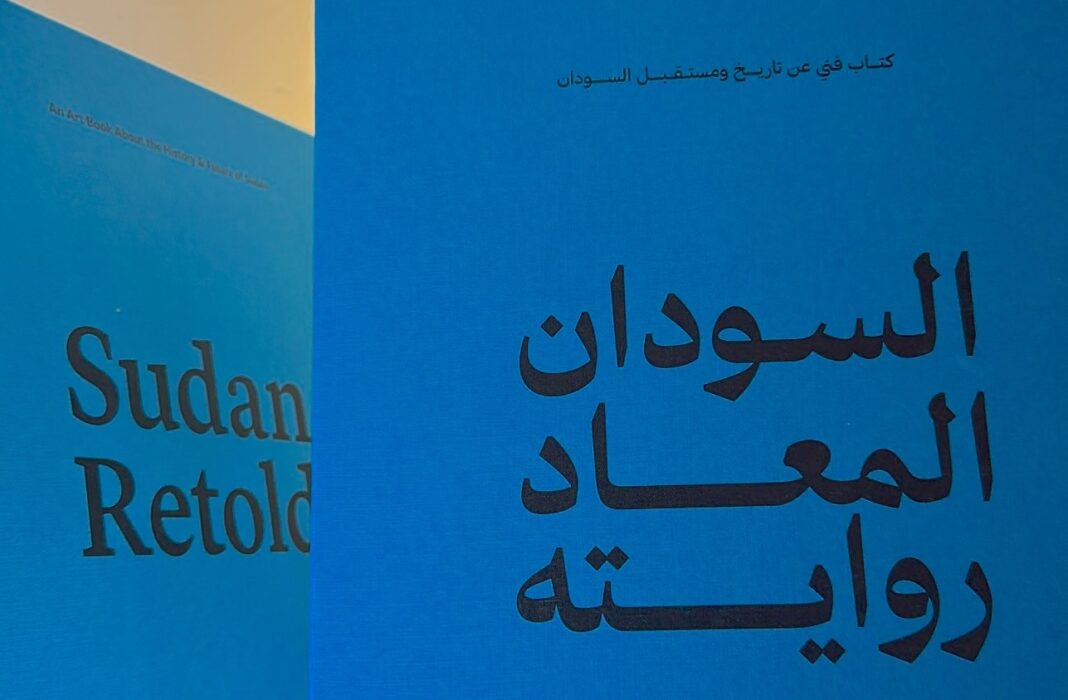
As part of the conference, an art exhibition and book launch of Sudan Retold took place on 19 September at Alhosh Gallery in The Pearl Island poignantly depicted the complex relationship between a nation and its people, and highlighted the devastation of war. “Who is missing right now are the artists in this room, barely any of them are here, and I want to dedicate this moment to them. While their art can travel, the artists can’t, they are trapped,” said Larissa-Diana Fuhrmann, researcher at Peace Research Institute, and exhibition co-curator.
By tapping into cultural narratives, the conference shed light on universal themes of love, belonging, and loss in a time of uncertainty. “War does not define our art. Our mission is to investigate the modes of expression that spill out of our consciousness into the world,” said Yafil Mubarak, curator, and director of Dara Art Gallery in Khartoum, adding: “Sudanese art is an essential part of the narrative of the country, we are stabilising this world that barely sees us.”
Part of GU-Q’s Hiwaraat conference series drawing attention to the most pressing topics of our day, the event became an essential platform for Sudanese cultural solidarity during a critical moment in history. For more information, visit seeingsudanhiwaraat.guqevents.qatar.georgetown.edu
The war in Sudan began on 15 April 2023 between the Sudanese Armed Forces (SAF) and the paramilitary Rapid Support Forces (RSF), creating one of the world’s largest humanitarian crises. This ongoing crisis devastates the present and threatens both the past and future, putting Sudan’s rich cultural heritage at risk.