

Sudan’s army chief, Abdel Fattah Al Burhan, announced on 27 October 2025 the withdrawal of his soldiers from their last stronghold in Darfur — just a day after the paramilitary Rapid Support Forces (RSF) seized control of the main Sudanese army base in Al Fasher and declared victory. The fall of Al Fasher leaves the RSF in full control of the city and the entire Darfur region, now left defenseless.
The army’s withdrawal has left more than a quarter of a million people – half of them children – trapped under RSF control.
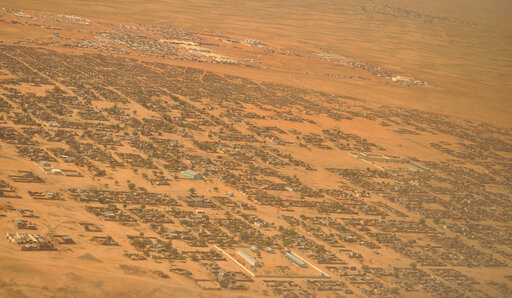
By April 2025, RSF attacks on Al Fasher had intensified, and by May 2025, the city had been under full siege as RSF fighters encircled it from all sides. By October 2025, satellite imagery confirmed near-total isolation, with berms and barriers cutting off access to the city, suggesting that the siege had tightened significantly.
Reports and footage emerging from Al Fasher point to widespread atrocities committed by the RSF, including killings, sexual violence, and the starvation of civilians. Civilians, including women and children, have reportedly been tortured and killed, their bodies left in public as acts of terror. Homes, hospitals, and entire neighbourhoods have been destroyed in the process. In addition, diseases such as cholera and dengue fever are claiming many lives.
Al Fasher is the capital of North Darfur, one of the five states that make up the wider Darfur region, alongside South Darfur, East Darfur, West Darfur and Central Darfur. The Darfur region is massive, covering about 493,000 sq km (190,000 sq m), which is roughly the size of France or slightly larger than California. It makes up around one-quarter of Sudan’s total land area.
The Casualties
The number of casualties varies. As of December 2024, the United Nations Office of the High Commissioner for Human Rights (UNOHCHR) documented at least 782 civilians killed and over 1,143 injured in Al Fasher since May 2024. In June 2024, Médecins Sans Frontières (MSF) recorded 1,280 casualties (combined deaths + injuries) in Al Fasher since the fighting escalated from May 2024; within that, they cited 203 deaths from injuries. Additional reports state hunger‐related deaths: an estimated 171 children and 58 elderly people died from hunger in the besieged city between August and October 2025.
Where are people fleeing to?
People who have managed to flee Al Fasher fled 60 km away to Tawila, a town in North Darfur, where many humanitarian organisations are providing aid to survivors. Over 26,000 people have fled to Tawila and are in need of aid – medical support, food, water and shelter.
Famine in Al Fasher
The UN World Food Programme (WFP) and other humanitarian organisations are either unable or struggling to deliver aid because access routes remain blocked by the RSF, purposely starving the people of Al Fasher to death, including children. On 5 August 2025, the WFP warned that families trapped inside besieged Al Fasher face imminent starvation. The Integrated Food Security Phase Classification (IPC) confirmed famine in Sudan in August 2024. It has been confirmed in 10 locations across Sudan, reaching IPC Phase 5, the highest level of food insecurity. The hardest-hit are Al Fasher’s Zamzam and the adjoining Abu Shouk camps, and the Nuba Mountains in South Kordofan. An additional 17 areas are at risk. Nearly half the population — 24.6 mn — are facing acute hunger, with 638,000 experiencing catastrophic levels of food insecurity. This means at least 20% of households face extreme food shortages, 30% of children are acutely malnourished, and two in every 10,000 people are dying daily from starvation or related causes.
People have resorted to eating animal fodder, leaves, weeds, plants, and even soil and charcoal to sustain their hunger.
Al Fasher and Darfur: Beyond the Headlines
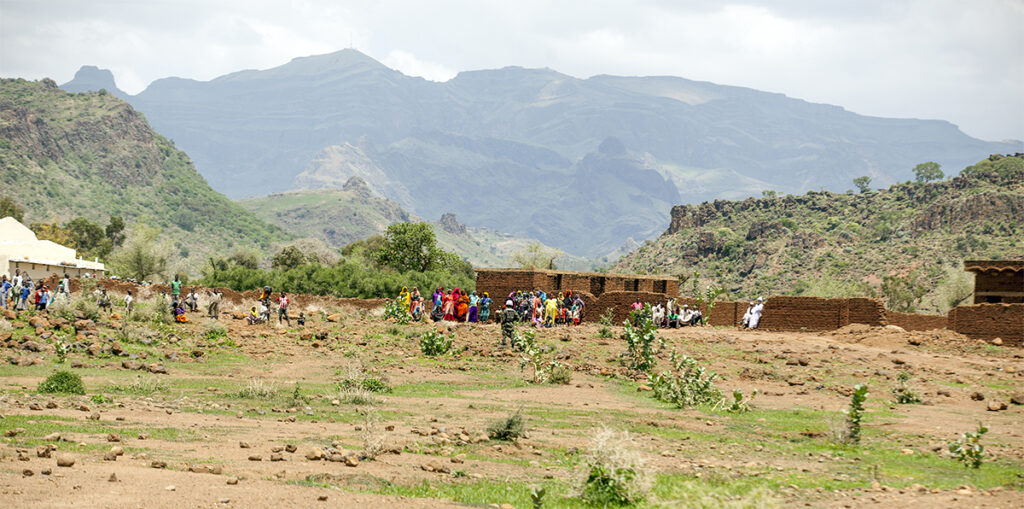
The population in the Darfur region is estimated to range between 6 million and 9.5 million people broadly. Al Fasher’s population has declined significantly due to the ongoing conflict. The current estimate is approximately 413,454 people, reflecting a drop of around 62% from its pre-war level of about 1.11 million.
Darfur, meaning “the land or home of the Fur people,” is a vast region in western Sudan, historically known for its rich culture, trade, and independent kingdoms. For centuries, Darfur stood at the crossroads of Africa and the Arab world, linking the Sahel to North Africa through caravan routes that carried gold, ivory, salt, and textiles — and, tragically, enslaved people.
At the heart of North Darfur lies Al Fasher, a city that has long been more than just a provincial capital, it has been a crossroads of trade and culture. Once the seat of the Sultanate of Darfur, Al Fasher was a thriving hub on ancient caravan routes connecting Sudan, Chad, and Libya, where merchants, travellers, and nomads exchanged not only goods, but languages, songs, and stories.
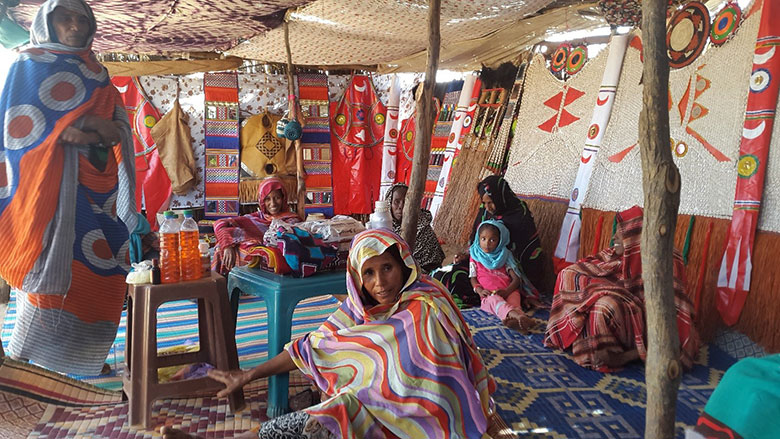
A market in Al Fasher, North Darfur with women selling handcrafts and perfumes.
© Mohammed Osman, World Bank Group
The Darfur region is a land of striking contrasts — sweeping savannahs and desert plains, acacia-dotted landscapes and fertile valleys that once supported vibrant agricultural communities. Its people — Fur, Zaghawa, Masalit, Arabs, and many others — have lived side by side for centuries, sharing deep-rooted traditions of hospitality, music, and oral storytelling. Darfur is home to various markets and traditional handmade handicrafts especially woven baskets and fabrics dyed in bold indigo and red.
The war has brought devastation, displacing millions, shattering homes, and silencing once-lively streets, leaving displaced families in camps and makeshift shelters without access to food, water, electricity, shelter and healthcare.
Other Regions at Risk
When the war erupted in April 2023, Kordofan found itself trapped between warring powers. The RSF quickly took control of much of West Kordofan, while South Kordofan remains under SPLM–N control. Al Obeid, a strategic city, has endured repeated clashes and blockades, cutting off food and fuel supplies to surrounding areas. Like Al Fasher, Famine was also declared in the western part of the Nuba Mountains by the IPC in May 2024, while the central Nuba Mountains was declared at-risk.
Shortages of food, shelter, and medicine, coupled with a campaign of arbitrary arrests and detentions, paint a grim picture of the reality faced by thousands of internally displaced persons (IDPs) in Blue Nile State, southeastern Sudan. As the humanitarian situation deteriorates due to escalating military operations, these displaced people are calling for urgent intervention from local and international agencies to save their lives. The crisis worsened after many Sudanese refugees returned from South Sudan and Ethiopia to Blue Nile State due to the deteriorating living conditions in these refugee camps. The influx of IDPs has created significant pressure on the displacement camps in the state, while those still in the refugee camps in South Sudan are suffering from similar conditions.
A History of Marginalisation, Conflict and Genocide
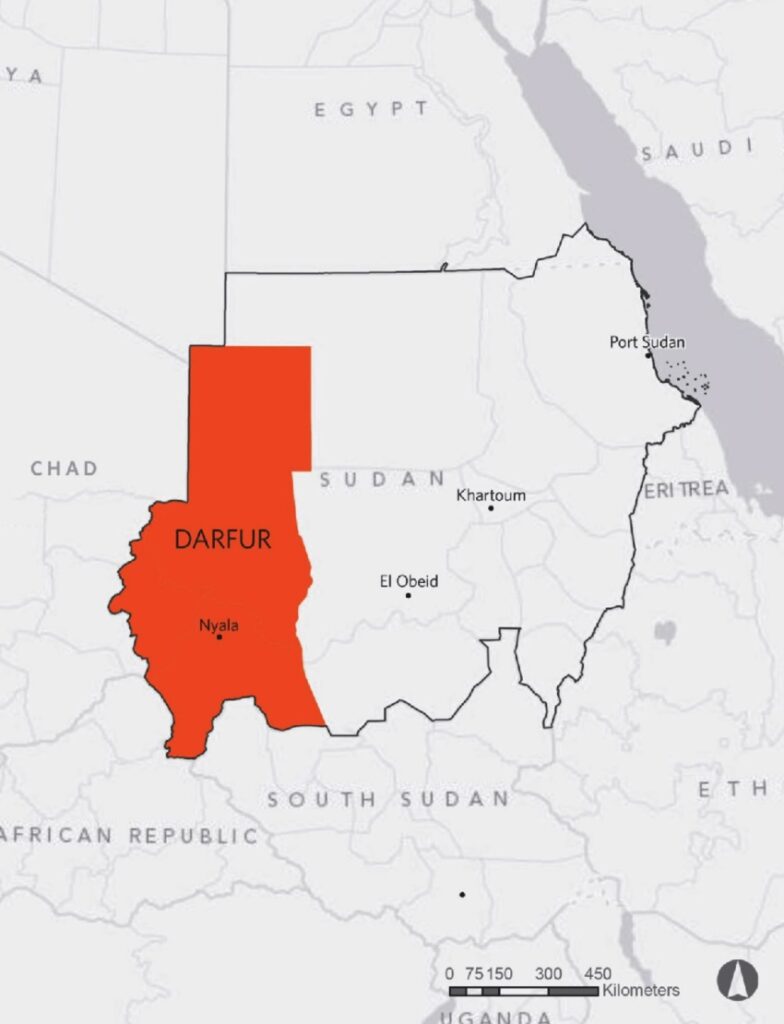
Map of Darfur and Sudan. Data source: GADM database of Global Administrative Areas, January 2012. Basemap: ESRI data and maps, 2012. © ResearchGate
After Sudan’s independence in 1956, Darfur, like many regions far from Khartoum, suffered from marginalisation and neglect, despite its size, resources, and cultural importance. This imbalance fueled resentment and instability that later exploded into the Darfur conflict in 2003, when two rebel groups, the Sudan Liberation Army (SLA) and the Justice and Equality Movement (JEM), rose against the government, accusing it of discrimination and underdevelopment especially political and economic neglect, and of favouring Arab groups over the region’s non-Arab ethnic communities such as the Fur, Masalit, and Zaghawa.
In response, the government of former Sudanese President Omar Al Bashir launched a devastating counterinsurgency campaign. It armed and supported the Janjaweed (the precursor to the RSF), who carried out widespread killings, rapes, and village burnings across Darfur. Entire communities were wiped out. Villages were razed, wells were poisoned, and families were driven into the desert or across borders.
By 2005, the UN estimated that hundreds of thousands of people had been killed and millions displaced — one of the world’s worst humanitarian crises of the 21st century. The atrocities led to the International Criminal Court (ICC) charging Al Bashir and several officials with war crimes, crimes against humanity, and genocide — the first time a sitting head of state was indicted by the ICC. On 6 October 2025, the ICC convicted Ali Muhammad Ali Abdulrahman, known as Ali Kushayb, a former Janjaweed militia commander, on 27 counts of war crimes and crimes against humanity committed in Darfur between August 2003 and March 2004, marking the court’s first conviction of a Sudanese official related to the Darfur war.
Today, Darfur’s suffering has returned to the world’s blind spot. Cities like Al Fasher, Nyala, El Geneina, and Zalingei have witnessed renewed massacres and ethnic killings, echoing the horrors of 2003. Yet amid the devastation, Darfur’s people continue to fight for survival, memory, and justice — determined not to be forgotten again.
Darfur human rights and advocacy groups
There are many non-profit organisations around the world dedicated to Darfur, raising awareness about the region’s long history of political and economic marginalisation and discrimination, ongoing rights violations, and working to protect the rights of its people.
- Darfur Advocacy Group
- Darfur and Beyond
- Darfur Genocide Victims Advocacy Group (DGVAG)
- Darfur Network for Human Rights (DNHR)
- Darfur Women Journalists Forum
- Darfur Youth Centre for Peace and Development
Social Media Reactions
Many took to social media to highlight the suffering of the people of Al Fasher and the entire Darfur region, and other regions under the seige of the RSF. Some to educate, some to evoke emotions, others to encourage action.
This article was written with the assistance of AI.
Related posts