
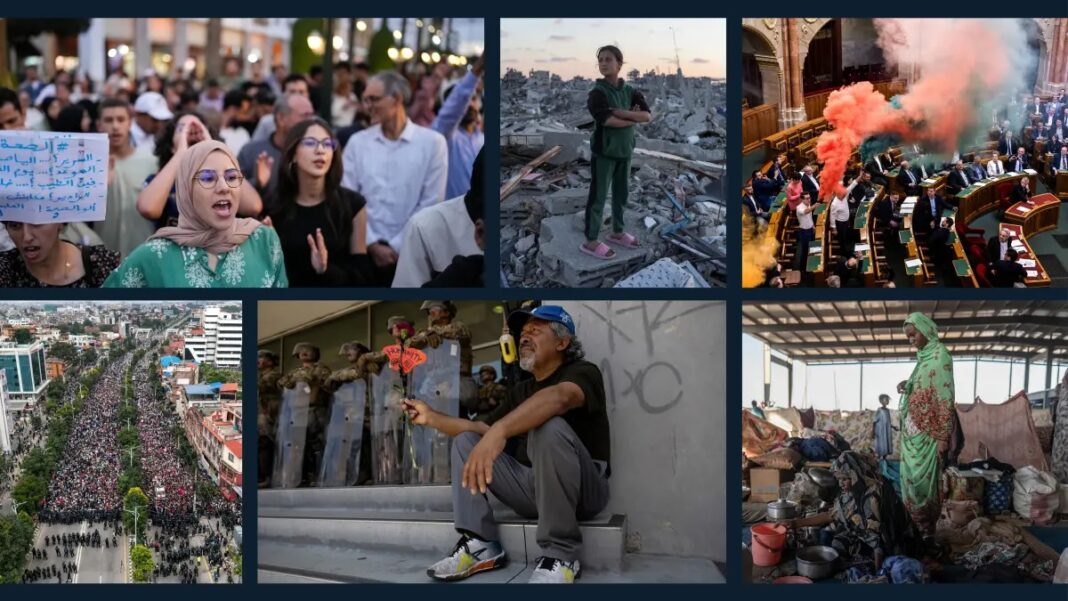
Human Rights Watch (HRW) published its World Report 2026 on 4 February 2026. Released in English, Arabic, French, and Dutch, the report — the organisation’s 36th annual review — examines human rights practices and trends in more than 100 countries worldwide, including Sudan and South Sudan.
In an opening statement by the Executive Director of HRW, Philippe Bolopion, the global human rights system is in peril, and mostly holds US President Donald Trump responsible. “Will human rights survive a trumpian world?” he asked.
“Under relentless pressure from US President Donald Trump, and persistently undermined by China and Russia, the rules-based international order is being crushed, threatening to take with it the architecture human rights defenders have come to rely on to advance norms and protect freedoms. To defy this trend, governments that still value human rights, alongside social movements, civil society, and international institutions, need to form a strategic alliance to push back,” he said.
In highlighting various troubled countries around the world, Bolopion also addressed the ongoing war in Sudan. “Twenty years ago, the US government and civil society were instrumental in galvanising a response to mass atrocities in Darfur. Sudan is burning again, but this time under Trump, with relative impunity. Sudan’s Rapid Support Forces (RSF), which emerged from the militias that led the prior ethnic cleansing campaign, are again committing murder and rape on a mass scale. A growing body of evidence indicates that the UAE, a longtime US ally that recently made multi-billion-dollar deals with Trump, is providing the RSF with military support,” he said.
The following are exceprts from HRW’s World Report on South Sudan and Sudan.
South Sudan
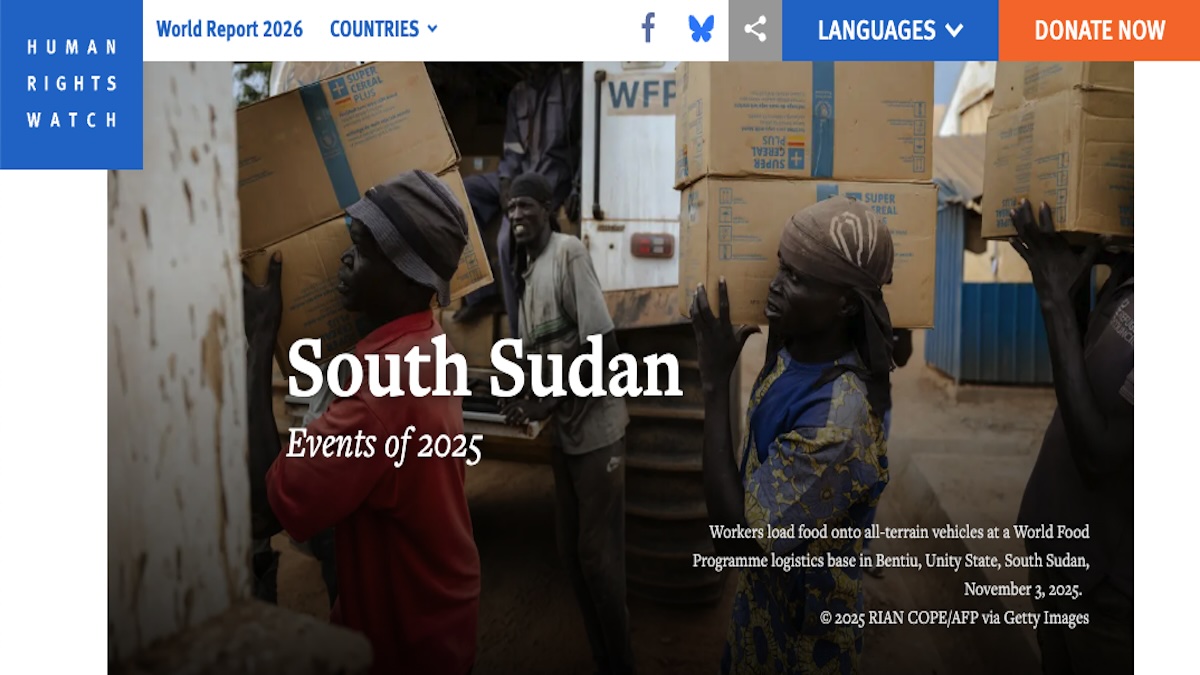
South Sudan’s human rights situation significantly deteriorated with escalating political violence and intensified armed clashes between government forces and aligned militias and armed opposition groups, including the Sudan People’s Liberation Army in Opposition (SPLA-IO). Clashes occurred mainly in Western Equatoria, Western Bar Al Ghazal, Upper Nile, Unity and Central Equatoria, bringing the implementation of the 2018 peace agreement to a standstill.
The government conducted indiscriminate aerial bombardments in populated areas under opposition control, killing and injuring civilians and destroying property.
The National Security Service (NSS) severely curtailed civil and political rights, escalating arrests, detentions, harassment, surveillance, and other abuses against civil society and political actors. Authorities initiated criminal proceedings against the SPLA-IO leader and first vice president Riek Machar and other opposition figures with charges including treason.
The National Salvation Front (NAS), a non-signatory to the peace deal, continued its insurgency campaign in Greater Equatoria and formed a military alliance with the SPLA-IO in September 2025.
The humanitarian crisis worsened with approximately 70% of the population needing food assistance amid conflict, food insecurity, the impacts of extreme climate events and USAID aid cuts.
According to the UN refugee agency (UNHCR), as of October 2025, 1.9 million people were internally displaced in South Sudan. South Sudan also hosted nearly 600,000 refugees, mostly from Sudan, and over 800,000 South Sudanese returnees who fled the conflict in Sudan since April 2023.
Renewed conflicts in parts of South Sudan had dire impact on civilians. Government aerial bombardments in populated areas, including with incendiary bombs, which may constitute war crimes, killed and injured hundreds of civilians and caused considerable displacement.
Following yet another postponement of South Sudan’s elections, the government heavily restricted fundamental rights and freedoms and arbitrarily detained and charged opposition party leaders with serious crimes.
These developments significant marred South Sudan’s human rights record for 2025.
For the full report on South Sudan, visit hrw.org/world-report/2026/country-chapters/south-sudan.
Sudan

Conflict between the Sudanese Armed Forces (SAF) and the Rapid Support Forces (RSF) continued for a third year, with all warring parties committing war crimes and other violations of international humanitarian law.
The warring parties’ actions made Sudan the worst global humanitarian crisis. The United Nations’ World Food Programme (WFP) reported that 24.6 million people suffer from acute hunger and 2 million face famine or risk of famine. Over 11.8 million were displaced by the conflict as of September, including 7.4 million internally displaced and 4.2 million in neighbouring countries.
While the SAF retook the capital, Khartoum, and other cities and villages including in central Sudan, by the end of October El Fasher, North Darfur’s capital, fell to the RSF and immediately there were reports and images of RSF extrajudicial killings and other serious violations against people fleeing. The SAF carried out indiscriminate airstrikes in South Darfur as well other parts of the country.
Both parties continue to wilfully obstruct aid despite the population’s desperate needs, and to detain and harass humanitarian workers and local volunteers.
In July, the RSF and their allies announced the creation of a parallel government, based in Darfur.
The US rolled out designated sanctions against individuals and entities in relation to the conflict. In July 2025, the European Union (EU) adopted more targeted sanctions for serious human rights violations, including against the Sudan Shield Forces leader Abu Aqla Keikel. In Conclusions adopted by EU foreign ministers, the EU stated its grave concerns over violations across Sudan, called for accountability and committed to advance concrete measures for the protection of civilians. The International Criminal Court (ICC) investigations in Darfur continued. In September 2025, the UN Security Council renewed the Sudan sanctions regime for another year. They did not expand it to cover the whole of Sudan nor designate new individuals under the existing regime. The mandate of the UN Independent International Fact-Finding Mission (FFM) was extended by the UN Human Rights Council in October 2025.
For the full report on South Sudan, visit hrw.org/world-report/2026/country-chapters/sudan.