


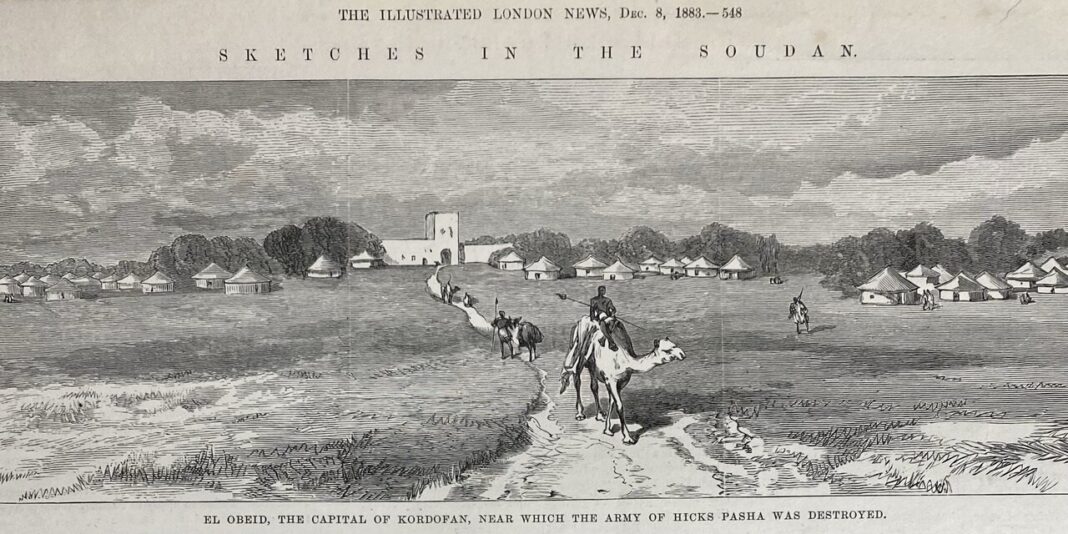
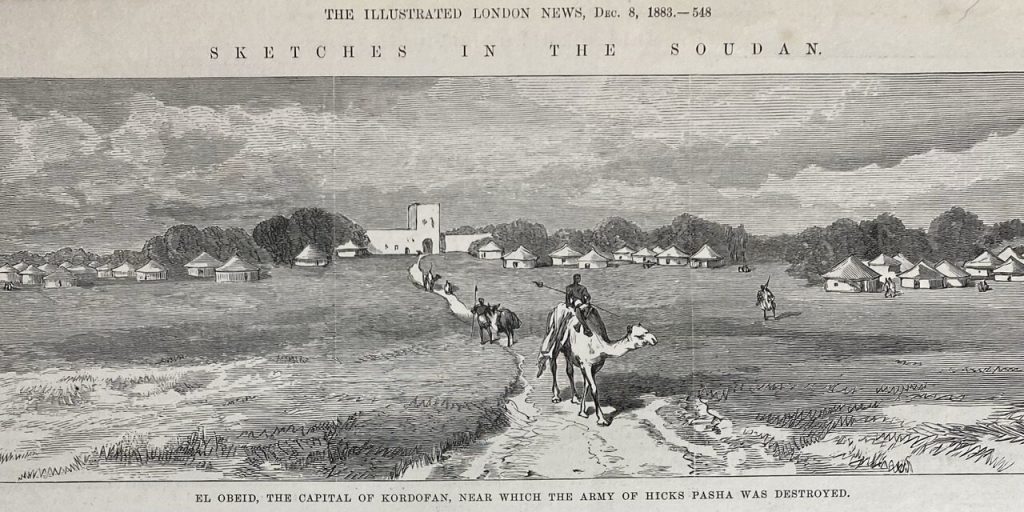
A 19th-century sketch from The Illustrated London News of the Sudanese city El-Obeid. Image source:
Women’s Literacy in Sudan
While the word ‘forgotten’ feels inescapable when Western writers mention Sudanese history, Sudanese people themselves are not indifferent to their past, much less forgetful. Oral genealogies bind tribal communities together with shared historical narratives, shaping everything from land ownership to marriage norms. The kingdoms of Kush and Sennar are used in patriotic art as symbols of political strength and cultural hybridity. Both civilian parties and armed militias adapt the Mahdist legacy to legitimise their ambitions.
Therefore, it cannot be said that Sudanese history is forgotten; at least, not by the people it concerns. That said, as material conditions encourage a focus on lucrative fields of study, many may not see the value in dedicating free time to history reading, much less pursuing it professionally.
Even for those uninterested in an academic career, studying Sudanese history – especially from a critical perspective – is a necessary exercise for anyone who wants to understand the current Sudanese reality.
A History of Sudanese History: Before Colonialism
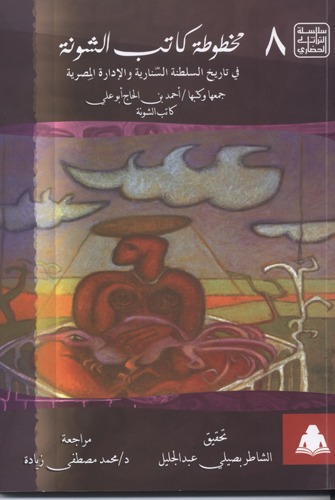
A modern reprint of ‘The Granary Clerk’s Manuscript’ by Ahmad bin Al Haj Abu ‘Ali, written during the precolonial era and completed during the Ottoman occupation of Sudan, considered one of the first Sudanese history books. Image source: Goodreads
At the simplest level, history can be defined as the study of “the past,” a broad array of changes across time on all levels, ie social, political, economic, etc. While associated today with specialists producing written chronological works, history is not limited to this format. In Sudan, as with most of the world, oral literature especially has played a crucial role in recording historical change. In Sudan, this includes genres such as genealogy, poetry, song, and brief, non-formulaic narratives that employ archetypes and shorthand to document the community’s memory.
These techniques were likely also employed by Sudanese people’s ancestors. For the literate elites among them, these oral histories would coexist with written records. These sources ranged from commemorations of royal conquests in the Kushite period, to documentation of church construction in the Christian period, to the chronicles of the Islamic period.
A History of Sudanese History: After Empire
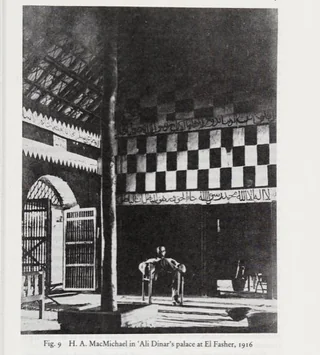
Colonial administrator and historian, Harold MacMichael, sitting in the conquered palace of Sultan Ali Dinar of Darfur. Image source: MW Daley via Reddit
After the colonisation of Sudan in the 19th-century, it was these indigenous sources that colonial officials, such as British colonial administrator Harold MacMichael (1882-1969), partially drew from to develop their own historical works. These authors situated Sudan’s history within imperial paradigms of ethnicity and civilisation, helping develop the racial and tribal categories used to administer the conquered populace.
Through the colonial education system, their methods were introduced to Sudanese, creating a new brand of local historian: the academically-trained scholar. In contrast to the classic Sudanese history experts — traditional authorities deeply-versed in oral history and local writing — this emerging class employed Western methods to bring new insights into the Sudanese past. Inherited colonial biases, however, were evident in their work, particularly the use of colonial racial categories such as “Hamite” and “Negroid,” or bias against local sources.
This set the tone for post-independence Sudanese historiography up until the 1980s, where Sudanese academics such as Abdullahi Ibrahim made a call to move away from imperialist frameworks and centre the Sudanese oral record and its perspectives. This call to decolonise has been somewhat echoed in Western academia, albeit still with severe blind spots for the local point of view.
Today, the work of Western-style scholars exists alongside oral literature and so-called “amateur history,” writers working outside academia who, as Ibrahim notes, have always made extensive use of both oral and written documentation.
A Subversion of Eurocentrism
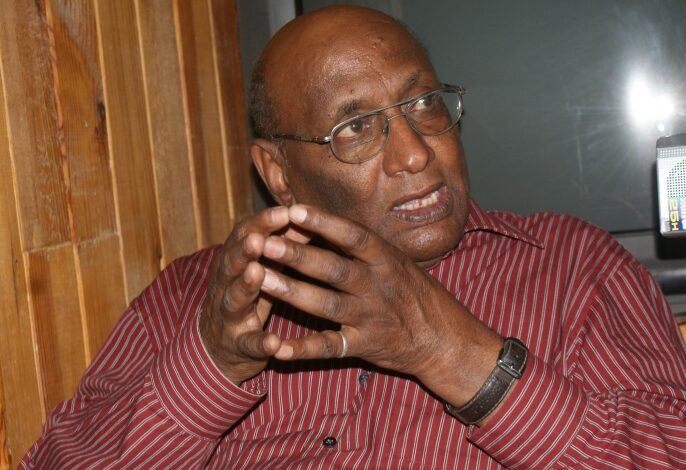
A photo of Sudanese historian Abdullahi Ibrahim, an early and vocal critic of Eurocentrism in Sudanese historiography. Image source: An-Nileyn
The role Sudanese history can play in subverting Eurocentric myths cannot be ignored. At its best, history is a means of broadening perspectives by including the thoughts and actions of peoples past. However, both before and after the colonial period, Western historians have largely dismissed the value of non-Western histories, particularly those of Africa. UNESCO’s General History of Africa, an attempt to rectify this history, quotes one professor from 1963 saying “There is only the history of the Europeans in Africa. The rest is darkness” – pleading their colleagues not to “amuse” themselves with “the unrewarding gyrations of barbarous tribes.”
In the colonial hierarchy of societies, African peoples are “primitive,” at the beginning of a journey that ends in “civilisation,” coincidentally exemplified by the capitalist, European state, with elite institutions such as writing and complex architecture. Where Africans have subverted their expectations, such as the Nubians of the Nile or the Daju of Darfur, Europeans have sought explanations through influence from peoples they consider racially superior. Ultimately, these ideologies were meant to justify imperial domination under the guise of a civilising mission.
Many of these notions have been internalised by Sudanese people, who may view their own societies as inferior to Western ones, or view as lesser those societies who Europeans considered “less civilised” for using forms of political organisation unfamiliar to them. When studied critically, carefully analysing scholars’ conclusions in their larger social and political context, Sudanese historiography can combat these falsehoods, highlighting the complex and diverse realities of societies that operated outside imperial models.
A Tool for the Present

Flag of the Rapid Support Forces (RSF) militia, a paramilitary group currently opposing the Sudanese Armed Forces (SAF).
Proper study of Sudanese history does more than rebuke misconceptions, however. Where it holds the most utility is as a tool for navigating the present. This is perhaps its most important role, allowing for an evidence-based picture of the modern Sudanese reality.
One cannot properly understand the ongoing genocide committed by the Rapid Support Forces (RSF), without understanding how mediaeval, colonial, and postcolonial systems shaped tribal relations in Darfur. Nor is it possible to understand contemporary Sudanese and South Sudanese attitudes towards each other without assessing their relationships in the Funj, Turkish, and British eras. When a modern militia claims to be the legacy of the Mahdist Movement, the late 19th-century religious and political revolt in Sudan, led by Muhammad Ahmad (believed to be the “promised” Mahdi of Islamic eschatology), or a marriage candidate is rejected for their genealogy, it is historical forces at work. Indeed, personal and political historical narratives themselves can be analysed to unveil contemporary beliefs about Sudan.
While it is easy to feel the past is distant and irrelevant in the face of Sudan’s innumerable challenges, there is no aspect of Sudanese society untouched by decisions made decades, centuries, or millennia ago. For anybody who wants an accurate picture of why Sudan is the way it is, committing some leisure time to historical study is indispensable.
How to Start
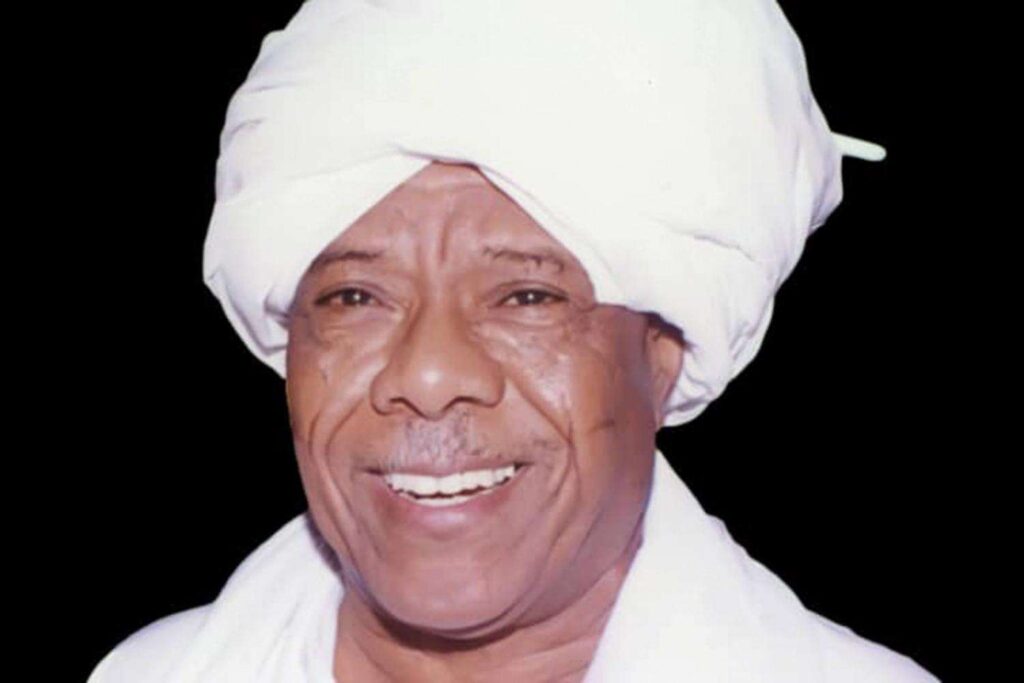
Yusuf Fadl Hassan, one of Sudan’s most famous academic historians, best known for his works The Arabs and the Sudan and Scarification: Its Origins and Role in Sudan and the Middle Nile Valley. Image source: Atalayar
Yusuf Fadl Hassan, one of Sudan’s most famous academic historians, best known for his works The Arabs and the Sudan and Scarification: Its Origins and Role in Sudan and the Middle Nile Valley. (Source: Atalayar)
Unfortunately, Sudanese people’s access to their own history is limited by a number of factors. These range from issues in the national curriculum, instability and/or displacement restricting educational access, to financial and linguistic barriers erected by European researchers. That said, efforts have been made, especially since the 21st-century with the help of digital technology, to provide more access to research about Sudan.
One such initiative is Sudanese scholar Razan Idris’s Sudan Syllabus, a gargantuan list of sources, Sudanese and non-Sudanese alike, on various aspects and epochs of Sudanese history. For those new to the topic, it’s the best starting point, of stunning breadth and scope, with the caveat that it does not always provide access to sources. For this, sources such as the Internet Archive should be utilised, as it provides free access to hundreds of works of Sudanese historiography.
When approaching these sources, there are a few crucial tenets to remember. Firstly, remain critical: No author is totally free of bias, so take the time to consider how biases from the author’s environment may influence their interpretation of historical evidence. This is not just true of European historians, but Sudanese historians, as well, who are just as influenced by their environment.
Secondly, don’t just study one or a handful of groups. It can be tempting to comb through historical sources for ways to reinforce national or ethnic pride, but this ultimately leads to a narrow, distorted view of Sudanese history. The history of, say, the Beja, Nuba, or Midob tribes is no less relevant due to their relative lack of ruins or military conquests. Sudanese history is not solely determined by powerful royals, any more than current Sudanese life can be summarised through a profile of the president’s life. To get a complete picture of Sudan, one must look at everyone.
Thirdly, remember history is constantly in the making. The Second Sudanese Civil War (1983-2005) between the Sudanese government and the Sudan People’s Liberation Army (SPLA), or the country’s Arab Spring-protests from 2011-13, are no less historical for taking place in our lifetimes. With the speed of political developments in Sudan, one’s historical reading should always include recent history.
Most importantly for those seeking historical knowledge, don’t limit yourself to academia. Outside institutionalised history is a rich body of oral literature that is crucial to how Sudanese people remember their past. For us younger Sudanese, this means being attentive and inquisitive with our elders, whose memories hold historical insights inaccessible to academia.
It is only by synthesising academic, non-academic, written and oral sources under a critical lens that we can begin to situate the current Sudanese condition within its material and ideological causes. It’s certainly no sure-fire way to discover solutions to the country’s crises.That said, without a carefully considered, historical understanding, no real solution can be reached. Thus, the study of the Sudanese past is always, simultaneously, a study of the Sudanese present — and it is invaluable for anybody seeking to understand the Sudan experienced today.

500WM Columnist Hatim Eujayl is a Sudanese-American writer involved in various projects to promote Sudanese culture. His most famous works include the Sounds of Sudan YouTube channel, the Geri Fai Omir Kickstarter, and the Sawarda Nubian font. More of his writing can be found on his Substack, ‘My Sudani-American LiFE,’ where he discusses Sudanese literature and cinema. He can be reached on Instagram @massintod or by email at [email protected].