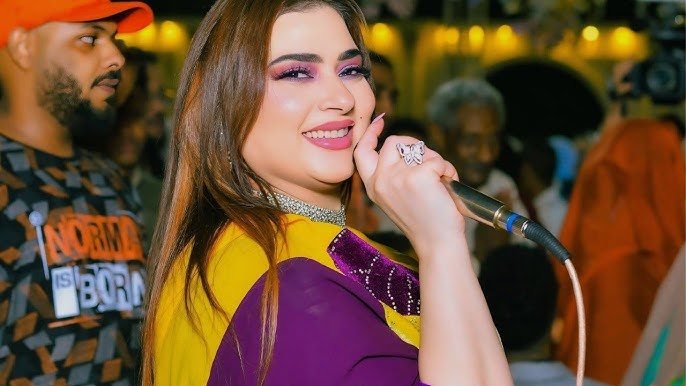

A recent viral clip featuring Sudanese singer and actress Monica Robert, also known by her social media name Monica Bella Bianka, shows her being interviewed by Egyptian journalist Hanan Gasim on her TV show A‘ala Al Maqam. Gasim began the interview by introducing Monica and saying, “I know you’re Sudanese, Egyptian, and Italian. It’s a weird mix.” She then bluntly and blatantly asked, “How are you Sudanese? You’re beautiful! I want you to tell me more about yourself.”
Monica responded, “By the way, most Sudanese women are very beautiful.” The journalist attempted to clarify her comment, saying, “No, that’s not what I mean. I know Sudanese women are beautiful. I mean the most common thing about them is that they are dark-skinned.”
Monica replied, “Oh, you mean skin colour. Sudan is known for having dark-skinned people, but when people tell me I’m white, Sudanese get upset. Sudan has light-skinned people as well, by the way, and there are many half-casts, including Turkish, Italian, and other backgrounds.”
After that rocky, awkward, and offensive start to the interview, Gasim quickly shifted to the formal questions.
Many Sudanese social media users were infuriated by the clip, with most reprimanding Gasim, calling her “unprofessional,” and applauding Monica for her response. The clip highlights deeper issues of colourism, racism, stereotyping, and beauty standards imposed on Sudanese people, particularly by Arabs, who have a long history of making racist and offensive remarks toward Sudanese individuals, especially regarding the appearance of Sudanese women.
However, it is a prime example of colourism. Gasim perceived Monica as beautiful because she is “white” or light-skinned. A form of discrimination, colourism differs from racism, although the two are deeply linked. Colourism occurs when people are treated differently based on their skin tone, typically favouring lighter skin over darker skin. Rooted in historical racism and colonialism, it is a global issue, widely seen in countries across the world from the US to India to Nigeria. It’s particularly an issue in Asia and Africa. Colourism is also deeply tied to beauty standards. Globally, lighter skin is often perceived as more appealing or attractive.
In India, for example, products that feed into colourism have long existed, such as the highly controversial Fair & Lovely, which has since been renamed Glow & Lovely. “Fair” itself is another word for “white” or light-skinned. In various African countries, such as Nigeria, skin bleaching and bleaching products have been the subject of heated debate and strong criticism, where Black people use them in an attempt to become whiter or lighter to meet imposed social beauty standards.
Colourism in Sudan remains a major, long-standing issue, where skin bleaching is also widespread. While Gasim’s statement is an example of a non-Sudanese person being colourist toward a Sudanese woman, we often do the same to our own people and to one another. There are even labels for specific skin tones, such as bedah/abyad (white), gamha/gamhe (light tan), samra/asmar (dark tan), and zarga/azrag or khadra/akhdar (dark-skinned or Black), among many others. This hierarchy of skin tone is deeply rooted in Sudan’s long history of discrimination and racism. Sadly, Sudanese society, like many others around the world, still measures beauty by how light one’s skin is.
Just recently, at a family gathering, a relative made a comment similar to Gasim’s toward a young, light-skinned Sudanese woman. “Oh, she’s beautiful! She doesn’t look Sudanese,” she said. I was appalled. Why do we make these comments? And why do we make them about ourselves?
Although they may sound like compliments, they are not. They are offensive. We have adopted the same harmful language that non-Sudanese often use against us. In moments like these, one is left unsure whether to say “thank you” or, “Please mind your words — that’s offensive.”
Such comments are degrading and self-loathing. They reinforce the world’s already flawed beauty standards and impose them on our own people. We begin to see ourselves through the eyes of outsiders and their judgement — a judgement we have unfortunately learned to value and measure ourselves by. All of this is deeply damaging, sabotaging our self-esteem and distorting our sense of beauty.
Beauty is subjective, as the saying goes: “beauty is in the eye of the beholder.” Yet beauty can also be found anywhere and in anything, and it differs from one place to another. In Sudan, beauty exists in our many skin tones, our diverse hair textures, our different body shapes, and in countless other aspects of the human form. That is our beauty. Contrary to popular belief, it is not defined, it is not singular, and it is not uniform. It comes in many sizes and shapes.
Our beauty is also rooted in our rich cultural practices and traditions, from the Sudanese toub, to henna and dukhan, to khumra perfume, all of which play a significant role in enhancing our beauty and appeal. We have our own beauty, and it is one we should more than appreciate, value, and celebrate, we should reclaim it.
The world’s beauty standards are already deeply flawed and misleading, we don’t need to follow a world system that will only further encourage intense, chronic hatred, harsh self-criticism, feelings of worthlessness, trauma, abuse, amongst our own people.

Ola Diab is the new founder and editor of 500 Words Magazine, and the deputy editor of Marhaba Information Guide, Qatar’s premier information guide. Based in Qatar, the Sudanese journalist graduated from Northwestern University in Qatar (NU-Q) in 2012 with a Bachelor of Science in Journalism and has since built a successful career in the print and digital media industry in Qatar. Find her on X (formerly Twitter) @therealoladiab or on LinkedIn.