

The 1st of January marks Sudan’s formal independence from Anglo-Egyptian rule in 1956 and the emergence of the modern Sudanese state.
It is also the day the country’s first national flag was raised and therefore, a moment that invites reflection on how Sudan has chosen to represent itself and how those representations have shifted over time. A recent proposal by the Chairman of the Transitional Sovereign Council and the country’s de facto leader, Abdel Fattah Al Burhan to return to the independence-era flag has brought renewed attention to the history of Sudan’s national symbols and the meanings embedded within them.
The Independence Flag: A Place-Based Identity
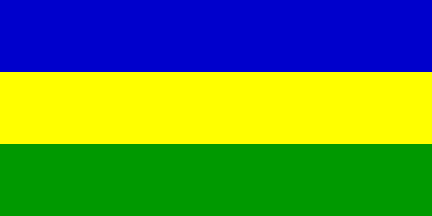
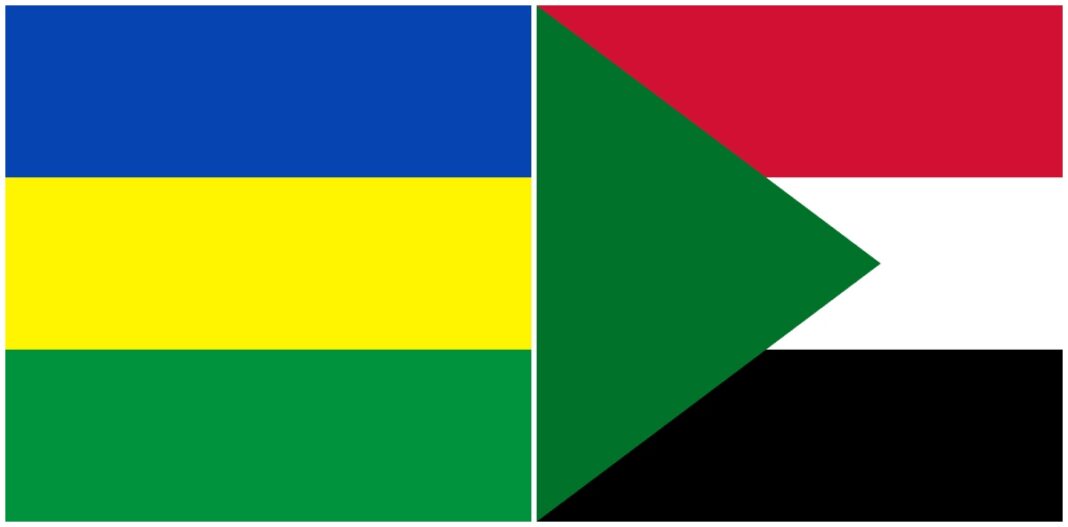
Sudan’s first national flag, adopted at independence in 1965, consisted of three horizontal stripes in blue, yellow, and green. The design emerged in a political environment that was shaped by caution and compromise. As Sudan transitioned out of colonial rule, the leaders at the time faced the challenge of articulating a national identity that accommodated the country’s deep cultural, religious and linguistic diversity. Rather than resorting to political, religious, or ethnic symbolism, the flag drew on Sudan’s geography as a shared reference point that was inclusive of all groups without any feeling marginalised.

It was designed by Sudanese artist, poet, and teacher, Al Sarirah Makki Abdullah Al Sufi, who was known for writing poetry calling for the end of Anglo-Egyptian colonial rule. The colours were widely understood in relation to Sudan’s physical landscape. Blue was associated with the Nile River that has sustained life for centuries, yellow reflected the land itself, particularly the deserts that make up a large part of the country’s territory and green evoked agriculture, fertility, and growth, signalling both economic importance and future aspirations. Together, the flag presented Sudan as a place before it was an ideology, rooting the national identity in land and environment that everyone can relate to rather than political alignment.
Inclusivity and Early Statehood
At a time when questions of identity were already politically sensitive, the designing of the independence flag offered a way of encouraging national unity without demanding agreement on culture, ideology, or political direction, a wise decision in a new-born state that was still grappling with its own diversity.

When the flag was raised for the first time on 1 January 1956, it represented more than just independence, but a moment that carried hope and grand expectations of the first ever Sudanese government. That period proved unfortunately brief. Within a few years, disagreements over governance and the growing role of the military would alter the country’s political course, leaving the independence flag to be forever tied to an early, short-lived phase of statehood.
The Shift to Pan-Arab Symbolism

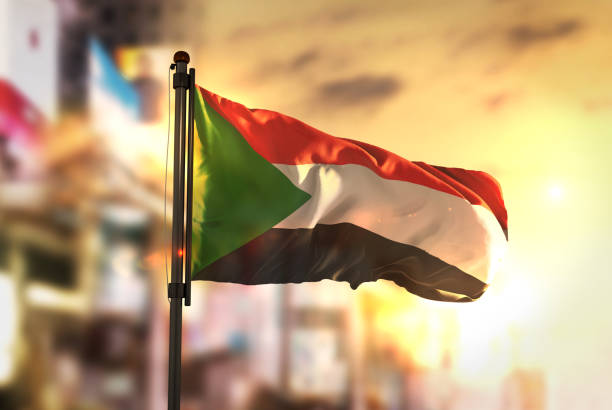
On 21 May 1970, following a military coup, Sudan’s independence flag was officially replaced by the red, white, black, and green design that remains in use today. The change marked a clear shift in how the state chose to represent itself. After the May 1969 coup, Sudan was renamed from the Republic of Sudan to the Democratic Republic of Sudan, and a public competition was launched to design a new national flag, signalling a distancing from the previous government.

The winning design, created by Sudanese artist Abdel Rahman Ahmed Al Ja’ali, drew on the Pan-Arab colour scheme, visually aligning Sudan with a wider regional current that had gained strong political and cultural traction across the Middle East and North Africa (MENA) by the late 1960s. By that point, the colours had come to function as a signifier of Arab nationalist identity, shaped by shared narratives of struggle and liberation.
The meanings attached to the colours were not new but could be traced back to a verse by the 14th-century Arab poet Safi Al Din Al Hilli: “White are our acts, black our battles, green our fields, and red our swords.” The four colours were first brought together in a single flag in 1916 during the Arab Revolt against the Ottoman Empire, where they came to symbolise a shared struggle and an emerging sense of Arab political identity. In the decades that followed, newly independent Arab states adopted the same colour palette, embedding it into the visuals of regional nationalism at the time.
In Sudan, the adoption of this symbolism was closely tied to the political direction of the post-coup leadership under former president Jaafar Nimeiri and to the wider regional climate in which the coup took place. Pan-Arabism was a dominant political force at the time, shaped in part by Egypt’s influence and by the legacy of earlier Arab nationalist movements. Aligning Sudan with this ideological framework was part of an attempt to place the country more firmly within an Arab political and cultural identity. As with many military takeovers, changing the country’s flag was a way for a new leadership to distance itself from the government that preceded it and signal its own aspirations.
Over the coming decades, the Pan-Arab flag flew through periods shaped by military rule, changing regional alignments, and long bouts of internal conflict, its meaning evolving with each chapter in Sudan’s history.
A Shared Symbol, Unevenly Lived
As a result, Sudan’s two flags came to carry distinct historical associations. The independence flag became linked to beginnings, state formation, and an early attempt at unity. The current Pan-Arab flag, by contrast, became associated with later phases of Sudan’s political development and with the decades of lived experience that followed under its banner. For many Sudanese today, it is the only national flag they have ever known, and its meaning has been shaped more by their experiences than by its original symbolic intent.
Those experiences, however, have not been uniform. For some Sudanese, particularly non-Arab ethnic groups who have lived through periods of marginalisation, violence, or repression at the hands of the state, the Pan-Arab flag can carry complex and often negative associations because it emerged as part of a political project that emphasised Arab identity and cemented centralised Northern power. The flag has come to be linked with feelings of exclusion rather than belonging. For some, the flag represents continuity and familiarity. For others, it is inseparable from a state that has not always recognised them equally. Together, these experiences help explain why Sudan’s flags continue to provoke discussion. They are not only historical artefacts, but symbols shaped by history. How people relate to them depends not just on age, but on where they come from, how they have been governed, and how the state they symbolise has treated them.
Why the Flag Question Re-emerges Now
The proposal to revisit the independence flag carries particular weight because it comes in the middle of a devastating war, at a time when authority, territory, and even the very idea of the state are under existential threat. In times like this, national symbols matter more. Returning to the 1956 flag during a time of massive regional, political and ethnic tensions can be read as an attempt to refer back to that shared starting point, one that existed before the divisions and political turns that followed.
The choice of the independence flag is also telling because of what it leaves out. Unlike the current Pan-Arab design, its symbolism is tied to land and geography, uniting all Sudanese people, rather than to Arab nationalism. That distinction matters in a country where many Sudanese do not see themselves as Arab, including large numbers who are currently serving in the armed forces and fighting on the front lines.
In this context, returning to the independence flag can be understood as an effort to project a more inclusive image of the nation. It gestures toward a version of Sudan defined by shared territory and collective sacrifice, rather than by any particular cultural or ethnic identity. In a period of profound uncertainty, this proposal functions less as a solution and more as a signal about how the nation’s future is being imagined.
At the same time, the proposal by Al Burhan has drawn criticism, particularly over its timing. Many Sudanese commentators and civilians have questioned the relevance of such an issue while the country faces widespread displacement, destruction, and the world’s worst humanitarian crisis. For critics, the discussion of a flag change at this time risks the leadership appearing as disconnected from immediate priorities, including ending the fighting and addressing civilian suffering. From this perspective, the proposal is seen less as a practical intervention and more as a symbolic distraction at a moment when conditions on the ground remain dire.
Flags as Condensed Histories
Whether or not Sudan’s flag ultimately changes, the discussion surrounding it highlights the fluid nature of national symbols. Flags do not hold a single, fixed meaning. Their significance evolves with time, absorbing the realities of the periods in which they are used.
As Sudan marks another 1 January, reflection on its flags allows us to see them as symbols of condensed histories, carrying within them ideas about land, identity, and political direction that continue to shape how we understand Sudan today and in the future.

Khansa Al Bashier is a medical school graduate exploring her passion for writing and storytelling, with a deep interest in Sudanese culture, history, and politics.