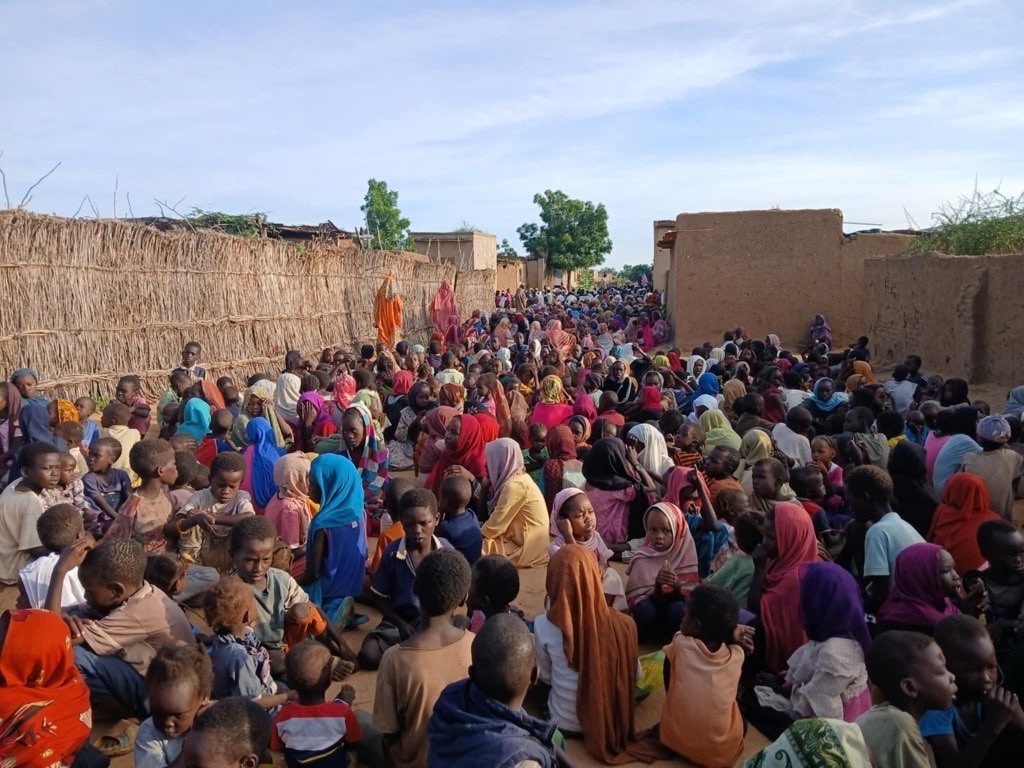

From a distance, the scene in the picture seems to capture the authentic beauty of life on the outskirts; sunshine over mud and straw houses, the reflection of the sky on scattered trees, children in colourful clothes filling the open space while women sit quietly behind them. It almost looks like a festival.
In reality, however, the children and their families, gathered in groups, are waiting for their food rations from Al Takiya, a community-led kitchen that provides meals to those in need. This picture, along with other pictures and videos of the starving children and women have been shared for weeks across all platforms – making it unable to track the original source – highlighting the plight of the people of Al Fasher, the capital city of North Darfur with the hashtags #SaveAlFasher/#SaveElfasher, #SaveSudan and #ElFasherUnderSiege.
According to civil society activist and journalist Khalid Elwalid, Takikyat Matbakh AlKhair continues to prepare and distribute meals to more than 3,500 displaced people still living under the siege of Al Fasher by the paramilitary Rapid Support Forces (RSF), which has now lasted more than a year. Some residents have managed to escape to nearby towns and relatively safer parts of Darfur, while others remain trapped, exhausted and hopeless, and worn down by constant bombardment. The city is shelled daily, and people continue to die from shelling, hunger, or disease, particularly the cholera outbreak. Escaping the war and looming death is not an option for many trapped residents. Elwalid, explains that those attempting to leave Al Fasher must pay the RSF, or risk being killed. In this desperate situation, those without money have no way out. Sudanese people, both inside the country and abroad, are calling for an end to the siege on Al Fasher to save the lives of its residents.
The UN World Food Programme (WFP) and other humanitarian organisations are either unable or struggling to deliver aid because access routes remain blocked by the RSF, purposely starving the people of Al Fasher to death, including children. On 5 August 2025, the WFP warned that families trapped inside besieged Al Fasher face imminent starvation. The Integrated Food Security Phase Classification (IPC) confirmed famine in Sudan in August 2024. It has been confirmed in 10 locations across Sudan, reaching IPC Phase 5, the highest level of food insecurity. The hardest-hit are Al Fasher’s Zamzam and the adjoining Abu Shouk camps, and the Nuba Mountains in South Kordofan. An additional 17 areas are at risk. Nearly half the population — 24.6 mn — are facing acute hunger, with 638,000 experiencing catastrophic levels of food insecurity. This means at least 20% of households face extreme food shortages, 30% of children are acutely malnourished, and two in every 10,000 people are dying daily from starvation or related causes.
As the war in Sudan enters its third year, regions such as Kordofan and Darfur remain in alarming conditions due to famine and disease, and becoming the main battlegrounds for the RSF and SAF. Life in Al Fasher and neighbouring cities grow increasingly unbearable with each passing day. Food prices skyrocketing, making basic staples such as sorghum and wheat unaffordable. Many people are reported to be eating ambaze, the residue from peanut oil extraction, usually fed to livestock. The humanitarian situation is dire especially with the widespread cholera outbreak, in addition to destroyed hospitals and healthcare centres and services, and a severe shortage of doctors and medicine. Children are dying from malnutrition.
A closer look at the photograph reveals the faces of children expressionless, joyless, and silent. No one knows exactly what horrors some of them have witnessed. Yet, day after day, they gather. Their presence alone is a testament to their will to live, their determination to endure, and their refusal to give in to despair.
500WM Columnist Dominica Amet Joseph Marco is a 26-year-old South Sudanese writer, freelance journalist and feminist/social activist who graduated from the faculty of law from the University of Bahri in 2018. She is one of many who had to flee war in Sudan to finally come and live in her homeland South Sudan. She has written and published articles, stories and poems since 2017. She has worked with and published articles in Aka’bar Alwatan Newspaper in Sudan, Almugif Newspaper in South Sudan, and several other Arabic websites.